Beginnings and Endings

The first thing I did after getting my line editing back over the weekend was work on the ending of my novel. Beginnings and endings are so important, and as is probably typical, I’ve changed them a lot.
The ending is important because it’s what has to wrap everything up, and what leaves the aftertaste in the mouth of the reader. But it isn’t going to do you any good unless they get there.

Which brings us to the beginning. So important in so many ways. First of all, agents and editors glance at the beginning,and if it isn’t awesome, they’ll just put it down right there. Second, so do many readers. They browse the first couple pages in the bookstore (or on Amazon), or even if they buy it, if it doesn’t grab them right away they might just move onto to another book. I know I do.

During revision, The Darkening Dream has already had three different beginnings. But I’ve never been totally satisfied with them. I took a new high level crack at rearranging the flow of my story’s first crucial day, and ended up whipping out two new takes on the first ~7,000 words. That puts three beginnings on the table if you include the current draft. Each have their plus and minuses.

Do I start with the violent supernatural event that kicks everything off?  Do I start with character development on the protagonist? How do I introduce my large cast of characters?

Now that I have a couple takes I’m trying to decide which one to pursue. IF YOU’RE ONE OF MY BETA READERS, HAVE READ THE BOOK ALREADY, and are interested and throwing your opinion into the ring, drop me a note and I’ll send you some options 🙂

The good news about my new novel, is that before I even started writing I found a totally awesome place to start the story. I LOVE the start of that book, and so does everyone I’ve showed it to so far. Lessons learned.

Book Review: The Road to Tyburn

Title: The Road to Tyburn

Author: Christopher Hibbert

Genre: Biography / History

Read: Feb 18, 2011

Summary: Really fun glimpse into a sordid little world.

_

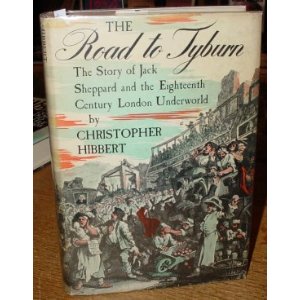
In the last 2-3 weeks I’ve read at least 8-10 books on 18th century London, many on the criminal element of said city. Lest one think I’ve got an unnatural fascination with antique crime this is research for my new novel (more on that here). This book, however, was a standout, and despite being long out of print is well worth mentioning.

It’s short (160 pages), and very lively, reading as fast as a novel. It does a very good job characterizing the bizarre underworld of 1720s London, pretty much that which is depicted in the engravings of William Hogarth. London of this time was a city unique on earth, transitioning out of the 17th century’s religious zealousy and into the head long rush toward industrialization. It was a place of great freedom, great crime, great industry, and an infrastructure and society nearly overwhelmed by change. Pretty damn fun, and why I chose it for my novel.

Jack Sheppard — not to be confused with the protagonist of Lost — is a colorful character I hadn’t previously encountered. More or less just a charismatic young house burglar, he entered the public eye in a huge way — foreshadowing today’s media fascination with crime and criminals — by being a prison breaker of staggering talent. Nothing could keep the guy down, tied, barred, locked, or whatever. He broke out of the notorious Newgate prison no less than three times! (and several others as well).

As a working class, non-violent, handsome, achem… thief, seemingly able to escape punishment at will, he captured the hearts and minds of his fellow Londoners. For me, one of the book’s great moments is the description of his insanely daring and audacious fourth escape, known even then as the “Great Escape.” The guy used only a single bent and rusty nail to extract himself from a huge pile of irons, fetters, and chains, broke open a masonry chimney, climbed up, picked and opened five heavily fortified prison doors, leapt across rooftops, and descended great distances on a rope made of bedding. If anyone ever earned an escape, it was this guy!

Too bad they hung him when they caught him the last time. But he seemed to enjoy the attention and show.

The book does a great job telling Jack’s life story intermixed with really vivid and quick background sketches. The story of the the infamous Jonathan Wild, self proclaimed “Thief-taker General of Great Britain and Ireland” is also an eye-opener as to the origins and history of organized crime. As the book states, no other criminal mastermind in 300 years has ever had London crime (a pretty notorious city) so well organized!

Juggling Brains

As the process of the revising my — hopefully — almost finished novel, The Darkening Dream, draws out the amount of work I have to personally do on it declines toward the limit of… well very little. More and more I’m just waiting on something to come back from someone else. When it does, I have a little flurry of activity and then it’s back to waiting. This is par for the course in the glacially paced publishing business, and I haven’t even seriously gotten into the game of waiting on agents and editors yet, which makes glacial look fast. Hell, publishers routinely (read almost always) sit on books for 12-18 months between signing and release. Of course, this is mostly because that’s how it was done prior to the computer and internet age, and must change very soon or they will find themselves in Chapter 11. One only has to look at something like this to realize that.

But in any case, the authorial solution to this process is to write another book in the meantime.

I’d had a really fantastic idea a couple months ago, as usual a hybrid between some new ideas and one of the forty-two thousand stories that have been bouncing around in my head for years. Often a great book comes out of the evil-mutant-mating of two or more half-formed book ideas. In this case the oldest of these is a time travel concept I conceived in the fall of 1994. Anyway, I’ve been doing some outlining work on it since the new year and finally began writing. Three chapters (5700 words) popped out in no time, as I’m very good at the process of converting a scene idea (as long as I know in my head roughly what’s supposed to happen) into the actual prose. I’d half-forgotten how fun first-drafting is. More fun for sure than line editing, and WAY more fun than outlining, and WAY WAY more fun than writing queries or synopses.

The tricky part when flipping back and forth between books is not getting the voice all confused. The Darkening Dream is in third-person past, and has six distinct character voices, while the new one is first-person present with very clipped immediate sentences. Good synaptic exercise for sure.

The Darkening Dream

Since I’m always cryptically referring to my novel in progress, I figured I’d post a few words about it.

The Darkening Dream is a historial dark fantasy. It’s currently 95,000 words and I’ve just finishing up the line editing and polish. [ Updated 3/16/11 ] I’m looking for a literary agent to help me start slogging through the process of publishing.

ANY CHARACTER HERE

As to the thing that matters — the story [ Updated 3/25/11 ]:

An ominous vision and the discovery of a gruesome corpse lead Sarah and her friends into a terrifying encounter with a fledgling vampire. Eager to prove themselves, the young heroes set out to track the evil to its source, never guessing that they will take on a conspiracy involving not only a 900-year vampire, but also a demon-loving Puritan warlock, disgruntled Egyptian gods, and an immortal sorcerer, all on a quest to recover the holy trumpet of the Archangel Gabriel. Relying on the wisdom of a Greek vampire hunter, Sarah’s rabbi father, and her own disturbing visions, Sarah must fight a millennia-old battle between unspeakable forces, where the ultimate prize might be Sarah herself.

To read about my second novel (in progress), click here.

Or here for the index of all my Creative Writing posts.

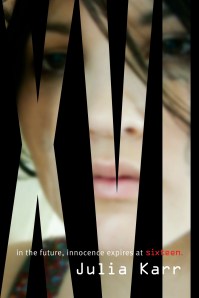
Book Review: XVI (read sexteen)

Title: XVI

Author: Julia Karr

Genre: YA Dystopian Fiction

Read: Jan 16-19, 2011

Summary: Good premise, tried hard, fell flat.

_

I really wanted to like this book more than I did. The premise is fine, set in a dystopian 2150 where teens are branded at 16 as”legal for sex.” Nina is almost 16, and is dealing with not only the stress of this oncoming rite of passage, but boys, the death of her mother, and a bigger conspiracy.

But where to begin with the problems. The protagonist is okay, and there isn’t anything wrong with the prose, but fundamentally this book stands out as an example of premise over plot. Plot, we are told is how the characters in a story deal with or overcome the premise. A good one sells the premise in an engrossing and personal manner. The plot just felt weak, and the characters reactions to it rushed and forced. People keep popping up out of nowhere. Dramatic events — like the narrator’s mom dying — blink by. They live in Chicago, yet everyone seems to know everyone. The villain tattles his villainy while playing hide and seek with the heroine — so very Scooby Doo.

And the Science Fiction is pretty darn mediocre. This is 150 years from now and music and films are stored on “chips!” There won’t even be physical media in 15-20 years. There is no mention of a net or internet — nary a computer. They still have magazines! Video playing machines that play films on chips (like a DVD player). People have phone numbers (also on the way out already). There are no substantial tech improvements. Some “transports” that maybe fly. Mention of moon and mars settlement, but no matching tech on earth. No new biotech, no new computer tech.

150 years ago is 1860 and the civil war!

I didn’t hate the book, in fact wanted to like it, but it just fell flat.

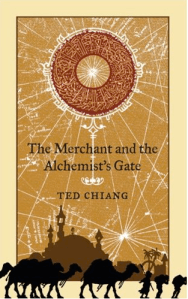
Short Story: The Merchant and the Alchemist’s Gate

Title: The Merchant and the Alchemist’s Gate

Author: Ted Chiang

Genre: Historical Time Travel

Read: Jan 10, 2011

Summary: Awesome and lyrical.


This 60 page short story is so up my alley. A story of time travel, set in medieval Baghdad, what could be better? If it were written in a lyrical style reminiscent of the Arabian nights! This is a gold and gem encrusted little dagger of a story. Mimicking prose style AND story telling conventions of its chosen era. It manages to demonstrate its time travel device and constraints in a manner so clear even an Abbasid merchant could understand.

It won both the Hugo and Nebula Novellette awards. Good show. Read it. Ali ibn Hammud al-Nasir (the villan from my own novel) commands that you do so. And he’s been known to make tea from the ground bones of those who refuse him.

It’s for sale standalone (very expensive), and in this anthology (cheap).

Book Review: Girl Walking Backwards

Title: Girl Walking Backwards

Author: Bett Williams

Genre: Lesbian cuming of age YA

Read: Jan 10-15, 2011

Summary: Less than Zero meets Rubyfruit Jungle.

_

This book is rather brilliant, but isn’t for everybody. In my review of Lost It (CLICK HERE), I had inquired if anyone knew any YA that was racy, and this was recommended. It’s written in a breezy first-person past with a kind of stream-of-consciousness lightweight quality that made me have to look to make sure it wasn’t persent tense. The prose is very very good — fitting the material perfectly.

Skye is a fifteen-year-old growing up in Santa Barbara, and she’s basically raising herself. Her mother is a self-help seminar junkie and all-around new age psychotic, her dad (divorced) lives in LA where he directs films and has sex with pretty production assistants. Neither seem to think about her at all. She has a boy friend, sort of, but wants a girlfriend. She drinks and does drugs, but she isn’t a bad girl.

Somehow this character rang very true for me, and the voice is intensely personal and likable. Even the hare-brained situations seem very real, and like Less than Zero the substance abuse and self destructive behavior believable. The voice effortlessly shifts with the state of mind — often altered — and does a first class job conveying that. For some, this might be a hard book to read, particularly if one were right-wing, but I thoroughly enjoyed it. Bret Easton Ellis‘s above mentioned masterpiece feels like watching a train wreck. While Girl Walking Backwards doesn’t have the terrifying “all rashed and looks dry and I can see that it’s been shaved” moment, and is ultimately transcendant.

Finally, his is a book that is very candid about sexuality.

Not only do we have various incidents of masturbation, near sex, and actual sex, but they aren’t even the focus. This isn’t gratuitous, it’s just frank. This isn’t about a girl becoming a lesbian, or coming out. It’s about a girl trying to find her footing in a world without foundations.

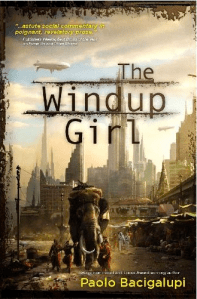
Book Review: The Windup Girl

Title: The Windup Girl

Author: Paolo Baciqalupi

Genre: Sci-Fi

Read: Jan 5-9, 2011

Summary: Interesting Science, mediocre Fiction.


This novel won the 2009 Nebula and tied for the 2010 Hugo. It’s set in an approximately 100-200 years-from-now dystopian future Bangkok ravaged by gene engineered diseases. Fossil fuels are nearly exhausted and society eeks by on “megadont” (gene hacked elephant) and human power.

At first I found this intensely gripping, as the depiction of the future world is crystal bright and highly novel. The prose is fantastic, bordering on slightly literary. The problem is that the story has a lot of characters, five or six main points of view, and I found it very hard to care about most of them. I only really liked Emiko, the gene hacked whore/slave looking for a better life. The American gene thief was okay too. The rest of them I could hardly focus on enough to follow their rambling monologues. Once the relative novelty of the world ground down a bit, I just couldn’t keep myself interested in what was happening. There’s plenty of plot, but it’s moderately byzantine, and I just didn’t care.

Because books are all about the characters. Contrast The Windup Girl with something like Song of Ice and Fire (which I need to write up, but is being adapted into an HBO series). The plot and world in that book are intense, but Martin makes you care for all (well most) of the characters. The Windup Girl has a lot of repetitive rantings. The elderly Chinese guy for example goes on for about two pages in his second chapter about his distrust of banks. Sure this was supposed to instill the sense that he no longer trusts any institution (for good reason), but it just felt self indulgent. The seedy scenes with the titular character in sort of future Patpong where cool though, albiet disturbing.

Let me get back to the world, as this is the biggest strength of this book. The author clearly spent some serious time in Bangkok, and the  foreign, yet vaguely possible future was pretty damn good. I don’t really buy the relying on springs for power, and there’s very little impact here of either nanotech or computers, both of which I think will dominate the 21st century. Still, it was pretty cool. There’s a serious element of “environmental preachy” between the lines, which I suspect is a factor in it’s award winning status. Award gives love a leftist cause. Not that I’m not pro-environment, I’m just not a “causist.” The book reminded me of Neuromancer and Diamond Age in that they described really cool and consistant worlds, but had inadequate character development. Diamond Age in particular is pretty darn boring once you get over the world (which is great). Two many characters, no reason to care about them, opaque and weird motives.

Personally, I think authors should focus tighter on character in these “new world” type books. For example, Consider Phlebas worked for me. People bag on it’s story, but at least it focuses fairly well on a particular guy’s adventure, and the world is amazing. There’s only so much you can do in one book, and a totally new world is a lot. Occasionally someone managed both, like one of my all time favorite novels, Hyperion, but brilliant as that is, even it still suffers from switching the POV so often. But boy does he work some serious pathos into a number of them.

Book Review: Across the Universe


Title: Across the Universe

Author: Beth Revis

Genre: YA Science Fiction

Read: Jan 10, 2011

Summary: Great read. Reminds me of books I read 30 years ago.

_

A couple months ago one of the book/writing blogs I read featured an article about first chapters that included one from this book. It was unpublished at the time, but I liked the first chapter enough to pre-order the book on Amazon. Liked it enough to actually read it yesterday when it came in the mail (one day before it was supposed to and the Kindle version wasn’t out yet — so for the first time in a little while I read on paper).

I knew I’d liked the first chapter for a reason. Besides the fact that it (the first chapter) featured a naked seventeen year-old girl, this was a fun book. And no there isn’t much sex in here — at least not for the characters that matter.

And the reason this is a good book… drumroll please… the characters. Particularly Amy, the female lead.

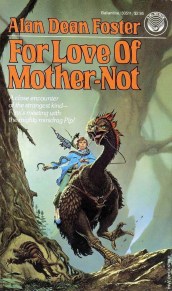
Superficially this is fairly old-school Science Fiction, slanted a bit younger than adult, almost like Citizen of the Galaxy, Home from the Shore, or For Love of Mother-Not (boy is cover design today 1000x uglier than it was in 1980!). Worth a 2 minute diversion:

Left the old one, the right is new. Which would you pick? Personally, I hate photography on fiction covers. I like COVER ART. Call me old-school. Anyway.

Across the Universe (not to be confused with the movie of the same title), is about a girl who joins a generation ship as cryogenically frozen cargo (the ship will take 300 years to go to it’s colonial destination) with her parents, but is accidentally woken early (alone) to find herself amongst a very strange society. The crew has been left to run the ship for centuries, and well nothing stays the same, certainly not human society over the course of generations.

The science here isn’t the most innovative, but it is consistant and easy to grasp. I didn’t totally buy the society and all it’s premises. But it didn’t really matter. The book is told in double first person view point, from Amy’s POV and that of the young future captain of the ship (simplified explanation for review purposes). The POV’s are very good, and stick tightly to single interwound storyline. The classic device of having a newcomer (Amy) works well to make the experience more visceral and personal, and this ties us as a reader into the story. It’s also worth contrasting this with a more “mature” Science Fiction novel I read the day before, The Windup Girl (review HERE), which although Hugo and Nebula winning, and possessed of a MUCH more elaborate and interesting SciFi world, just isn’t that fun to read. As the two main characters are literally the only people on the ship their age, they are fairly obviously in it together. I like the “forced” relationship device.

Again, because the character narrative is too fragmented. I like character. I like narrative. Don’t get me wrong, I LOVE Science Fiction, I’ve read thousands of them. I like elaborate worlds. But they’re nothing without the glue to hold you there.

Now my small beefs. The book was too teasy on the sex. There was sex flying all around, we should’ve had some with the protagonists! I’m old school that way too. 60s, 70s, and 80s SciFi had lots of sex.

And the last 20% of the book started to get that we-have-reached-the-big-reveal-and-now-it’s-all-going-to-feel-a-little-forced stage that many “big reveal” books have. I had this same beef recently with the otherwise perfect Dead Beautiful (review HERE). Still, I read Across the Universe in one sitting, literally, and I enjoyed it the whole way through. I love when this happens — fairly rare as it is for a reader as jaded as I am — it reminds me that there’s still good writers out there.