Book Review: Across the Universe


Title: Across the Universe

Author: Beth Revis

Genre: YA Science Fiction

Read: Jan 10, 2011

Summary: Great read. Reminds me of books I read 30 years ago.

_

A couple months ago one of the book/writing blogs I read featured an article about first chapters that included one from this book. It was unpublished at the time, but I liked the first chapter enough to pre-order the book on Amazon. Liked it enough to actually read it yesterday when it came in the mail (one day before it was supposed to and the Kindle version wasn’t out yet — so for the first time in a little while I read on paper).

I knew I’d liked the first chapter for a reason. Besides the fact that it (the first chapter) featured a naked seventeen year-old girl, this was a fun book. And no there isn’t much sex in here — at least not for the characters that matter.

And the reason this is a good book… drumroll please… the characters. Particularly Amy, the female lead.

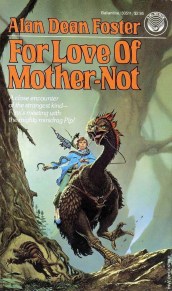
Superficially this is fairly old-school Science Fiction, slanted a bit younger than adult, almost like Citizen of the Galaxy, Home from the Shore, or For Love of Mother-Not (boy is cover design today 1000x uglier than it was in 1980!). Worth a 2 minute diversion:

Left the old one, the right is new. Which would you pick? Personally, I hate photography on fiction covers. I like COVER ART. Call me old-school. Anyway.

Across the Universe (not to be confused with the movie of the same title), is about a girl who joins a generation ship as cryogenically frozen cargo (the ship will take 300 years to go to it’s colonial destination) with her parents, but is accidentally woken early (alone) to find herself amongst a very strange society. The crew has been left to run the ship for centuries, and well nothing stays the same, certainly not human society over the course of generations.

The science here isn’t the most innovative, but it is consistant and easy to grasp. I didn’t totally buy the society and all it’s premises. But it didn’t really matter. The book is told in double first person view point, from Amy’s POV and that of the young future captain of the ship (simplified explanation for review purposes). The POV’s are very good, and stick tightly to single interwound storyline. The classic device of having a newcomer (Amy) works well to make the experience more visceral and personal, and this ties us as a reader into the story. It’s also worth contrasting this with a more “mature” Science Fiction novel I read the day before, The Windup Girl (review HERE), which although Hugo and Nebula winning, and possessed of a MUCH more elaborate and interesting SciFi world, just isn’t that fun to read. As the two main characters are literally the only people on the ship their age, they are fairly obviously in it together. I like the “forced” relationship device.

Again, because the character narrative is too fragmented. I like character. I like narrative. Don’t get me wrong, I LOVE Science Fiction, I’ve read thousands of them. I like elaborate worlds. But they’re nothing without the glue to hold you there.

Now my small beefs. The book was too teasy on the sex. There was sex flying all around, we should’ve had some with the protagonists! I’m old school that way too. 60s, 70s, and 80s SciFi had lots of sex.

And the last 20% of the book started to get that we-have-reached-the-big-reveal-and-now-it’s-all-going-to-feel-a-little-forced stage that many “big reveal” books have. I had this same beef recently with the otherwise perfect Dead Beautiful (review HERE). Still, I read Across the Universe in one sitting, literally, and I enjoyed it the whole way through. I love when this happens — fairly rare as it is for a reader as jaded as I am — it reminds me that there’s still good writers out there.

Book Review: Lost It

Title: Lost It

Author: Kristen Tracy

Genre: YA Romance

Read: Jan 3, 2011

Summary: Forever 2007.

_

This is a very likable teen romance about an Idaho girl’s first real relationship and of course… how she lost her virginity. I read this in my continued meandering quest to find out just how edgy and racy YA can actually be. I hope someone points me to another answer, but I’m thinking… not very. If you know anything really edgy, please put it in a comment. Lost It is pretty reminiscent of Judy Blume‘s Forever (my review HERE), and it’s gone backwards in the sexual explicitness department big time. Really there’s barely any.

Don’t get me wrong. This is a good book, and it stands on its own. It’s just not racy. But I really did like the voice. Using the standard first person past you are immediately and tightly drawn into protagonist Tess’s head. She’s pretty funny too, and not your totally typical teen girl. There is a lot of interior monologue, but it doesn’t suffer from the “too much tell” problems that this often entails. Like, for example, the Indy book Switched (my review HERE) I read the previous day. With Lost It, I actually laughed a number of times aloud — or at least chuckled. Like all these books, the narrator is what drives the whole thing, and the book delivers 100% in that regard.

Many of the other characters are good. The best friend, the boyfriend, and the grandmother all felt unique and real. The parents less so. Tracy doesn’t have the effortless ability to make every character totally and completely believable like Judy Blume, but who does? Nevertheless, she gives it the good old college try and the results are very good.

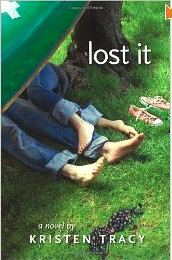
But the tameness bothered me. In our era of hyper shock factor, it would be nice if an honest book like this was a bit more honest and open about its central topic. Sex. Forever certainly has the edge there, and it’s more than 35 years old. It’s also worth noting that the two books have almost the same cover. I guess publisher marketing departments all think alike. Observe to the right!

I don’t know what it is, but at the same time the internet has opened the door to vastly more sexual material than my 70s or 80s brain could have ever conceived, popular media has less and less. But more violence. Somehow this seems pretty twisted — at least the more violence less love thing.

Anyway, Lost It, is a good book. Refreshing actually because I didn’t have to force myself to finish it. It’s all character driven, and when well done that’s a very good thing.

Book Review: Switched

Title: Switched

Author: Amanda Hocking

Genre: Paranormal Romance

Read: Jan 2, 2010

Summary: Easy read, but needs editing badly.


I’ve been doing research on publishing for the last year. I’ll have to write a separate post about the changing nature of the biz, it’s relationship to other publishing businesses (like video games), and the rise of the self published ebook author. But in any case, I stumbled upon this independent and self published author who is selling very well (mostly on Amazon) with no prior print history. I figured I’d check one out. Switched appears to be her best seller and she says on her blog that it’s her favorite.

This is a funny little paranormal romance about a girl whose mother hates her and thinks she’s a changeling — but she is. In fact she’s a troll. She’s then dragged off to her real mother. The first 25% is slightly “high school novel,” and the later 75% “fish out of water.”

Overall, I’m not sure what to make of the book. The first person voice was strangely engaging and I pounded through it easy in an afternoon. Still, it felt like a first (or maybe second draft), and it’s full of flaws.

According to her website the author has roughly ten novels, mostly written in 2010 and she pounds out the first drafts 2-4 weeks! I consider myself fast at 2,500-4,000 words a day of first draft, but I have to admire that kind of lightning pace. The book was short. Maybe 50-60k words and it could perhaps be classified as “engaging” but could’ve been “really fun read” with some real editing.

There is a crazy amount of “tell,” in this book. A lot of it buried in the overzealous volume of interior monologue. Characters are constantly attributed characteristics directly, without them being shown. Often, these characteristics are never shown. The protagonist gives the straight dope on things as she sees it, but this often feels more like how the author wants the reader to see it than how it really is. In fact, there isn’t a whole lot of “show” in the book at all.

The author is a solid writer. The sentences themselves are well formed, but a lot of them needed to come out, or be trimmed down. Conversations are redundant. Dialog points are redundant. The author loves the words creepy and foxy. Really loves creepy. The important scenes feel drained of emotion as the excessive interior monologue and somewhat forced dialog rob the moments of any real drama. The more casual conversations feel better than the important ones. When there’s action it’s awkwardly blocked, so that you have to go back and reread lines sometimes to figure out what happened physically. The overall plot is pretty straightforward. The end was abrupt and unsatisfying too.

But still. I can’t say it didn’t have a certain charm. I enjoyed reading it, more than many published POCs (like for instance Personal Demons). The fantasy concept is decent and didn’t bug me.

Of course the novel only cost 99 cents! The writing is probably on par with Twilight (see my review HERE). Not that that’s high praise. It just needs a lot of revision. Some plot changes to increase drama, character tune-ups, and most of all line editing (see my detailed post on that HERE).

This is an Indy book. It’s professional, but it’s also the novel equivalent of a B movie. Written quickly, revised quickly, and sold cheaply. The author has enough talent to shoot higher.

On Writing: Line Editing

Line editing and polish is an interesting part of the process of professional writing. It bears a lot of similarities to optimizing code as a programmer, but more fun. One of the weird things is that no mater how many times one has read a chunk of prose, there’s always room for improvement. In code optimization, one is usually trying to make the code either smaller, or use less memory, and there’s a clear logarithmic curve, where for ever increasing energy one can achieve ever shrinking gains. Plus, in order to make it faster or smaller one often has to make the code messier or more complicated. Caching is a frequent speed optimization and this always leads to extra complexity and bugs.

Not so with prose. Optimizing prose should always make it better.

With prose, shorter is usually better — not always, but usually. You want your story to move. Scenes serve a number of purposes. They must entertain, and be cool. They must characterize, and essentially, they must move the plot forward. Each scene therefore has a set of things it accomplishes, changes in the state of the characters, their knowledge, their situation. I have scenes that have dropped from 2600 to 1100 words and yet still accomplish all the same plot and character transformations. Oftentimes even more has been thrown in during the process. If every line, ever word matters, then the scene races along.

At first my editing was a mater of reading the prose over and tweaking the sentences using my inner ear. I have a pretty decent one due to lifelong obsessive reading (5000+ books at least — 150 novels this year alone). If you want to write, you must read. There’s no other way. You have to fill your head with sentences so that when you see an awkward one, it rings wrong. Plus, reading is also the key to vocabulary. Still, you can manually build vocabulary, but it’s tough to build inner ear quickly. My early editing passes were like what I’m going to do with this blog post. I wrote it, then I read through and neatened up the bad sentences — very casual.

But there’s a much deeper level of craft possible.

Here is a paragraph from my novel’s first draft:

The newly exposed body was that of a young boy, perhaps fourteen years of age.  He lay naked on his bake in the dirt, covered now only by a few random sticks and leaves.  He had light mouse brown hair, and his pale eyes were wide open leaving him frozen with a startled expression.  His skin was very pale all over, and one arm was bent savagely behind his back, the shoulder bulging in an odd way as if it had been ripped halfway out of its socket.   This was on the opposite side of the mangled leg, lending him a kind of grim diagonal symmetry.  He had gashes on the wrists, ankles, and a deep gouge on the side of his torso.   There was surprisingly little blood.  Numerous flies however had discovered what little there was, they buzzed happily about the wounds, and crawled in and out of his nostrils and mouth.

Then again as it was a couple weeks ago, after probably 15 or so light self-editing sweeps:

Revealed was the body of a boy, naked in the dirt, belly up, covered only by stray sticks and leaves. His eyes stared at the sky, a startled expression frozen on his face. His skin was bluish white. One arm was twisted behind his back, the shoulder bulging halfway out of its socket in response. On the opposite side, his knee was mangled, lending him a ghastly diagonal symmetry. Cruel gashes scarred his wrists and ankles, and a deep gouge split the side of his torso. There was surprisingly little blood, though innumerable flies buzzed about the wounds, crawling in and out of his nostrils and mouth.

Then two weeks ago, I did a serious self edit pass. The heavy use of passive voice makes me cringe now, even though I had a deliberate intent in using it (to have the effect of someone looking, and then surprised to see this shocking sight). After that my editor got to it, then I cleaned that up yet another time. Notice how the final result is 40% shorter than the original, but isn’t really missing anything. There was too much prose the first time. There’s still a lot, as this is a purposeful attempt to kick the sentences into slow gear for horrific effect.

The body of a boy lay naked in the dirt, belly up, covered only by a few remaining sticks and leaves. His eyes stared at the sky, his face frozen in bewilderment. His skin was bluish-white. One arm was twisted behind his back, the shoulder bulging unnaturally. On the opposite side his mangled knee was twisted, lending him a ghastly diagonal symmetry. Gashes scarred his wrists and ankles, and a deep gouge split the side of his torso. There was surprisingly little blood, though flies buzzed about the wounds, crawled in and out of his nostrils and mouth.

Or take this example of some dialog from my first draft. The first speaker is the sister of the second (Sam).

“Hi Sarah,” she began, but quickly turned to her brother, “Sam get that pack on the horses and lets get going.  Nothing fun is going to happen here right in front of Sarah’s house.”
Sam snapped to mocking attention at his sister’s order, “yes ma’am!”  However, he quickly packed Sarah’s stuff into the saddle bags and then put his hands together allowing Sarah to step up and swing onto the small horse.

Then the current edited version.

“Sam, get that pack on the horses. Nothing fun’s going to happen here on the street five minutes from our house.”
Sam snapped to attention, “Yes, ma’am!”

The sentiment is the same, but it’s a third the words, and vastly snappier. A frequent culprit is first pass dialog. In the first line, the same thing is said twice, both indicate the desire to hurry (which is the only real point). Cut one, or merge. The beat about turning isn’t important. The “snapped to mocking attention” is a TELL. We can tell from the action and his dialog that he’s mocking her (it might not be obvious from the isolated lines, but it is knowing they are siblings of the same age). The final bit about mounting the horse isn’t really needed. In the next scene they’re ON the horses, so we don’t have to show them mounting, it’s assumed in the dead zone of the scene break.

In essence, even after one has worked out much of the plot and character quirks, each scene, each paragraph, each sentence can be polished. Lately for example I’ve been trying to make description more lively. A chunk from my first draft:

The Palaogos house was a large home that had been built approximately fifty years earlier, in the residential adaption of the gothic revival style.  It was all wood, and had a haphazard and eclectic appearance not unlike a giant gingerbread cake.  Frilly little wood details abounded, and it was even replete with a turret like tower.  Inside the atmosphere was generally dark (Palaogos men were not often bothered to draw curtains or open windows), and had lots of odd shaped rooms decorated with a very peculiar mix of period furniture.  The floors were draped in heavy carpets, mostly Turkish, covered with dizzying non-figural designs.  The furniture itself was all very large and heavy, a mixture of things like medieval trunks and benches, juxtaposed with Viennese, Bohemian, and Venetian baroque cabinets and consoles (the later adding a touch of gilt to offset the dark woods of the former).

The description is just description. There are a few amusing comments mixed in, but awkwardly with the parenthetical forms. Below is my current version.

He wound through the maze of staircases and twisty corridors that honeycombed his new house. Built by some baker-turned-architect maddened by the American Civil War, its gothic revival style lent it a haphazard appearance not unlike a giant gingerbread cake. Frilly wooden details included a turret-like tower and odd-shaped rooms carpeted with dizzying non-figural patterns. To this Grandfather had added his own taste for the baroque, all grand and substantial, a hodgepodge of medieval trunks and benches, juxtaposed with Viennese and Venetian cabinets. Dark portraits of dour old men and dying saints scowled down from gold-framed canvas perches.

I’ve converted it from passive to active. He actually travels through the space. Attributing the construction to the “baker-turned-architect” livens things up, and instead of just saying there is baroque furniture, it’s attributed to Grandfather such that we get just a smidgen of characterization.


As you can see this is a highly iterative process. If you are curious to learn more — and there is like 10,000 times more to learn — my freelance editor has a great book on the subject (click the picture to the right).

FOR MY PREVIOUS POST ON WRITING, CLICK HERE

Book Review: Uglies

Title: Uglies

Author: Scott Westerfeld

Genre: YA Science Fiction

Read: Nov 19-21, 2010

Summary: Great Read.

_

The Science Fiction in this book is a little hokey, but it’s still a extremely compelling read. There is a bit of a silly high concept in this dystopian future, where at 16 teenagers get an operation that promotes them from “uglies” (normal people) to super improved “pretties.” I didn’t really buy the idea of this particular and odd society, but I just suspended my disbelief and enjoyed the ride.

The voice is solid and captivating. It’s a good story, and the world has a really nice feel. The characters are pretty well painted too. I pounded though the book and ordered the sequel. I have some little beefs with the logic of the plot, and a bigger one with a motivation of the protagonist, and the ending. However, when I enjoy a story and care about the characters, a little ignoring is worth it.

There are also some cool gadgets. The tech feels a little uneven — I usually find that the case, where the level of technology changes aren’t consistant across the board. But a good read is a good read.

Satyrs and Maenads, Oh My!

On Friday, Nov 19, 2010 we went to a special event at the Getty Villa.

The Making of a Satyr Play
Villa Education presents a workshop on Sophocles‘ play Trackers, the second most completely preserved script of a satyr play, featured in the exhibition. Michael Hackett, chair of the UCLA theater department, directs UCLA theater students and graduates in this presentation, accompanied by an introduction to satyr plays and a visit to the exhibition lead by curator Mary Louise Hart.

This was a very interesting event. Most of you probably don’t know that there was a third type of Greek Theatre besides comedy and tragedy: The Satyr play. At the theatre festival dedicated to Dionysus (as all theater inherently was — Dionysus being the god to which theater, masks, and acting was sacred) a day consisted of three tragedies and a satyr play all written by the same playwright/poet and performed by the same amateur troop. The satyr play is a kind of tragedy which is somewhat funny (but not a comedy), and which generally involves some mythological theme into which satyrs have been inserted. If you insert satyrs anywhere, things get inheriently funny.

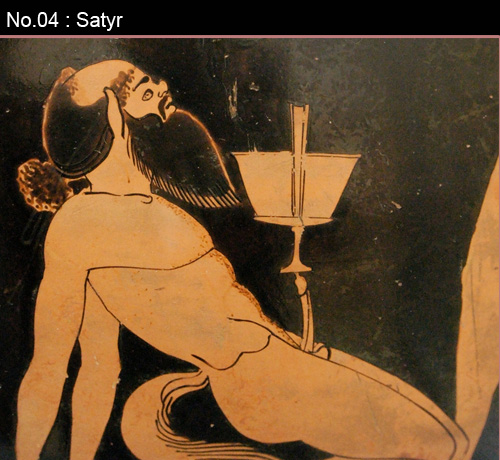
Case in point to the left here. Satyrs are the sacred disciples of Dionysus, and befitting the god of madness, intoxication, and altered states are hybridizations of male nature with beasts, specifically horses. Some might even argue that this is in fact the natural state of men, and doesn’t require a mythical race. In any case, satyrs inherit the tail, ears, and oversized member from their equine parent.

Back to satyr plays. We know little about them, as there are only 1.5 in existence. That’s right, dozens, possibly hundreds were written and performed, but beside a few scraps we only have the text of “Cyclops” by Euripides and half of  Sophocles’ “Trackers,” which was performed at this event. Ancient texts pretty much needed to be copied to survive, and well, monks weren’t that fond of satyrs.

The Trackers is the story of how Hermes steals Apollo’s sacred cows and builds the first Lyre, which eventually he trades to Apollo. So it could be thought of as the origin story of Apollo’s Lyre, which is one of the sun god’s primary attributes. Amusingly, and highly appropriate to satyrs, the tracking of the cattle involves detailed inspection of cow patties. Satyrs love a good shit joke, and this play has a veritable butt-load of them. The translation was brilliant, rendering them in meter and rhyme. It can’t be easy to translate poetic scatological humor from Greek to English.

Anyone who knows me well knows I’m an ancient history “amateur“, and how I’m particularly partial to death and resurrection gods like Dionysus and Osiris. So this was a brilliant and rare opportunity to see/hear some of this stuff in real life. They did some demonstrations of actor chorus interchange in Greek which I found fascinating. Then they paired this with reconstructed dance and limited music. You just don’t get to see/hear this very often. I know intellectually that Greek theatre was all written in meter, but it’s very different to hear it, even for someone who doesn’t (unfortunately) speak Greek. It gave me goosebumps. The UCLA students and professor who did the performance did an amazing job reconstructing the movements of the actors as well. Most of our visual information on Greek society comes from vase painting, and theatre (like drinking) is a favorite subject. To the right you can see an actor dressed as Hercules (left) and as Papa Silenus (right — father of the satyrs). Notice how the Silenus costume is basically a “furry body suit,” very cool. The actor holds the craggy old satyr faced mask up. As I learned yesterday, mask and “in character” are the same word in Greek. I love that, as I love masks and their Dionysian associations. My personal corporation is after all Mascherato, which is just Italian for masquerade. Back to the production. They did a really interesting job translating the postures and poses of satyrs and actors playing satyrs. You can see one of those in the upper right hand corner, recognizable by the fact that he is holding the head, actually a mask, of a satyr, and wearing special hairy “satyr pants.” These pants are the differentiating factor between real satyrs, like the one on the left “playing” with his wine vessel (real) and the upper right one (actor in satyr costume). It’s hard to explain in writing how they managed to copy the depicted mannerisms of satyrs, but they did.

The pairing of this often complicated motion, not so disimilar in some ways from modern dance, with the rhythm of the play’s dialog and the beat of the drum was very intriguing, and entertaining. One can totally see how these were exciting performances, and I think you could make a truly awesome modern ballet version of a satyr play. Perhaps with the satyrs and maenads preparing for the arrival of Dionysus. If I had a time machine I’d produce it, getting Stravinsky to write the music. Awesome! I guess you could do a production of The Rite of Spring with satyrs — as more or less was its intent — but I had in mind music that was somewhat more ancient in composition and instrumentation. The cult of Dionysus is not some happy go lucky party thing, but is essentially bound up with madness, chaos, and ecstatic murder. In other words, it’s pretty badass.


It’s worth mentioning our own little homage to the spirit of Dionysus, representing as it does an essential aspect of human nature. Our 2006 “Empires of the Ancient World Ball.” This was one of a series of black tie costume balls we hosted. This one included not only guests dressed as ancient characters and gods, but ancient music, theatre, and my personal favorite touch: A menu constructed entirely by recipes we selected from Apicius, the greatest of ancient chefs. The amazing Celestino Drago was kind enough to humor us by recreating these selections from an Italian version of the Latin cookbook. I should maybe blog separately about Apicius, but the flavor profiles of Roman cooking were in a lot of ways similar to watching this bit of ancient theatre: an exotic taste of the past. Both remind us that despite the passage of twenty five centuries, humans remain human, and interests, be they arts, food, politics, power, love, wealth or family, all remain at their core, the same.

On Writing: Yet Another Draft

The good news is that the comments from my Nov 13  draft came back Tuesday and they were very positive, and a lot less extensive than the previous three batches. So hot off an intense 8 day mega redraft, followed by one day of toddler party, followed by a full read in one day, followed by a half day of fixing the things I found in my own read… I did another 2 day mini full draft. v4.60.

I think it’s finally getting pretty close to just needing line editing (polish and smaller scale fixes). One thing about the process, however, is that a bit like a video game before you’ve had the testers pound on it, one is not entirely sure what one has. Sure, I know the book so well I can name every one of my 300 scenes in consecutive order, quote passages, or tell you to the day and version how a scene has evolved. Still, it’s hard to judge the work as a whole without a full read — and I just did one on Monday (plus two full drafting passes since then).

This is why one needs a ready supply of beta readers. Too bad it’s illegal to lock friends in a room with the book and tell them no food until they slide notes back out under the door.

FOR MY PREVIOUS POST ON WRITING, CLICK HERE

On Writing: Passes and Plots

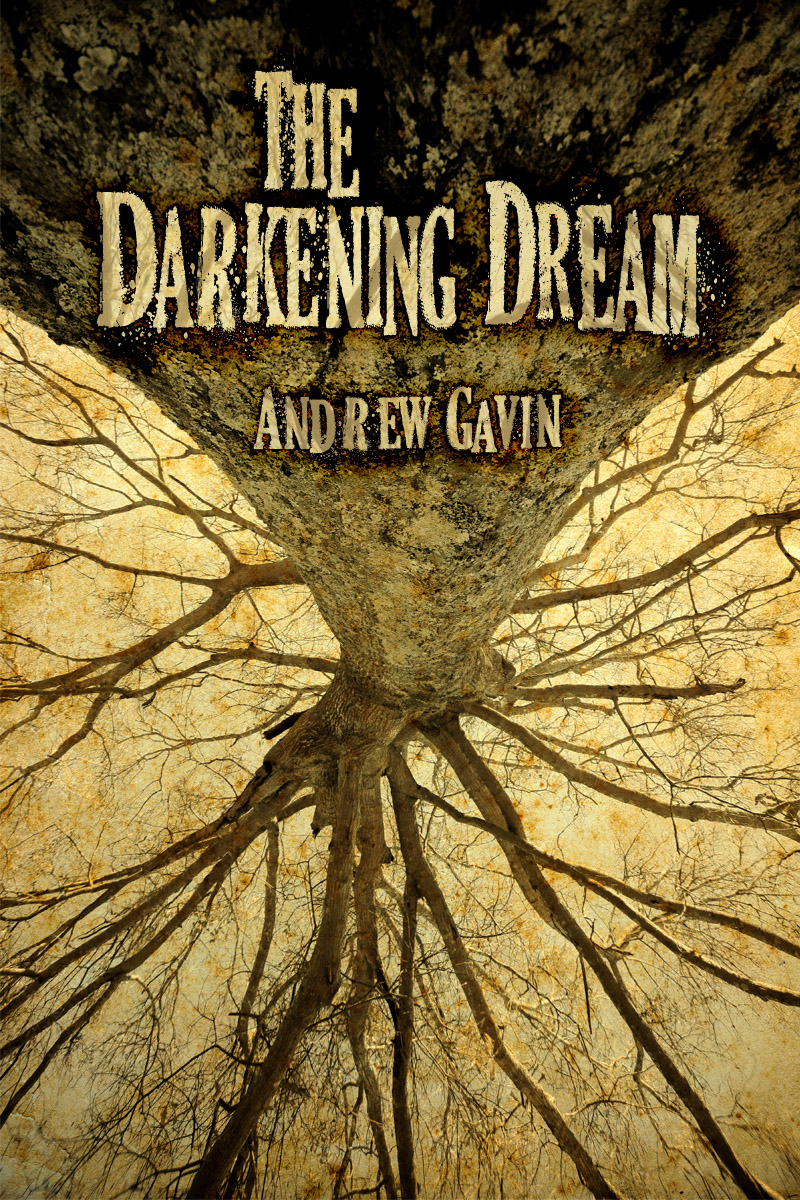
This afternoon I finished the rough cut of my 7th major draft of my novel, The Darkening Dream. In my process, a rough cut is a draft (in this case v4.55 — yes you can tell I’m also a computer programmer) where I’ve done all the major changes I intend, but I haven’t yet gone through and reread the whole book (again, for the 40th or so time) to fix up little inconsistencies I missed and to tweak and improve the prose specifically. Part if this is that different read and edit passes have different paces, and it’s not a great idea to mix them.

In a rough cut pass one is struggling to perform large scale surgery. To cut out big sections and sew them back together. To remove characters, objects, or character the motivations, purposes, or settings of things. I like to move fairly fast during this phase because I have to keep in my head all the little loose ends that need to be tied up (I try to write them in my change plan — a kind of chapter-wise outline of changes — which I follow as I redraft). Plus, during a big rough cut the novel is also “broken”. To me this is analogous to the period when a program can’t be compiled or crashes in some heinous way. So, I don’t really want to stop too long and noodle over a sentence. I don’t like either my novels or my programs broken. It was S.O.P. during Crash Bandicoot and Jax and Daxter to build a test disk every night that testers would play the next day. If your build was broken, this couldn’t happen and other people couldn’t work. Same with the book, I like to be able to give it to a beta reader if necessary. You can’t if it’s broken.

On a read-as-a-reader pass one drops the thing on the iPad (these days) and then read it from start to finish, jotting quick notes or highlighting problems. If you stop to fix them for too long, then you loose the feel of the book as it was intended to be read. This, by the way, is why if you want to really enjoy a book, you should read at least a few pages each day. If you take a two-week hiatus (or more), you lose too much continuity.

And finally, there is polish. In this kind of pass you line edit, or change on the fly. Improving sentences, polishing phrases, fixing errors, trimming fat, whatever. It’s possible while doing this to easily trim 5-15% out of a scene without actually removing any real content. This too has its easy analogy in programming: optimization, particularly of memory or code size (no longer very relevant). In this kind of pass you just work at the low level, and so you can move slowly.

So that was passes. Now onto plots and subplots.

In my previous major draft (v4.43 — don’t ask) my editors pointed out something huge that I was subliminally aware of as a problem, but hadn’t pinpointed the exact cause. I had two major subplots going in my book. One was the main plot, and the other was the villain‘s secondary agenda. I used to have three, but that was in versions before 4.xx.

To explain this, in v4.43 and before: There were the heros and the villains. The villains had this super bad plan going, and they had multiple sub goals serving this plan. The two main villains (meaning the ones who have points of view in my story, not the boss villains) had this separate — albiet bad — agenda to get something from a vaguely good third party. The heros were both the target some of the other offscreen villains and collateral damage of the pov villains. Now this was done originally to show that the villains were so badass that even distracted they were crazy nasty. The heros had as their agenda stopping the villains and saving themselves (nothing really wrong with that), however, they were never really able to understand the actions of the villains because of the mysterious secondary objective.

By making the seemingly simple change of merging the secondary objective and with something the heros had this entire situation was changed and improved. Now, the villains want something the heros have, and although they do much the same things they did against the third party + the collateral part, they do it all to the heros (and a little to each other, because they’re evil!). By way of analogy, before the heros and villains were on adjacent train tracks lobbing bombs at each other and trying to cut each other off at the pass, now they’re on a head-on collision course firing full time at the other. This got rid of the third parties which no one cared about, and had the net effect of creating literally dozens of additional opportunities for conflict and 5 or so new big head to head confrontations — and this is in a book filled to the brim with fights. Conflict is a novelist’s bread and butter, so this is win-win.

It’s also worth saying that to improve any work. Be it video game, novel, or whatever. When you get well articulated suggestions you have to be willing to try and view their merits objectively. This is with the end of judging if the end result would be better in an absolute sense. Of course, sometimes even if it is, the bang for the buck isn’t there, or there are tradeoffs. The changing itself, however, is part of the process.
FOR MY PREVIOUS POST ON WRITING, CLICK HERE