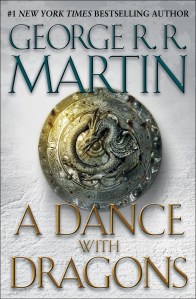
A Dance With Dragons

Title: A Dance With Dragons

Author: George R. R. Martin

Genre: Epic Fantasy

Length: 959 pages, circa 400,000 words

Read: July 12-23, 2011

Summary: Awesome, but not without issues.

ANY CHARACTER HERE

My charge through book 5 of Martin’s epic fantasy series was a bit drawn out by my need to concentrate on the second draft of my new novel Untimed, but I finally finished. Before I launch in, it should be noted that this review is full of spoilers.

Dance is huge, weighing in at nearly 1,000 pages. This itself is actually a welcome and comforting fact because these books are something to savor. Overall, I would rate this volume as better than A Feast of Crows and slightly worse than the first three. Still, it’s a fantastic book. Prose-wise, Martin is still a master at both people, places, plotting and reversals. It’s just that this book suffers from a few pacing and structural issues.

Most of these stem from his controversial decision to pull out half the characters from the bloated manuscript of Feast and push them into Dance by themselves. So the first two thirds of the new book is everyone who didn’t get a turn in Feast. Now, for the most part, this saved the best for last. Dany, Jon, and Tyrion make up the bulk of the book, particularly this first two thirds, and they are some of my favorite characters. But overall this leaves both Feast and Dance feeling a little more threadbare than the first three books. Personally I think he would have been much better off winding out the story chronologically, trimming out some useless threads (Aeron Damphair, Victarion, and probably the Dornes), and rearranging the plot so as to have some kind of sub-climax at the end of each book.

As it is, Dance reads excellently for the first 2/3, feeling fairly focused on its three mains. But it’s weird to rewind in time and revisit certain happenings from Feast from the other side (for example Sam leaving the Wall). When we get to the cut off point, however, some of the characters from Feast start to weave back in. This mostly has the effect of slowing the narrative and making it more diffuse. At least until the set of cliffhangers and deaths that come in the final chapters.

I also think that Martin is letting his pacing slip a bit. It’s not that each chapter isn’t entertaining and well written — they are — but many threads there have multiple chapters where the happenings could’ve been collapsed without loss. If we hadn’t known a few of those details were there, we would never have missed them. Worse than the pacing issues, however, is a weirdly increasing fondness for skipping some of the big moments. Now Martin has always done that (the Red Wedding, the “death” of Bran & Rickon, etc) but it’s worse than ever. He has a real tendency to build slowly toward a big event, then skip the event itself, showing what happened to the characters obliquely through other eyes at a much later point.

I’m going to go through some of my opinions and analysis thread by thread.

Prologue

I don’t really understand why fantasy authors are obsessed with these. It was kind of interesting, but didn’t advance anything.

Jon

His thread is fine (until the end), but it does feel a bit static. While he’s certainly grown into command, he mostly sits back at the wall and fields interference between factions (Stannis, his queen, the Red Priestess, the Wildlings) etc. Then at the end, he mysteriously decides to rush off to Winterfell. This is a move that makes no sense as he has refused to enter into family entanglements about six times before, and while he is goaded, there is really less at stake for him. Then out of nowhere comes a reaction to this decision that leaves us in a bad cliffhanger. Boo.

Tyrion

The Imp is funny as always and now I can hear Peter Dinklage cracking each and every droll line. Still his thread is also a little dragged out, although it does involve some great sightseeing and is certainly entertaining all along. In the first part of the book it feels like he (and everyone else) is heading toward Dany, but then he gets within inches and turns back. Using him to introduce us to Griff and “Young Griff” is however an excellent device and works much better than an extra POV would have. It is mostly through Tyrion and Dany that we get a sense of the complex and old slave societies of the mainland. Unlike Westeros which feels like late Medieval England, these realms feel more like the ancient east (perhaps an updated Babylon vibe).

Dany

Her chapters are mostly political. She does feel a bit passive. I don’t really understand why she doesn’t try to get a handle on her dragons earlier, this is obviously a key move which could trump all of her political problems. Instead she dicks around (literally and figuratively) with various factions. This is all fairly entertaining, but feels like treading water. Then “a big event occurs” (at least this one is on screen) and she rides off on Drogon. That’s all great, but her narrative disappears until the last chapter. When it returns nothing is resolved at all, but a new out of the blue cliffhanger is introduced. I do really like the world of Meereen and the slave cities, although it feels like we are lingering here a bit long.

Barristan

The hero serves to replace Dany as the POV in Meereen. He’s actually a great POV character with all his lingering thoughts about events during and before Robert’s Rebellion. I really enjoyed his chapters. But they didn’t come to any resolution.

Theon

The hier to the seastone chair returns to us, a few bits worse for the wear. I hated Theon in books 2 & 3, but I enjoyed his chapters immensely here. His transformation into Reek and back again is very deftly handled, with a very proper (and sordid) period quality. It isn’t for no reason that Tarantino used the phrase “medieval on his ass” and that is exactly what the Bastard of Bolton has done to Theon. His pseudo redemption is good. Still, we have classic Martin avoidance of the action with the actual escape from Winterfell. In the cut between Theon jumping from the wall into the snows and his delivery to his sister is a big blank. Not that we needed the travel, but whatever battle happened at Winterfell needed some detailing.

Asha

I could have lived without her POV. It mostly serves to fill in some parts of Stannis’s story when he leaves the wall. The technique is sketchy and I ended up having no idea what really happened during his brutal snowy march and the seige of Winterfell. This I thought was the weakest part of the book structurally, as I’m basically confused.

Quentin and the Dornes

Cut! Dull for the most part, except for some info about the cultures they traveled through. I couldn’t have cared less for these characters. The attempt to steal a dragon was interesting, but was also vaguely described. I’m thinking that Martin, for all his brilliance as a character and world builder, isn’t actually the best at action scenes.

The Dorne chapter back in Dorne: It was okay, but we didn’t really need it.

Jaime

This sucked. I like Jaime’s POVs, but this single chapter had a bunch of crap, followed by one of those annoying Martin reveals that just serve to highlight the gap in information. Brienne returns and they ride off. You don’t find out how she escaped her predicament, what she knows, anything. It just kinda sucked. The effect of her cliffhanger was entirely spoiled.

Cersei

These were pretty good, and I enjoyed seeing her get hers. Martin certainly knows how to throw in the creepy little details so your mind fills in the rest.

Victarion

Cut! I could have lived without these, and they basically just told you he was heading off to Dany with a horn and a Red Priest. Although he’s better than his brother — I’d take any chapter over Aeron Damphair.

Arya

These were great. I have no idea where they’re going, but that’s fine. Arya has always been one of my favorites. Give us more. To be honest it felt like these were the chapters that should have gone in Feast and this the conclusion that book should have had for Arya’s thread. Probably that was Martin’s original plan.

Bran

His chapters were good, but so little, and it all felt dropped as his last chapter is about midway in the book.

Davos

I’ve never been a fan. I think we could have just had these told by raven.

Epilogue

This was actually very good, really being a Kevan in King’s Landing chapter in disguise. I loved the return of Varys at the end — particularly his dialog.

Some observations: There is more magic of sorts in this volume. Martin has a real thing for nubile slave girls — but then again, what self respecting fantasist doesn’t? The scope of this book, with it’s gigantic foreign cities reminiscent of the ancient world is going to make for some hard adapting should the TV series get this far. As I noted in my series reviews the show already has problems with handling large scale people scenes. These slave cities and the like will make that even harder. Likewise with the slave sex and slave violence. I’m all over it (in fiction) but some of it will undoubtedly have to be cut/changed. Sigh. I like that Martin at least highlights some of the sad reality of actually being a nubile slave girl.

Overall, Martin’s books are among my all-time favorite novels. I enjoyed the book immensely, and eagerly await the the next volume (and I’m sure I’ll be waiting for a long time), but I can’t help but think it could have been SO much better if Martin had taken all the material in both Feast and Dragons and reedited them together into two chronological and slightly leaned down volumes.

Also check out my reviews of each episode of Season 1 of Game of Thrones (the HBO series):
[12345678,910]

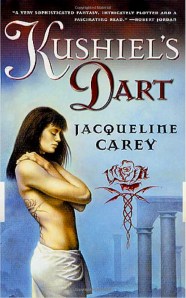
Kushiel’s Dart

Title: Kushiel’s Dart

Author: Jacqueline Carey

Genre: Epic Historical Fantasy

Length: 912 pages, 315,000 words!

Read: June, 2011

Summary: Long, overdone, but intriguing

ANY CHARACTER HERE

This book itself as Fantasy, but it’s certainly not your typical one. Really it’s a sort of reinterpreted epic (and I mean long) historical romance — without much of the modern sense of romance (almost none). But it does have plenty of the traditional, more atmospheric form.

This is a flowery first person narrative about a slave girl brought up as a sort of high end courtesan who gets involved — very involved — in politics. I’m going to try and break down and discuss various elements of the work.

It’s worth noting the tremendous length. The book is 900+ pages and feels it. I enjoyed it, but it’s like four novels glued together. This lends it a decidedly Gone with the Wind effect. Just when you think it should be over (except for the fact that you have 650 pages to go!) everything switches up and it moves on to a new stage. This happens several times.

First the setting. With the exception of a bit of prophecy and one large scale pseudo divinity (the Master of Straights) at about the 85% mark this novel really has no magic. And in fact, is actually a sort of disguised work of Historical Fiction. The Fantasy is more the invented nature of the tale than any actual magic. As best as I can tell the whole thing is more or less set in a reinvented thirteenth or fourteenth century France. It felt late medeval or early Renaissance. At times I wondered if it even had overtones of Carolingian (ninth century France). The names of the places and faiths are all changed, but in a recognizable way for those of us who know our European history. Rome is “Tiberium,” Spain “Aragonia,” the Germanic tribes the “Skaldi.” Carey does a good job of this, and her grasp for the flavor and cultures of Europe between the fall of Rome and the modern era extremely solid. The central nation of the novel feels both troubadour French and even a little Late Venetian Republic at times. There are plenty of deviations from real history. First an foremost the loosey goosey religious situation (as opposed to the dogmatic Catholic church). The religions have been reinterpreted and the nation founded by what appears to be an interesting mating of Jesus and Dionysus. An intriguing (and Romantic) mythical entity who was also followed around by a bunch of demi-god disciples who seeded various schools or bloodlines. Overall, the setting was probably my favorite part of the novel.

The voice. At first I loved the voice. Yeah it’s flowery. Girly. Really girly. And full of words that the Kindle dictionary informed me were “archaic” or just chosen for plain weighty flavor. Words like “limned” or “ague.” The sentences have an unusual and formal structure. There is a LOT of reppetition. This began to wear on me. Carey reminds you like 50 times who everyone and everything is, which considering the vast cast of characters and the incredibly complex political situation might be necessary for those that don’t have a semi-photographic memory or an obsessive knowledge of European history. The narrative is first person, and told from some unspecified far future point in Phedre’s (the protagonist) life. It’s the antithesis in many ways of my own voice, as it’s really really really heavy on the TELL and fairly light on the SHOW. Carey loves to insinuate before the action (when it occasionally occurs, separated by many many pages, but often enough given the titanic length of the book) that things won’t turn out as planned, or that something bad is about to happen. Lots and lots of stuff is done with narrative summary. I myself try to set everything in scene and tell it as it happens in a more hard boiled style, more like the Maltese Falcon or the Big Sleep, even if the subject matter is very different. Carey chooses a more sentimental approach. But at the same time I found the voice very distancing. A lot of this is the feeling that it is written looking back on events, which removes a lot of the tension inherent in the action. The rest is probably the TELL factor.

I liked the whole sex-slave-girl-bondage-courtesan angle. But Phedre is a little too good at just about everything other than pure agressive bravery, and she has her constant companion the warrior-monk for that. While bad things do happen to her, she pretty much flawlessly reads every situation and is titanically lucky / unnaturally talented. I still kinda liked her. And the fact that she has a lot of edgy sex is good. The book alternates between graphic and evasive in this realm, which ends up being more teasing than satisfying. Still, I guess normal people might find it dark.

Now the overall affect of this novel is pretty good. It starts off great. But it sometimes bogs under volumes of political talk I found excessive — and I read multivolume political histories for pleasure! Some of the sub-adventures (like Phedre’s time as a Skaldi slave) are really good and there are lots of varied settings, cultures, and characters. I also really enjoyed the depth of world building and the alternate but very “realistic” religious mythos. But…

There is absolutely no psychological realism to any of the characters, our protagonist included. The central condition of Phedre’s nature is supposed to be that she finds pain and suffering intrinsically hot. Even this isn’t really handled totally consistently. The rest of the people — while interesting and possessed of different traits — merely serve the story or the need to roster out a bunch of interesting types. The don’t feel exactly cardboardy, as they are detailed, but unlike the completely brilliant Game of Thrones, there is no fundamental relationship between the different nature of different personalities, their situations, and the decisions they make and the consequences those decisions bring.

In the end, I found the way in which things just sort of grandly worked out for Phedre tedious. The big war at the end is complex, but summarized, and the wrap up phase of the story nearly 100 pages. Carey also just loves to throw in grand and sumptuousness just for it’s own sake, which at the beginning felt lush, but by the time Phedre has dressed in 62 elegant gowns a bit much.

Still, I kind of liked the book, if only for its world and its very creative reinterpretation of medeval/renaissance fantasy. At times it reminded me of Guy Gavriel Kay, but his works felt somehow a bit more connected to place and certainly more emotional.

For more book reviews, click here.

The Big Sleep

Title: The Big Sleep

Author: Raymond Chandler

Genre: Crime Noir

Length: 234 pages

Read: May 27-31, 2011

Summary: Slick and stylish.

ANY CHARACTER HERE

Continuing my between the wars “hard-boiled” novel kick, I followed up on The Postman Always Rings Twice and The Maltese Falcon with The Big Sleep.

The novel is very much influenced by Dashiell Hammett‘s classic. It shares the atmospheric quality, complex plot, moral ambiguity, and dark wit.  Stylistically The Big Sleep has slightly more straightforward and less quirky prose. It’s a little more wry, a little less over the top than the earlier novel. Both have extremely compelling voices and stark style. The lean irony of the narrator in the The Maltese Falcon gives way to the dark cynicism of Sleep‘s Marlowe and his first person voice. “If you can weigh one hundred and ninety pounds and look like a fairy, I was doing my best,” is a typical zinger. The dialog is fantastic, although not as oblique and contrary as in Falcon. It’s a little more natural.

Marlowe is more likable and less belligerent than Sam Spade, although they’re both minted from the same cool-cucumber tough guy template. The plot is involved, and to tell the truth even having seen the movie twice, I had no idea until the end what Marlowe was digging at with his investigation of Vivian’s missing husband. Occasionally some bits of action took me for a loop too, requiring that I reread them to find out exactly what happened. But these are minor complaints. The book really is great. Marlowe’s compelling voice pulling you through at breakneck pace. But at the backbone for me was the sinister portrait of pre-war L.A. While visually tame by today’s jaded standards, this is a dark book, with realistic characters. The movie is forced by 40s standards to gloss or smooth over many of these darker elements, but the novel exposes them for what they are.

I do have to say that these hard boiled detectives are awfully confident in their ability to read dangerous situations!

For more book reviews, click here.

On Stranger Tides

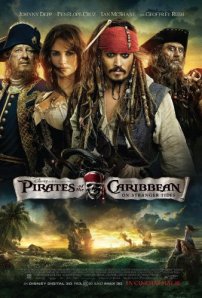
Title: Pirates of the Caribbean IV: On Stranger Tides

Director/Stars: Johnny Depp (Actor), Ian McShane (Actor), Rob Marshall (Director)

Genre: Pirate Fantasy

Read: May 28, 2011

Summary: Better than 2 or 3.

ANY CHARACTER HERE

This post isn’t so much a review of the 4th Pirates installment, but an little digression on its amusing relationship to one of my favorite books. Still, I’ll mention a few things about the film:

On Stranger Tides is a major improvement over Pirates 2 and 3 (blech). It feels more like a prequel to the first film (although technically it’s a straight sequel). Gone are Orlando and Knightly, and the plot focuses mostly on Jack Sparrow and some of the other baddies like Barbarossa and the new Blackbeard (played by the always likable Ian McShane). The plot is a bit of a retrenchment, involving a hectic quest for the Fountain of Youth. It’s more contained, more classically swashbuckled, with a welcome elimination of giant krakens, the afterlife, pirate councils, and ludicrous giant whirlpool ship battles. As such, if you can ignore the gapping plot holes and the merely token setup, it’s much more satisfying and fun to watch. It rates fairly close to the original, which is actually a pretty damn good movie — albiet a guilty pleasure for sure. The CGI is also much reduced. Not that it isn’t in nearly every frame, but it’s more contained and less bombastic. Structurally the elimination of the Orlando/Knightly thing also simplifies the whole character focus.

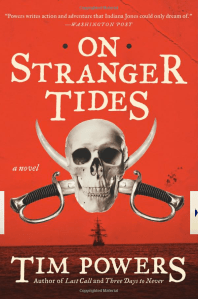
Now, on to the reason I’m writing this post. When I first saw the preview a year or so ago I was struct by the subtitle (On Stranger Tides) and the fact that the plot involved Blackbeard and the Fountain of Youth. I was instantly reminded of one of my three favorite Tim Powers novels, On Stranger Tides, about the same. Now This is a 1987 novel, and I read it in the 90s. But Powers is one of my favorite authors, and probably one of the biggest influences on my own writing (at least my first novel, The Darkening Dream). He blends history, the occult, and fantasy in an artful and seamless way. Anyone who hasn’t read him must immediately buy and read The Anubis Gates, one of my all time favorite novels. The original novel (On Stranger Tides) is a creepy and heavily researched story about Blackbeard’s maniacal search for immortality. It’s pretty brilliant and quintessential Powers. Much darker and scarier than this film.

Pirates IV is well… a Pirates of the Caribbean movie that involves Blackbeard and the Fountain of Youth. That’s about as far as it goes. Unless I missed something, the only other elements borrowed from the novel are a vague mention of zombies and the fact that when we meet Blackbeard his beard has smoldering flames hidden inside. This is a well documented feature of the man, as he claimed to be a priest of the voodoo god Baron Samedi whose magical totem is smoldering flame. This famous engraving shows the details. In any case the book is really cool and much more interesting than the film.

What’s interesting here is that Disney put “suggested by the novel On Stranger Tides by Tim Powers” in the credits and felt it needed to option the novel just to include the two basic elements of Blackbeard and the Fountain. Nothing else.

Hollywood.

Although I’m glad that Mr. Powers got at least some kind of payday as a result — he deserves it.

The Maltese Falcon

Title: The Maltese Falcon

Author: Dashiell Hammett

Genre: Detective Noir

Length: 217 pages

Read: May 25-26, 2011

Summary: Pure awesomeness.

ANY CHARACTER HERE

There are so many reasons why this is the archetypal detective novel. It’s pure pleasure from start to finish.

Let’s start with the writing. The prose is lean, but it has a way of sparing with the reader, a delightful economy and turn of phrase. Things are handled in a straightforward sequential manner. Simultaneously spartan and luxurious. There’s actually a surprising amount of description. Nearly every character is detailed on first meet, often with a good full two paragraphs. But they’re worth it (more on that later). Spade‘s actions are spelled out in exquisite and exhaustive detail — there must be at least fifty cigarettes rolled and smoked in this tiny book and countless details of dressing, moving from place to place, etc. Somehow these don’t drag, not at all. Action too, is quick, but handled in a kind of cold clear detail. What there isn’t, is one whit of interior monologue. The closest we get is the occasional, “Sam’s expression contained a hint of smugness” or “her hands twisted in her lap.” And more than anything, the prose is fun to read.

Plotting. The story is byzantine, and involves no one knowing exactly what’s going on, but Sam being a damn good judge of what’s likely to happen. There’s perhaps a bit too much action happening off screen, and a little too many coincidences or startling reverses. And for a book with so many shootings and double crosses, it’s mostly filled with dialogue scenes. But that isn’t a problem because…

The dialogue rules! Oblique, snappy, it crackles back and forth like a gunfight. The rules for writing quality dialogue could have been modled on this novel alone. Characters interrupt, they’re impatient, they lie (and lie again), they argue, they betray. They do a lot of talking. I enjoyed every minute of it.

Characters. Hammett really shines here. The villains are a bit over the top, but I adored them. The sinister (and limp wristed — oh so pre-politically-correct) Cairo, the fatman, the kid. The author uses a combination of amusing descriptive characterization (Gutman’s bulbs of fat — “He waved his palm like a fat pink starfish!” — or Cairo’s effete details — “when slapped he screamed like a woman”) and highly distinctive dialogue. Gutman’s is a real riot. Overblown, threatening and complementary at the same time. Sam himself is an interesting figure. Tough, incredibly competent, but also prideful, belligerent, and self interested.

Atmosphere. This is nailed, nailed cold and hard like a corpse left out in January. It oozes late 20s San Francisco. The dangerous dames, the cartoony gangsters, the police always one step behind. The tension in the way that the backstabbing moxie Brigid uses her feminine wiles eerily foreshadows basic instinct and countless followups.

The book’s been a classic for 80 years, and with good reason.

For more book reviews, click here.

Sophomore Slump – Delirium

Title: Delirium

Author: Lauren Oliver

Genre: Dystopian YA

Length: 114,500 words, 441 pages

Read: May 17-21, 2011

Summary: Big disappointment.

ANY CHARACTER HERE

Earlier in the week I read Lauren Oliver’s debut novel Before I Fall and loved it. So I eagerly downloaded her second book, Delirium, on my Kindle/iPad and set to reading. Ick.

She’s a very good writer, and the prose style is nearly identical, being first person present from the POV of a 17 year-old girl. For all it’s flaws (I’ll get to those), the voice is still very good, and makes for compelling reading at first. Oliver’s still great at inner monologue.

But everything else falls pretty flat.

Let’s begin with the premise. First of all, it feels like someone told Oliver that “dystopian is hot” and she jumped on the bandwagon. As far as I can tell, she shows no knack for it whatsoever. And worse, she pushes in this direction at the expense of her considerable talents elsewhere. This version of America exists an ill-defined period in the future, probably around 2050-2075. The central premise of the society is that LOVE has been diagnosed as a disease and the source of all societal ills. But fear not, a cure exists, some kind of magic brain surgery that gets rid of most feeling and desire. Everyone gets this at 18, because conveniently, that’s the age “the cure” works at.

Now besides this ludicrous premise, which involves a drastic about face of human tenants consistant since the dawn of time, we have to accept that in 50 years almost no technology has changed. Sure there are a few nasty totalitarian rules and such, but they still use cell phones, they still text. The book has absolutely NO description of anything different other than attitudes. Hell, there was probably more innovation between 1300 and 1350 than shown here! I just completely didn’t buy the world. Not one bit. There’s no way we could get from here to there. And it’s been done to death before. Better. Delirium is like a lame The White Mountains crossed with Uglies. Both books are far better (particularly the first). The whole thing felt entirely forced, like it was all derived from the high concept premise without any other consideration.

In Before I Fall, Oliver showed herself adept at painting peer groups. This is hard stuff, and fascinating when done well. But we don’t have it here. We have a protagonist, who isn’t bad, albiet a little generic, but then we don’t have too much else. Next up we have the romantic interest and best friend — both okay also. But that’s it. The other characters are like cardboard cutouts. I find this hard to jive with her first book where even the minor characters are deftly drawn.

Also in her first book was an intricate and cleverly woven progression of plot and character, while not perfect, it formed a lovely little puzzle unfolding across the length of the novel. And most importantly, giving a sense of emotional depth.

So what happened? I’m forced to conclude that either: 1) she spent much much longer writing her first book and really polished the hell out of it (nothing wrong with that) or 2) that she should have stayed more firmly rooted in the familiar early 21st century as the complexities of world building (even this minimally) sucked her focus.

Or both.

Still, I do have to give her credit for prose skills. They pulled me enthusiastically through the first third, then groaning and moaning through the rest. If it hadn’t been for this I would have chucked it in the middle and you wouldn’t have seen the review (I rarely review the many books I give up on — doesn’t seem fair).

I’m sad. It could have been so much better. I have nothing against dystopian — I am after all a hard core sci-fi reader — I’d have read nearly anything she gave me and enjoyed it if she just provided some reason to care.

For a review of Before I Fall, click here.

Lessons from a Lifetime of Writing

Title: Lessons from a Lifetime of Writing: A Novelist Looks at His Craft

Author: David Morrell

Genre: Writing Guide

Length: 240 pages

Read: May 21-22, 2011

Summary: Very good.

_

Having just finished the first draft of my second novel I did what I always do after a draft: take a little time to consider my craft (and not look at the book). So I pulled this puppy off my stack of books on writing. I’ve read a lot of such books, and this is one of the better ones in it’s category.

They fall into a number of broad groups: books on specific components like plot or character, books on sentences, books on editing, books on selling your books, books on summarizing your books, windy pontifications on the nature of creativity, and this type, the bit of everything, with a dose of personal experience thrown in. Lessons is a lot like Lawrence Block‘s Telling Lies for Fun & Profit. Both cover a bunch of the big areas quickly like plot and structure, and also include the author’s personal perspective on his career (Morrell’s best known for First Blood, on which the first Rambo was based) and the writing business. It does not focus heavily on sentences or editing.

There were a number of interesting insights. He has a technique for getting past sticky points in your story construction I might try (next time it happens). There were also some interesting technical thoughts on the structure of scenes and chapters. He has a perspective on selecting POV that I hadn’t come across, which was interesting. Although he is slightly dated in his opinion of first person stating that he feels it always needs a reason why the narrator is telling the story. This used to be the case, but in the last few years the rise of first person (particularly in YA) was sort of negated this.

A good chunk of the book is about his career, optioning books to Hollywood etc. This was amusing as well. He started in the early 1970s so he’s a product of that different era in publishing. The book was written in 2002 and while none of the writing advice is dated, the advent of ebooks and changes in the market are shifting the business side. Still, good writing is still good writing, and even writing style itself doesn’t change all that fast. Books I’ve read by authors whose prime was the 1950s still have plenty to offer. Last weekend I read The Postman Always Rings Twice, published in 1934, and that hardly seems dated.

So if you like books on writing and plan to read many, I’d check Lessons out. While that doesn’t sound like spectacular praise, I do like this book. Many writing books I read are total drivel. This one was worth the time, and that says something.

Some of my favorites are:

Before I Fall

Title: Before I Fall

Author: Lauren Oliver

Genre: Magical Realism YA

Length: 117,000 words, 470 pages

Read: May 16-17, 2011

Summary: Very very good.

ANY CHARACTER HERE

This is one of the best YA books I’ve read in a long while. Part Groundhog Day, part The Source Code, part Judy Blume, part The Lovely Bones — all itself.

We start with a high school girl, Sam, who dies in a car accident, and is doomed(?) to repeat the last day of her life again and again. Seven times to be exact. Sound like a recipe for repetition? It’s not.

First of all the writing is lovely. Really lovely. I’ve read perhaps 50+ first person girl narratives in the last year alone and this one had the best voice. It’s fairly well tied with Mary E. Pearson in that regard for recent entries (Judy Blume still wins for lifetime achievement). It’s funny clever without the annoying Snark. The voice is so good that it just drags you through the entire book, and it’s a pretty long book for YA. Lauren Oliver really is a lovely writer. The dialogue is good, the narrative description and interior monologue are amazing, and even the flowery interstitial description that glues together connected days is short but evocative. The Lovely Bones also had great voice, and a tremendous first half, before it fell apart into an abysmal mess of moral apathy. Before I fall is better.

There are some things worth noting. The characterization and the high school realism is top notch. I was reminded a bit of a modern Freaks and Geeks in that there was that kind of insightful tragio-comic realism. These girls felt pretty darn real. Even the minor characters had some depth. It’s this more than anything else that echoed the master of all YA: Judy Blume. Blume uses dialogue more liberally, as it’s her main method of characterization. Oliver prefers interior monologue and narrative description. The net result is similar. There’s a lot of detail here too, but the voice manages to make it interesting. Sam and her friends are popular girls, and more than a little bitchy, but they don’t extend into characterture. They are a little bad, but not too bad — realistically so. This is no melodramatic Gossip Girl. There is plenty of drinking, rudeness, etc. The sexuality is muted. Handled well enough, but perhaps a bit tamer than it could have been.

Now as to structure. Oliver does a really first notch job repeating the same day seven times without ever being dull. Sam makes different choices, and on some days this plays out very differently. One time she doesn’t even go to school. Still, even when the same scenes are repeated, and they are, different angles are shown, revealing and painting from different directions. This is hard to do, and must have taken considerable planning and rewriting. I’m actually facing a bit of this myself in my second novel, which is a time travel book and involves overlap and revisiting.

I’m going to stop for a second to pontificate on writing this kind of fiction. One of the things that makes this work in Before I Fall is the loose structure of the high school day. Sam’s day includes: getting up, driving with her friends to school, various classes, lunch, ditching, hanging out after school, and the party. These events flow from one to the next because of the inherent structure. If she skips lunch, or English class, she can pick back up on the schedule, because it’s immutable and set at a level greater than herself. This it has in common with Back to the Future I and II. There the structure of the dance forms a background on which Marty can play. In my own story, I have been trying to revisit a complex action scene multiple times. The whole scene — even the first time — folds out from the actions of the protagonist without any background structure, which makes altering that flow… complex.

In any case, in Before I Fall there is a also a very strongly structured arc, like, Groundhog Day, the protagonist has to learn a series of lessons from the failures of the first and subsequent trials. Much like a video game level, she gets to play it over and over again until she gets it right. This is very satisfying to read. Too bad real life doesn’t work like that.

The seven day structure also helps avoid the dreaded “reveal” problem. There is no giant structural reveal, the premise is setup in the first couple pages, and so the book does not suffer from the first half being better than the second. It races right on to the end. But there is an end, and I’m not entirely sure how I feel about it. Given the options, Oliver chose a pretty good one, and it does leave one with a deep sense of catharsis. So it was probably the right choice. Still the looming shadow over the entire affair left me with a deep sense of sadness not unlike that caused by reading The Time Traveler’s Wife (the excellent book, not the mediocre film).

For a review of Oliver’s second novel, Delirium, click here.

Untimed – Two Novels, Check!

Today I reached a milestone and finished the first draft of my second novel, tentatively titled Untimed. Now this doesn’t really mean it’s done, revision is usually more work than the first draft. Still, it’s a book. It has a beginning, a middle, and an end.

Untimed is the first book in YA time travel series. I haven’t written a log line yet, but it’s currently 70,000 words, and is a lean-mean-fast-paced first person present story about a boy whose name no one remembers — not even his mother.

Oh, and it features Ben Franklin, Napoleon, a male gang leader that wears red high heels, and the Tick-Tocks, creepy clockwork time traveling machines from the future.

I started it Feb 9, 2011 and finished the first draft May 20, 2011. I took about three weeks “off” to work on revisions of The Darkening Dream. So that’s roughly three months. My output was actually slower (as measured in words) than with TDD, because a don’t overwrite now. If anything Untimed is underwritten and certainly needs a lot of character work in revision, which might make it grow slightly.

I learned a lot of things from problems with TDD (mostly fixed in my many many revisions). I learned to find a place to start your story that really hooks BEFORE starting to write. I learned not to write any scenes that involved merely going from place to place. I learned not to flash back. I learned to stick with the plot, not the sub plots. And a whole lot more.

And I tried to outline the entire story before I wrote it, failed miserably, and concluded that I’m really a pantser (a seat of the pants writer).

For info on my first (and completed) novel, click here.

ps. If you’re one of my many dedicated beta readers, and want to offer early high level feed back, send me a note.

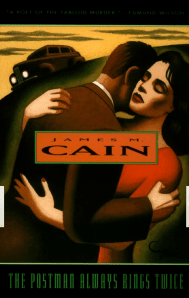
The Postman Always Rings Twice

Title: The Postman Always Rings Twice

Author: James M. Cain

Genre: Crime Noir

Length: 116 pages

Read: May 15-16, 2011

Summary: Taut.

ANY CHARACTER HERE

For my second novel I’ve been trying to adopt a sort of hardboiled style, even though it isn’t a crime or a noir. So I figured I go back to the beginning and read some of the classics.

This 1934 novella just breezes on by. The first half (act I) is like watching a train wreck unfold. I greedily devoured the setup. Seedy drifter, sexy unhappy wife, and loser older husband. Plus it’s a crime novel. You know things aren’t going to end up good. The style here is lean and mean. It feels fully modern, dated perhaps only by certain phrases and actually it’s utter bare bones quality, devoid of really deliberate voice. My only complaint here was that it’s so sparse on dialogue tags that I often got confused as to who said what and had to back up and count. That’s too few tags.

Not that it detracted much. So then mid book, the crime itself happens (not counting the aborted first attempt) and the gears shift a bit into legal territory. This middle section I found had a bit too much “tell.” It breezed along, but it reminded me of the second half of The Magician. Then we get to the third act. This was back more to the mater-a-fact what happens, but it did feel a little fast, perhaps resorting to a bit too much forced plotting.

Still, I enjoyed the book immensely, and it seems best as I can tell the blueprint for countless crime stories where greed/lust/whatever drives everyone to an inevitable bad end. Some great movie entries in this genre would be Body Heat, A Simple Plan, or the very recent The Square.

Another interesting thing about this story is not only could you set it in any era, but the exact text could pretty much serve from 1920 through to present day. The only difference now would be cell phones and better police investigatory techniques.