All Your Base Are Belong to Us

Title: All Your Base Are Belong to Us

Author: Harold Goldberg

Genre: Video Game History

Length: 306 pages

Read: April 5, 2011

Summary: All the good stories!

_

This new addition to the field of video game histories is a whirlwind tour of the medium from the 70s blips and blobs to the Facebook games of today, with everything in the middle included. Given the herculean task of covering 45+ years of gaming history in a completely serial fashion would probably result in about 4,000 pages, Goldberg has wisely chosen to snapshot pivotal stories. He seizes on some of the most important games, and even more importantly, the zany cast of creatives who made them.

My personal favorite is Chapter 8, “The Playstation’s Crash” featuring none other than that lovable Bandicoot, myself, Jason, Mark Cerny and various other friends. This chapter covers loosely the same subject matter that Jason and I detail in our lengthy series of Crash blogs (found here). It’s even 98% accurate! 🙂 If you enjoyed our Crash posts, I highly recommend you check out this book, as it includes not only some extra insights there, but 18 other chapters about other vitally important games or moments in gaming history.

These include old Atari, the great 80s crash, Mario, Tetris, EA, Adventure Games, Sierra Online, EverQuest, WOW, Bioshock, Rockstar, Bejeweled, and more. All are very entertaining, and focus heavily on the personalities behind the scenes — and boy, are there personalities in this business! In many ways this reminds me of Hackers, which is dated, but was one of my favorite books on the 80s computer revolution.

So click, buy, and enjoy!

For my series on Making Crash Bandicoot, CLICK HERE.

Bleeding Violet

Title: Bleeding Violet

Author: Dia Reeves

Genre: Paranormal YA

Length: 84,000 words, 454 pages

Read: March 14-20, 2011

Summary: Unique, good, and very different.

_

This is a weird weird book, and I mean that in a good way. Nominally, it’s about a schizophrenic girl, Hanna, who’s dad has died and who decides to move in unannounced with her mom she’s never met. But her mom doesn’t live in a normal town. She lives in some kind of weird place in Texas where gates between universes have let all sorts of strange monsters and realities in. A town with its own supernatural police.

The voice here is really fun. It’s first person past, but with a sort of cavalier devil-take-care crazy-girl style. I liked it. Some sentences were fantastic (both literally and figuratively). Not exactly in the lyrical kind of way that you might expect, but because of their deft wit, and quick and creative way of describing utterly fantastic goings on.

Because this book is FILLED, PACKED, STUFFED, with weird monsters and magic. Reeves uses the protagonist and POV character very deftly to explain it, or mostly just show what happens. She doesn’t feel the need to combine herself to easy concepts either. For example, sound sucking, student grabbing, invisible squids live inside the high school windows and one of the characters defeats them with a deck of playing cards! It’s a tribute to her skill that I could follow nearly all of this stuff. And it’s compact too, not being a very long book and containing dozens of strange encounters. The descriptions are lean but vivid. Occasionally she violates POV slightly on the side of clarity because the protagonist is new to this stuff and she explains it with a bit more understanding than she might be expected to have. But this isn’t very noticeable. Now I do wonder if someone with less experience reading speculative fiction in all its forms might have trouble with this novel. I mean, I’ve read A LOT (5000+ speculative novels), and played hundreds if not thousands of video games with magical systems etc. We won’t even count the movies and TV shows. Certainly someone who likes their reality… well… real, would be put off by the book. I wasn’t. The supernatural flavor was really interesting and unique, reminding me ever so slightly of something like the eerie Lost Room, or the wonderful but very out of print Marianne series by Sherri S Tepper.

The choice of using such a fractured POV character was interesting. There could be an argument that the entire book was some sort of delusion. I myself just treated Hanna’s view point as literal, and everything she saw as factual. The protagonist, and some of the other characters for that matter, don’t feel entirely real. They aren’t cardboard per se, as they feel well rounded, they just have a bit of surreal style to them that comes from their rather depressed moral compass. There’s a lot of killing and murder in this book, often horrifically grisly in fact, and no one seems to care too much. One of your best friends has been impregnated by evil demon spawn who are eating her from the inside out, well, just cut them out and leave her bleeding to die. That sort of thing. It works in the story, but if you stop and thing about the reactions any non psychopathic person might have… These characters just move on. It didn’t  really bother me in the context of this story as the narrator’s view point tends to whitewash away the consequences.

There’s also a good bit of cavalier sexuality — a welcome break from the self censorship that seems to be the norm since the 90s. Hanna is certainly open minded in that regard, and likes to take off her clothes. Unfortunately 🙂 there isn’t a lot of detail, like most everything else in the book a lot is left to the imagination. This is also part of the trend. To tell the truth Judy Blume’s Forever (1975) is still the most explicit teen book I can remember.

Overall, this is a great book, but it’s much more FANTASTIC than your typical paranormal. Being a fantasist, that was more than fine with me.

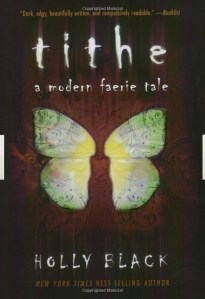
Tithe – A Modern Faerie Tale

Title: Tithe – A Modern Faerie Tale

Author: Holly Black

Genre: Paranormal YA

Length: 66,000 words, 310 pages

Read: March 13, 2011

Summary: Well written and evocative.


This is the second Holly Black book I’ve read. I enjoyed White Cat (REVIEW HERE) a lot and so I went back to read her debut novel. And liked it even more.

The similarities are striking. Both are short YA books, with nice prose and likable main characters thrown into ‘weird’ paranormal situations. Both have the action so condensed as to occasionally be confusing. Both wrap themselves up in the last quarter in a way that compromises the believability of the secondary characters. Both have unhappy but not completely tragic endings. While White Cat’s premise is perhaps a tad more original, I found Tithe‘s creepy fairy flavor more to my taste. Not that I didn’t like the first, but I really liked certain things about the second.

Tithe is written in third person past, with the protagonist Kaye dominating the POV. Mysteriously, approximately 5-10% is from the point of view of her friend Corny, and about 2% from the romantic interest. These outside POVs felt wrong, and at least in the Kindle version, no scene or chapter breaks announced the transitions. Every time one happened I was confused for a paragraph or two and knocked out of the story. Still, said story was more than good enough to overcome this minor technical glitch.

Kaye is an unhappy 16 year-old with a loser mom. When they move back to New Jersey she is rapidly involved with the Fey, discovers she’s a green skinned pixie, and gets drawn into a conflict between the Seelie and Unseelie (rival fairy) courts. It’s a fun read, and the prose is fast and evocative of the fey mood. Ms Black seemed to have done at least some research and the feel is quite good. The loose descriptive style sketches some rather fantastic creatures and scenarios, and that works. There is some darkness (which I like), and wham bam death of secondary characters without the proper emotional digestion. There is sexuality, but no sex (boo hiss!).

But I really like the way she handled the fairies. There isn’t a lot of description, but what there was left me filling in my own detailed, sordid, and mysterious collage of imagery.

I was loving the first two third of the book, and then it pivoted a bit and lost me a little. Don’t get me wrong, I still liked it, but the last third felt sketchier. The author had a bunch of double takes and betrayals on her outline, and it felt to me that it didn’t really matter if the secondary characters got to be true to themselves — they just followed the script. The protagonists best friend dies in like two seconds, and there is barely any reaction. Everyone also seemed to roll way too easily with the rather gigantic punches (as in Fairies are real). And to be darn good at picking up new powers in no time at all. This is a typical issue, and very hard to address perfectly, but it always bugs me when magic seems too easy. White Cat had the same final act issues.

It’s still a fun book — way above average — with nice prose and breakneck pace. But the potential for great gave way to merely very good.

Book Review: White Cat

Title: White Cat

Author: Holly Black

Genre: Paranormal YA

Length: 76,000 words, 310 pages

Read: March 12, 2011

Summary: Well written, fun, but a little contrived.


This is yet another foray into the world of paranormal YA (I am, after all, doing research for my own writing). Holly Black is a but best selling YA and MG author. This book, unusually, has a male protagonist, and he’s part of a family of “curse workers,” although he himself doesn’t do any magic. He lives in an alternative reality where a small minority of people are able to “lay on hands” in a bad way and curse people. They are known to society, it’s even illegal, and formed into criminal gangs in the 1930s just like the Mafia.

The premise is decent, although I’m not a fan versions of our reality with outed paranormal groups. I didn’t really buy the changes at a social level. The whole existance of this kind of power in volume would throw everything off, and here the only real social change is that everyone wears gloves (because it’s through bare skin that the magic works). We are reminded often of the glove factor.

The writing is very solid and straightforward, in first person present. So straightforward it took me awhile to even notice the tense. Or maybe writing it myself is acclimating me to it. The protagonist is likable and felt fairly real, although maybe not all of his decisions did. And I didn’t really feel the proper weight of his emotions. Big things happen, but without big feelings. By page three or thereabouts we discover he murdered his girlfriend. We’re supposed to still like him. And we do, but mostly because it’s totally obvious that he didn’t REALLY murder her, he only thinks he did. Oh and we quickly hear about the one flavor of curse worker that’s REALLY rare. And guess who’s from a magical family and doesn’t have any power…

But I enjoyed the book — quite a bit — I read it in half a day after all. Another book I attempted to read that same morning was so execrable that I only made it to fifty pages, so this was a vast improvement.

A couple other beefs. At times the writing was so lean that I felt like I missed something in the action and had to page back to find it — but it wasn’t even there. Now, it was then obvious moving forward what had happened, it just seemed that the attempt at leanness and/or agressive editing had taken the edge off the clarity. Then as we moved into the second half we hit the “after the big reveal” syndrome which many books with reveals often suffer from. I’ve mentioned this before (like HERE or HERE), but basically this is where after the big shocker no one really seems to act with appropriate emotional gravitas. I’m used to it, and it’s a tough problem to solve, so I moved on to the ending.

Which was the weakest part. Everything juggled into place such that the people were served the plot rather than their character. The plot wasn’t bad, it’s just that I didn’t really see some of the characters acting like they did.

Overall, the story was fast and fun. As I said Ms Black is a skilled writer, and the prose zipped along, with nice quick descriptions, and she isn’t afraid to be a bit dark or sexy (considering it’s YA). The gratuitous twist on the last two pages bugged me, but I ordered the sequel (which the Twitter/FB buzz says is very good) and another of the author’s books.

How different these neat little package YA books are from a meaty tome like The Wise Man’s Fear (which I finished the same day). There are subplots in that book about the size of this entire story.

For a review of Holly Black’s first novel, Tithe: A Modern Faerie Tale, click here.

Game of Thrones – The Houses

With the premier of Game of Thrones, the HBO series based on what is perhaps my all time favorite Fantasy series, fast approaching, the network has been releasing all sorts of goodies. Now I’ve posted about this before, but these books, and it looks like the show, are so darkly delicious that I fell I must share.

Power (above) is new trailer.

Fear and Blood (above) is another new trailer for the show in general.

Then we have a whole series of videos on some of the most important Great Houses. Like Dune before it, Game of Thrones is a story about the interplay of politics and loyalty among a number of great factions. This was frequently true during the late middle ages, and to some extent the series is based a bit on the War of the Roses.

The Starks (above) are the moral center of the story.

House Baratheon holds the throne… for now.

The Lannister’s you love to hate — except for Tyrion who rules.

House Targaryen knows all about dragons.

Above is a more detailed video on Jaime Lannister.

and above Robb Stark.

Above is Littlefinger.

and above about the world in general.

For a review of episode 1, click here.

The Wise Man’s Fear

Title: The Wise Man’s Fear

Author: Patrick Rothfuss

Genre: High Fantasy

Length: 380,000 words, 1000 pages

Read: March 4-12, 2011

Summary: A worthy sequel.

_

The Wise Man’s Fear is one of 2011’s two most anticipated Fantasy novels, the other being George R. Martin‘s A Dance with Dragons (due in July). WMF, however, can be all yours right now. It’s the sequel to The Name of the Wind (which I REVIEW HERE). This is High Fantasy of a rather less epic sort. Not that it’s any less fun to read, even weighing in as it does at 1008 hardcover pages. Although, who thinks about pages these days, as I read the Kindle version on my iPad (wouldn’t want to mess up that nice hardcover first edition I had signed by Mr. Rothfuss last week!).

Despite the length, it’s well worth it. This book is seamless with the first in the series, despite the four years gap between their publication. I read The Name of the Wind a second time last week, and WMF picks up and continues with exactly the same style and pace. There is still the box story in the present, but this accounts for no more than 5% of the pages. The action mostly takes place in the past with our hero, Kvothe, continuing on for a bit at University and then venturing out into the wider world. While we sense that some bigger events are in the works, this is still a very personal tale. And it defies all normal story telling expectations in that it just meanders along. My editor’s eye says that whole chunks and side plots could be snipped out without effecting anything. And to a certain extent this is true. But would the novel be better for it? Perhaps it could have lost 50-100 pages in line editing, but I’m not sure I’d take out any of the incidents. As the novel itself says, it’s not the winning of the game, but the playing of it that matters.

That is very much what The Wise Man’s Fear is about. It’s a story about stories. It’s rich and lyrical, a luxurious tapestry of world and story, without the distraction of the intricate mechanism of plot. The little glimpses into different sub-cultures show a deft eye for details and invention. This feels like a real place, not so much explained, but revealed through the narrator’s eyes.

As Rothfuss said in an interview, Kvothe is  older now, and he gets himself into more trouble. There’s more sex and violence this time out, although the main romance is still endlessly unrequited 🙂 Kvothe it seems, is a hero of many talents, and that includes those in the bedroom. Rothfuss doesn’t focus on these details gratuitously, it’s not a book filled with battle (or bedroom scenes).

I’m curious to see how Rothfuss wraps this up in the third book (and I suspect the trilogy might expand). Things still feel early. We find out barely anything new about the main villains. In fact they don’t even show in this volume. Just like the first book the end is completely limp and anti-climatic. Kvothe just wraps his story up for the day and we wait (hopefully for slightly less than four years).

But I’ll be waiting. Probably for so long that I’ll have to read book one and two again. I won’t mind.

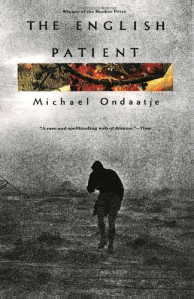
Book and Movie Review: The English Patient

The English PatientTitle: The English Patient

Author: Michael Ondaatje

Genre: Literary Historical Drama

Length: 82,000 words, 300 pages, 162 min

Read: Spring, 2010

Summary: Lyrical.

_

I had seen the film when it came out (and several times after) and it’s long been one of my absolute favorites. So to that effect the novel has been sitting on my shelf for over ten years waiting to be read and this spring I finally got around to it. In some ways I’m glad I waited because I wouldn’t have appreciated the prose as much years ago. The voice, told in lightweight third person present, and lacking nearly all mechanical constructs (like dialog quoting or tagging, preamble explanations of scene transitions, etc.) has a breezy lyrical quality to it. It can only be described as delectable. There is a feel of watching a beautiful but flickery film, a series of stuccato images flash through your head as you read it. It’s worth quoting to illustrate:

“She stands up in the garden where she has been working and looks into the distance. She has sensed a shift in the weather. There is another gust of wind, a buckle of noise in the air, and the tall cypresses sway. She turns and moves uphill towards the house, climbing over a low wall, feeling the first drops of rain on her bare arms. She crosses the loggia and quickly enters the house.”

The plot — such as it is — involves a war battered Canadian nurse lingering in Italy at the close of WWII. She has isolated herself in a half destroyed villa and cares for a mysterious burn patient who is dying and too fragile to move. The book focuses on the nurse as its protagonist, concentrating on her relationship with an Indian (via the British army) bomb disposal tech and her efforts to come to terms with the war and loss. The patient slowly unravels his own tale to her. It is his story, set mostly in Egypt before and during the start of the war, which is the primary focus of the movie. In the book it serves more to offset and focus the nurse’s point of view.

I am blown away by the effort of translating this book for the screen. Frankly, although I loved the novel, I like the film better — this is rare. Anthony Minghella managed the near impossible, translating this gorgeous prose into an equally lyrical visual style. It’s less stuccato, more “lush and languid.” Film is a more linear medium, and Minghella focuses the story to create grander more visual arcs. To do this, he expanded the patient’s epic story of love and loss in pre-war Egypt. I’m a sucker for Egypt, the exotic, the British Empire in decay, and worlds that no longer exist. This story feels bigger than the nurse’s, being as it is more tied in with history and international events. But in both you have a powerful sense of people fighting for their passions, both interpersonal and intellectual, despite the baggage of past choices and the buffeting blows delivered by the unstoppable forces of history.

Both variants of this story are inherently complex, ambiguous, and emotional works. Look for no answers here, just gorgeously rendered questions.

The Name of the Wind

Title: The Name of the Wind

Author: Patrick Rothfuss

Genre: High Fantasy

Length: 255,000 words, 720 pages

Read: May 2008 & Feb 28-Mar 2, 2011

Summary: Best new fantasy of recent years.

_

In 2008, I read this 722 page novel in Xian China during a single sleepless night, and I reread it just now for the second time in preparation for the sequel (released this week): The Wise Man’s Fear. NOTW is a beautiful book. Of all the Fantasy I’ve read in the last 15 or so years, this is perhaps second best after The Song of Ice and Fire. But that’s not to say that they have much in common, other than both being good Fantasy. George R. Martin‘s books are full of characters, POVs, violence, politics, and a darkly realistic sensibility. NOTW is much more focused and relies on more traditional Fantasy tropes. How focused can a 700 page novel be? Not very, but it is good, and it concentrates on a small number of characters and a single (albiet meandering) storyline.

Kvothe is the protagonist. He’s a young man of many many talents, of no means whatsoever, who winds his way from the actor’s troupe to the mean streets to the magical University and to (implied) great and terrible things.

If I have any beef with the book, it’s that the meta premise of the tired hero telling his story is too drawn out. This volume opens in the “present day,” where very little happens except to set us up for the life story of the hero, which is brilliant. Much like Lord of the Rings or Hyperion, the reader must slog for a bit to get to the gold. In this case about 50 pages in. But the slogging isn’t exactly painful because Rothfuss’s prose is lyrical and masterful. Seriously, it’s a wonder given the tangents, bloated conversations (the dialog is great but not efficient), and the like that this book is so easy to read — but it is. Damn easy, even the second time.

The world and the hero juggle uniqueness and heavy — but delicious — borrowing from classic Fantasy of the best sort. I sniffed out a bit of Ursula K. Le Guin (think Wizard of Earthsea), Raymond Feist, Robert Jordan (Wheel of Time), and who knows how many others. The world is extremely well developed, and feels big, but it doesn’t doesn’t have the camp and cheese of Wheel of Time (although it does pay homage). I love origin stories and I very much enjoyed Kvothe’s journey. He’s a great character: humble, proud, skilled, lucky, unlucky all at once, but in a fairly believable way. Perhaps the most important relationship in the book (and there are actually relatively few) is the romance, and it has a tragic quality that feels very refreshing, and slightly reminiscent of the best of Orson Scott Card (think his old stuff like Song Master) or Dan Simmons.

The magic is very unique and interesting, and we focus on it quite a bit, as this is a story that spends a lot of time in the Arcane Academy. This ain’t no Hogwarts either, it feels altogether more mysterious and dangerous. There are several different magic systems interwoven in what is a world overall fairly light on magic. But this is also a world that feels a bit more technological than most Fantasy, with larger cities, a little more like antiquity than the Middle Ages. The “magical bad guys” have a nice character and bit of mystery to them. I don’t like all my mystery explained. There is a lot of music and theatre in here too, and that just helps heighten the lyricism.

But what exactly makes this book so good?

Proving my geek-cred, swapping some Crash Bandicoots for signatures with Patrick Rothfuss

Fundamentally I think Rothfus is just a great writer, and a very good world builder. I don’t think he’s a great plotter. The story drifts along, relies a bit on coincidence and circumstance, and the end fizzles then pops back out of the interior story and waits for the sequel. But that doesn’t really matter, because the prose, world, and characters keep you enjoying every page.

CLICK HERE for my review of the sequel, The Wise Man’s Fear.

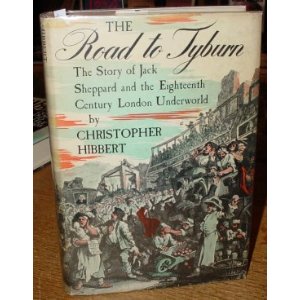
Book Review: The Road to Tyburn

Title: The Road to Tyburn

Author: Christopher Hibbert

Genre: Biography / History

Read: Feb 18, 2011

Summary: Really fun glimpse into a sordid little world.

_

In the last 2-3 weeks I’ve read at least 8-10 books on 18th century London, many on the criminal element of said city. Lest one think I’ve got an unnatural fascination with antique crime this is research for my new novel (more on that here). This book, however, was a standout, and despite being long out of print is well worth mentioning.

It’s short (160 pages), and very lively, reading as fast as a novel. It does a very good job characterizing the bizarre underworld of 1720s London, pretty much that which is depicted in the engravings of William Hogarth. London of this time was a city unique on earth, transitioning out of the 17th century’s religious zealousy and into the head long rush toward industrialization. It was a place of great freedom, great crime, great industry, and an infrastructure and society nearly overwhelmed by change. Pretty damn fun, and why I chose it for my novel.

Jack Sheppard — not to be confused with the protagonist of Lost — is a colorful character I hadn’t previously encountered. More or less just a charismatic young house burglar, he entered the public eye in a huge way — foreshadowing today’s media fascination with crime and criminals — by being a prison breaker of staggering talent. Nothing could keep the guy down, tied, barred, locked, or whatever. He broke out of the notorious Newgate prison no less than three times! (and several others as well).

As a working class, non-violent, handsome, achem… thief, seemingly able to escape punishment at will, he captured the hearts and minds of his fellow Londoners. For me, one of the book’s great moments is the description of his insanely daring and audacious fourth escape, known even then as the “Great Escape.” The guy used only a single bent and rusty nail to extract himself from a huge pile of irons, fetters, and chains, broke open a masonry chimney, climbed up, picked and opened five heavily fortified prison doors, leapt across rooftops, and descended great distances on a rope made of bedding. If anyone ever earned an escape, it was this guy!

Too bad they hung him when they caught him the last time. But he seemed to enjoy the attention and show.

The book does a great job telling Jack’s life story intermixed with really vivid and quick background sketches. The story of the the infamous Jonathan Wild, self proclaimed “Thief-taker General of Great Britain and Ireland” is also an eye-opener as to the origins and history of organized crime. As the book states, no other criminal mastermind in 300 years has ever had London crime (a pretty notorious city) so well organized!

Book Review: The First American

Title: The First American: The Life and Times of Benjamin Franklin

Author: H. W. Brands

Genre: Biography

Read: Jan 25-Feb 10, 2011

Summary: Big solid Bio of a VERY interesting man

_

While I’m waiting for the last bits of line editing on my almost-finished novel, The Darkening Dream, I’ve been researching and outlining the  next. Given that it’s me, the new novel features both the historical and the fantastic. As to the historical: enter Ben Franklin. Who was one cool dude.

There’s a reason why he’s on the hundred dollar bill.

Now to reviewing this biography (I’ll call it TFA). It’s very well written, and easy enough to read. It’s also LONG (800 dense pages). Now, Ben lived 84 years, from 1706 to 1790, and he was perhaps the best known and most highly diversified American of his era. So there’s a lot to cover. As a printer/writer Ben left us a lot of his thoughts, and the book does a tremendous job capturing these, with long tracks of his writing embedded in the text. Lest you think this might be dry, he’s a surprisingly witty and modern voice. Eerily so. The book could have used a little bit of trimming here and there — but no more than 5-10%. It marches along steadily from Ben’s parents to his death and legacy, covering everything in between. This is not a history of the Revolutionary War, but covers more Ben’s role than the conflict itself. Good thing since that would’ve doubled the size. TFA does a good job characterizing the era, and particularly the politics of both Pennsylvania and London, and to a lesser extent Paris. It does a great job characterizing Ben.

Overall, I would give the book a 8/10 on the biography scale. That’s independent of it being Ben, but just in managing the job of conveying an important life in a different era. It’s not quite as good as Caesar: Life of a Colossus, Alexander of Macedon, or the Rise/Reign of Napoleon Bonaparte, but it’s pretty close.

But it’s worth talking about Ben. He was a pretty amazing guy, as influential in his own wry was as those three aforementioned titans. And he didn’t kill thousands or conquer nations doing it. Ben was a man of rare genius. Observant as to causes and effects, be it weather, electricity, ocean currents, politics, or business. And he’s depicted here with all his very human faults. But fundamentally he was a spirit of curiosity, optimism, energy, and general good intentions. He wasn’t the best husband or general, but he sures seems to have been one hell of a human being.