Making Crash Bandicoot – part 2

CONTINUED FROM PART 1 ABOVE.

So what was it that Sega and Nintendo had in 1994, but Sony didn’t?

An existing competing mascot character. Sega had Sonic and Nintendo had Mario (even if the N64 was just a rumor at that point). But Sony product slate was blank.

So we set about creating a mascot on the theory that maybe, just maybe, we might be able to slide into that opening. I’m still surprised it worked.
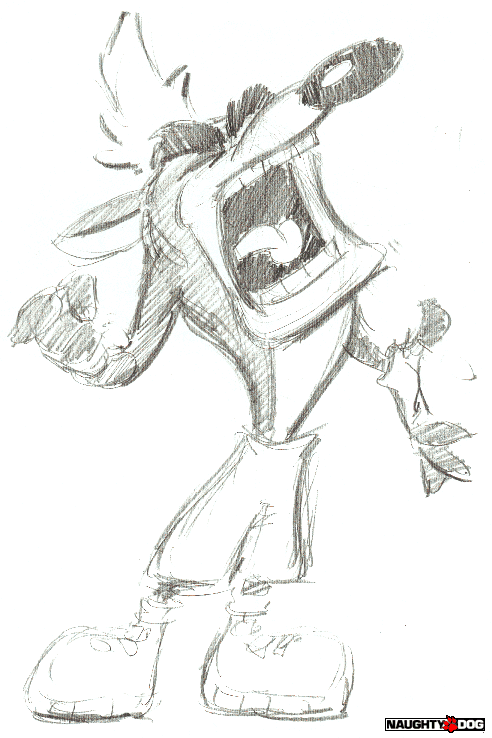
The first real Crash

Next we had to find a creature to hang our hopes on. We wanted to do what Sega had done with the hedgehog and Warner Bros had done with the Tasmanian Devil and find some kind of animal that was cute, real, and no one really knew about. We bought a copy of “Tasmanian Mammals – a field guide” and flipped through. The Wombat, Potoroo, and Bandicoot fit the bill. For the meantime we went with Willie the Wombat, as both Jason and I like alliteration. We never considered it a real name as it was too dorky. And just a month or so later someone told us about some other non-game property with the same name, so it remained a working title. By October 1994 the character was a Bandicoot as far as we were concerned.  We loved the word, but we kept calling him Willie, and the game Willie the Wombat until spring of 1996. It wasn’t really worth it to sort out a final name – some marketing department would probably change it anyway.

In September and October of 1994 we were busy trying to figure out who this Willie guy was. We felt he should be goofy and fun loving, and never talk — on the theory that voices for video game characters were always lame, negative, and distracted from identification with them.

But the villain gelled faster than the hero.

Dr. Neo Cortex -- pissed

I remember it clearly. The four of us were eating at this mediocre Italian near Universal and I had this idea of an evil genius villain with a big head. Obviously brainy cartoon villains have big heads. He was all about his attitude and his minions. Video games need lots of minions. Jason had become very fond of Pinky and the Brain and we imagined a more malevolent Brain with minions like the weasels in Who Framed Roger Rabbit. A villain, all full of himself, unable to conceive of ever doing anything the simple way, but constantly (in his eyes) betrayed by the incompetence of his henchmen.

I put on my silly villain voice and intoned, “If you had three neurons between you, you couldn’t make a triangle!” With this attitude, his name, Doctor Neo Cortex, popped instantly into our heads.

For “Willie” was to be – in our minds – a game that tried to combine the game play of Mario or Donkey Kong Country with the animation and cartoon sensibility of a Looney Tunes or Tex Avery cartoon.

To that effect, we took the very unusual step of hiring real “Hollywood” cartoon designers to help with the visual part of the production. This was Mark’s idea at first, although Jason and I saw the brilliance of it immediately. In those days we were enamored with the idea blending the best of Hollywood into game making – creative synergy if you will. In the long run, we would be disabused of much of the synergy notion. However, production design, sound design, voice acting, and later motion capture, were to be the areas in which Hollywood resources proved valuable to video game teams.

A Crash that wasn't

The guys we brought on were Charles Zembillas and Joe Pearson. Charles was principally character, and Joe background. These two were instrumental in developing the look of Crash Bandicoot, particularly prior to us hiring Bob Rafei in January 1995. Bob was an extremely talented young artist who would eventually come to head the art design at Naughty Dog. But in 1994, what Charles and Joe did was provide the fleshing out, or visualization, of ideas pitched mostly by Jason, myself, or Mark. In essence, they translated into cartoon sensibility.

Charles in particular was a very fast sketch artist, with a real knack for capturing cartoon emotion. So we would just say things like, “Cortex has a huge head but a tiny body, he’s a mad scientist, and he dresses a bit like a Nazi from the Jetsons” and in 2 minutes he’d have a gray and blue pencil sketch. We might then say, “less hair, goofier, crazier” and he’d do another sketch. Repeat.

The jungle, concept

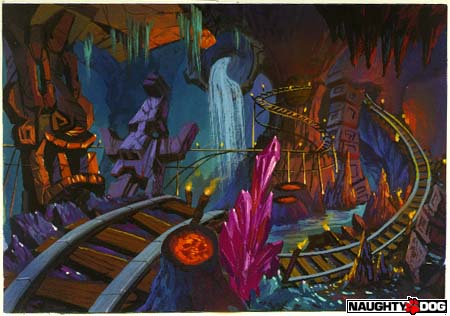
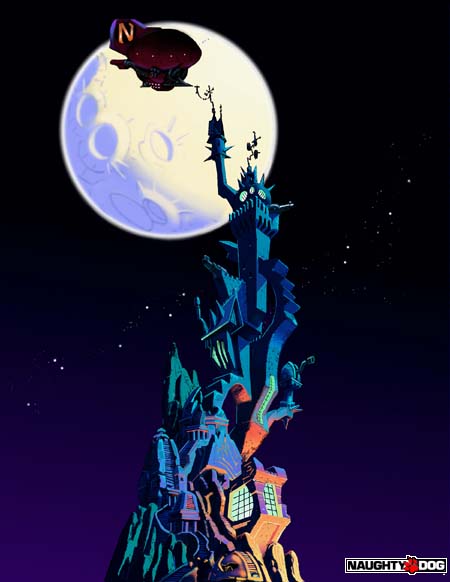
Joe did the same for the backgrounds, but as landscapes have more lines, on a slightly longer time scale. Given that “Willie” was Tasmanian we set him on a mysterious island where every possible kind of environment lurked. Evil geniuses like Dr. Cortex require island strongholds. So we had lots of environments to design. Jungles, power stations, creepy castles, evil natives, sunset temples, spooky caves, etc. At some point early on we hit on the “tiki” idea and thus: goofy Easter Island tikis everywhere.


Jason’s comments:

When we started designing Crash, or Willie as he was first known internally, we decided that there need be no connection between the real animal and the final design — hey, all mammals, uh marsupials.  A Wombat looks nothing like Crash.  He is closer to a Bandicoot, maybe, but that was pure luck.  Instead the design of the character was determined 51% by technical and visual necessity and 49% by inspiration.

A (very) partial list of the Necessities:

Why is Crash Orange?  Not because we liked it, but because it made the most sense.  First I created a list of popular characters and their colors.  Next I made a list of earthly background possibilities (forest, desert, beach, etc.) and then we strictly outlawed colors that didn’t look good on the screen.  Red, for example, tends to bleed horribly on old televisions.  At the time, everyone had old televisions, even if they were new!  Crash was orange because that was available.  There are no lava levels, a staple in character action games, because Crash is orange.  We made one in Demo, and that ended the lava debate.  It was not terribly dissimilar to trying to watch a black dog run in the yard on a moonless night.

Why is Crash’s face so large?  Because the resolution of the screen was so low.  Some people think we were inspired by the Tasmanian devilPerhaps, but it was the necessity of having features large enough to be discernable that caused us to push for the neckless look.  The move made it a little harder to turn his head, and created a very unique way of moving, but it let you see Crash’s facial expressions.  And that was to be very important.

Why does Crash have gloves, spots on his back, and a light colored chest?  Resolution, bad lighting models, and low polygon counts.  Those small additions let you quickly determine what part and rotation of Crash you were looking at based on color.  If you saw spots, it was his back.  Yellowish orange was the front.  As the hands and arms crossed the body during a run the orange tended to blend into muck.  But your eyes tracked the black gloves as they crossed Crash’s body and your mind filled in the rest.

We were wrestling with these design constraints the entire process.  Joe and Charles, with all their talent, were free to do anything that they could imagine on paper.  But Bob and I were the artists that eventually had to ground that back in the reality of calculator strapped to a TV that was the PlayStation 1.

Charles would hand us a sketch and we would start the math:  240 pixel high screen, character 1/6 to 1/4 of the screen height, character 40 to 60 pixels high, proposed hat 1/8 of height of Character, hat 5 to 6 pixels high, hat has stripes.  Striped hat won’t work because the stripes will be less than 1 pixel high.

Take the image Andy posted titled “A Crash that Wasn’t.”  I can tell you immediately that the tail and any kind of flappy strap was immediately shot down because it would have flickered on and off as the PlayStation failed to have pixels to show it.  And that little bit of ankle showing beneath the long pants would have been an annoying orange flicker every few frames around the bottom of his pants and shoes.  Shorter pants would have to prevail.  Crash did end up with a belly button, but it would be about 2x as big.
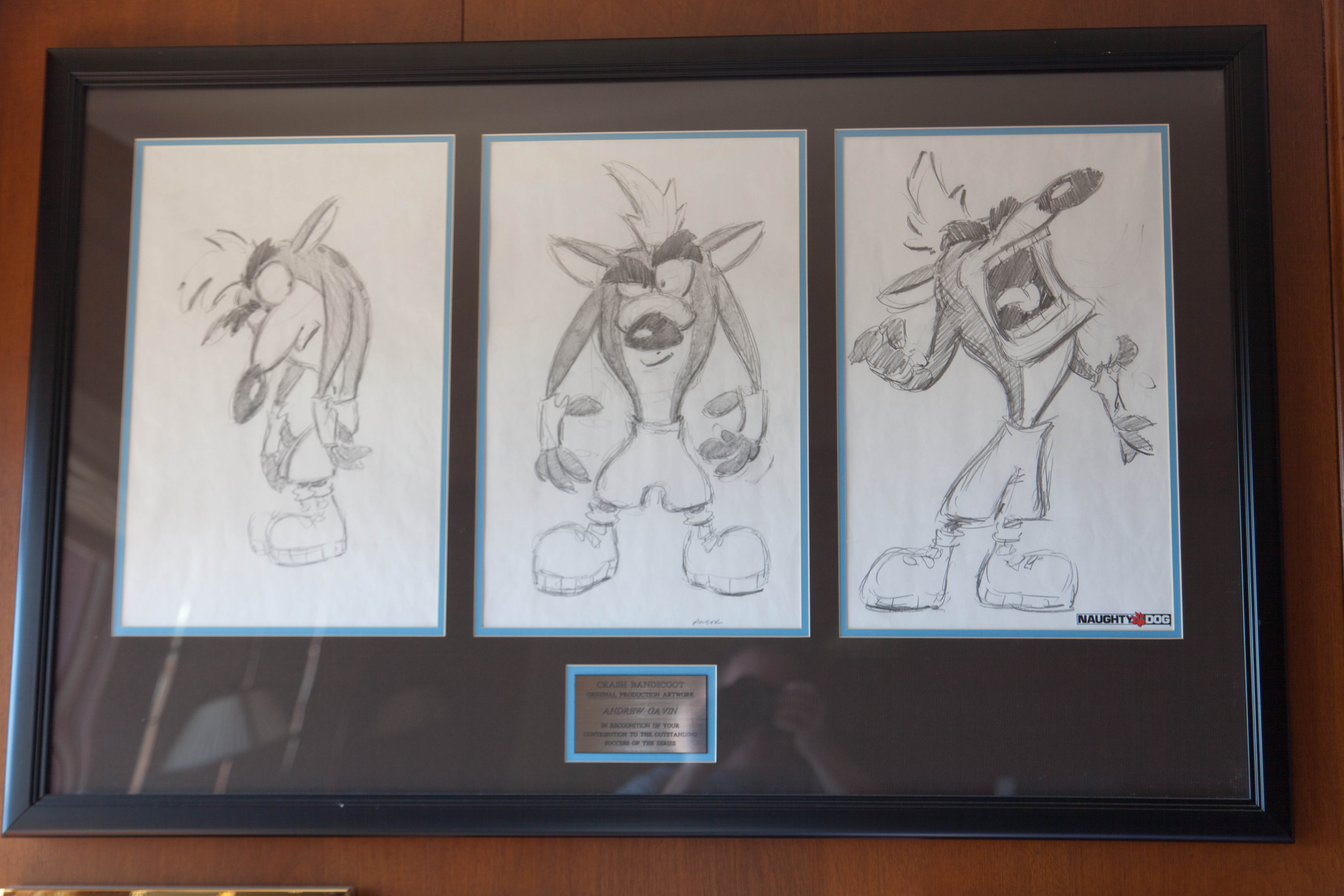
The first sketches of Crash as we know him

Charles would look at us like we were speaking SwahiliBut then he’d go off and draw something totally cool and all would be well.

Cortex had few of these issues.  We could make him totally improbable, un-animatable, and just keep him bigger on the screen.   He didn’t show up too often anyway.  He could never really walk with those short legs.  He had to do a weird thrusting tra-la-la dance.  But he looked cool so we just kept him stationary most of the time.

Cortex was my favorite.  I think Andy preferred Crash.  They fit our differing personalities!  Andy has the original ink Crash sketches and I have the original Cortexes.  Both are a true testament to Charles Zembillas’ skill as a character designer. [ NOTE from Andy: I love both, but I too have a secret fondness for my brainchild — he’s just funnier, and he takes himself way too seriously to ever dress in drag. ]


CONTINUED HERE WITH PART 3 HERE or

if you liked this, vote it up at Reddit or  HERE at Hacker News, and peek at my novel in progress: The Darkening Dream

or more on GAMESBOOKS/MOVIES/TVWRITING or FOOD

Caves, concept

Castle Cortex

Making Crash Bandicoot – part 1

Crash Bandicoot cover

In the summer of 1994 Naughty Dog, Inc. was still a two-man company, myself and my longtime partner Jason Rubin. Over the preceding eight years, we had published six games as a lean and mean duo, but the time had come to expand.

In 1993 and 1994 we invested our own money to develop the 3D0 fighting game, Way of the Warrior. In the summer of 1994 we finished it and sold the rights to Universal Studios. At the same time we agreed to a “housekeeping” deal with Universal, which meant moving to LA, and for me bailing out on my M.I.T. PhD halfway. It certainly didn’t turn out to be a bad decision.

Jason and I had been debating our next game for months, but the three-day drive from Boston to LA provided ample opportunity. Having studied arcade games intensely (yeah, in 1994 they were still relevant) we couldn’t help but notice that 2 or 3 of the leading genres had really begun making the transition into full 3D rendering.

Racing had, with Ridge Racer and Virtua Racing. Fighting, with Virtua Fighter. And gun games, with Virtua Cop. Racing was clearly 100% the better in 3D, and while Virtua Fighter wasn’t as playable as Street Fighter, the writing was on the wall.

Sensing opportunity, we turned to our own favorite genre, the character platform action game (CAG for short). In the 80s and early 90s the best sellers on home systems were dominated by CAGs and their cousins (like “walk to the right and punch” or “walk to the right and shoot”). Top examples were Mario, Sonic, and our personal recent favorite, Donkey Kong Country.

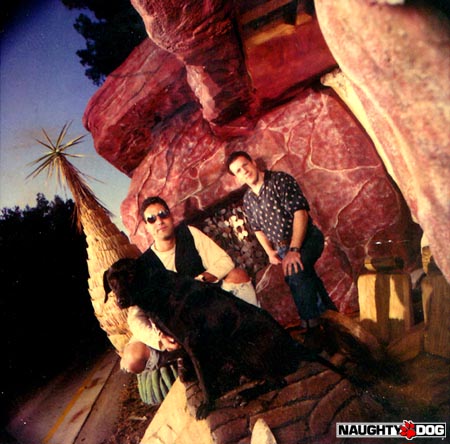
So on the second day of the drive, passing Chicago and traveling through America’s long flat heartland, fed on McDonalds, and accompanied by a gassy Labrador/Ridgeback mix (also fed on McDonalds), the idea came to us.

We called it the “Sonic’s Ass” game. And it was born from the question: what would a 3D CAG be like? Well, we thought, you’d spend a lot of time looking at “Sonic’s Ass.” Aside from the difficulties of identifying with a character only viewed in posterior, it seemed cool. But we worried about the camera, dizziness, and the player’s ability to judge depth – more on that later.

Jason, Andy & Morgan on arriving at Universal

Before leaving Boston we’d hired our first employee (who didn’t start full time until January 1995), a brilliant programmer and M.I.T. buddy of mine named Dave Baggett. We were also excited to work closely with Universal VP Mark Cerny, who had made the original Marble Madness and Sonic 2. In California, in 1994, this foursome of me, Jason, Dave, and Mark were the main creative contributors to the game that would become Crash Bandicoot.

We all agreed that the “Sonic’s Ass,” game was an awesome idea. As far as we knew, no one had even begun work on bringing the best-selling-but-notoriously-difficult CAG to 3D. Shigeru Miyamoto, the creator of Mario, was said to be working on Yoshi’s Island, his massive ode to 2D action.

But an important initial question was “which system?”

The 3D0 was DOA, but we also got our hands on specs for the upcoming Sega Saturn, the Sega 32X, and the mysterious Sony Playstation. The decision really didn’t take very long.  3D0, poor 3D power, and no sales. 32X, unholy Frankenstein’s monster – and no sales. Saturn, also a crazy hybrid design, and really clunky dev units. Then there was the Sony. Their track record in video games was null, but it was a sexy company and a sexy machine – by far the best of the lot. I won’t even bring up the Jaguar.

So we signed the mega-harsh Sony “developer agreement” (pretty much the only non-publisher to ever do so) and forked out like $35,000 for a dev unit.  Gulp.  But the real thing that cinched the deal in Sony’s favor though wasn’t the machine, but…

Before we continue to part 2 below, my parter and friend Jason Rubin offers the following thoughts on this section:

Andy and I always liked trying to find opportunities that others had missed.  Fill holes in a sense.  We had done Way of the Warrior in large part because the most popular games of the time were fighting games and the new 3DO system didn’t have a fighting game on it.  Our decision to do a character action game on the PlayStation was not only based on bringing the most popular genre on consoles into the 3D, but also because Sega already had Sonic and Nintendo already had Mario.  Instead of running headlong into either of these creative geniuses backyard, we decided to take our ball to a field with no competition.

Filling a hole had worked to an extent with Way of the Warrior.  The press immediately used Way as a yardstick to make a comparison point against other systems and their fighting games.  This gave it a presence that the game itself might never have had.  And as a result, ardent fans of the system would leap to defend the title even when perfectly fair points were made against it.  The diagonal moves were hard to pull off because the joypad on the 3DO sucked?  No problem, said the fans, Way of the Warrior plays fantastically if you just loosen the screws on the back of the joypad.

Why couldn’t the same effect work with a character action game on PlayStation?

And remember, at the time these games were the top of the pile.  It is hard to look at the video game shelves today and think that only 15 years ago childish characters dominated it.  There were first person shooters on the PC, of course, but sales of even the biggest of them couldn’t compare to Mario and Sonic.  Even second tier character games often outsold big “adult” games.

It’s also easy to forget how many possible alternatives there were along the way.  Most of Nebraska was filled with talk of a game called “Alosaurus and Dinestein” which was to be back to the future like plot with dinosaurs in a 2d side scrolling character action game.  I still like the name.

The “Sonic’s ass” nomenclature was more than a casual reference to the blue mascot turned 90 degrees into the screen.  It defined the key problem in moving a 2d game into the third dimension:  You would always be looking at the characters ass.  This might play well (it had never been tried) but it certainly would not be the best way to present a character.

Our solution, which evolved over the next 2 years, was multi-fold.  First, the character would start the game facing the screen (more on this later).  Second there would be 2d levels that guaranteed quality of gameplay and a chance to see the character in a familiar pose allowing comparison against old 2d games.  And third, we would attempt the reverse of a Sonic ass level – the run INTO the screen – which became the legendary boulder levels. [ NOTE from Andy, more on that in part 4 ]

It may have been this very Sonic’s ass problem that caused Naka-san to “cop out” of making a true 3D game called Nights for Saturn.  I also believe, but have no proof, that he felt so unsure of the move to 3D that Sega didn’t want to risk Sonic on that first experimental title.  Instead they created a new character.  This lost Sega the goodwill that Sonic would have brought to the three way game comparison that eventually ensued.  That ended up working to our favor.

Of course Miyamoto-san did not have this problem.  He created a truly new type of character action game with Mario 64.  The controls and open world allowed you to see the character from all sides.  Eventually this proved to be the future of 3d Character games.  But at the time it had disadvantages.  More on that later.

The concept of making a mascot game for the PlayStation was easy.  The odds of succeeding were next to nil.  Remember, we were two 24 year olds whose biggest title to date had not reached 100,000 units sold!  But if there was something we never lacked it was confidence.

NEXT PART [1, 2, 3, 4, 5, 6, 7, 8, 9, 10, 11] PART 11 is brand new 08/13/11.

The index of all Crash posts is here.

And peek at my novel in progress: The Darkening Dream

or more on GAMESBOOKS/MOVIES/TVWRITING or FOOD

The Crash Bandicoot in-game model. His only texture was the spots on his back, but every vertex was lovingly placed by Jason

On Writing: Passes and Plots

This afternoon I finished the rough cut of my 7th major draft of my novel, The Darkening Dream. In my process, a rough cut is a draft (in this case v4.55 — yes you can tell I’m also a computer programmer) where I’ve done all the major changes I intend, but I haven’t yet gone through and reread the whole book (again, for the 40th or so time) to fix up little inconsistencies I missed and to tweak and improve the prose specifically. Part if this is that different read and edit passes have different paces, and it’s not a great idea to mix them.

In a rough cut pass one is struggling to perform large scale surgery. To cut out big sections and sew them back together. To remove characters, objects, or character the motivations, purposes, or settings of things. I like to move fairly fast during this phase because I have to keep in my head all the little loose ends that need to be tied up (I try to write them in my change plan — a kind of chapter-wise outline of changes — which I follow as I redraft). Plus, during a big rough cut the novel is also “broken”. To me this is analogous to the period when a program can’t be compiled or crashes in some heinous way. So, I don’t really want to stop too long and noodle over a sentence. I don’t like either my novels or my programs broken. It was S.O.P. during Crash Bandicoot and Jax and Daxter to build a test disk every night that testers would play the next day. If your build was broken, this couldn’t happen and other people couldn’t work. Same with the book, I like to be able to give it to a beta reader if necessary. You can’t if it’s broken.

On a read-as-a-reader pass one drops the thing on the iPad (these days) and then read it from start to finish, jotting quick notes or highlighting problems. If you stop to fix them for too long, then you loose the feel of the book as it was intended to be read. This, by the way, is why if you want to really enjoy a book, you should read at least a few pages each day. If you take a two-week hiatus (or more), you lose too much continuity.

And finally, there is polish. In this kind of pass you line edit, or change on the fly. Improving sentences, polishing phrases, fixing errors, trimming fat, whatever. It’s possible while doing this to easily trim 5-15% out of a scene without actually removing any real content. This too has its easy analogy in programming: optimization, particularly of memory or code size (no longer very relevant). In this kind of pass you just work at the low level, and so you can move slowly.

So that was passes. Now onto plots and subplots.

In my previous major draft (v4.43 — don’t ask) my editors pointed out something huge that I was subliminally aware of as a problem, but hadn’t pinpointed the exact cause. I had two major subplots going in my book. One was the main plot, and the other was the villain‘s secondary agenda. I used to have three, but that was in versions before 4.xx.

To explain this, in v4.43 and before: There were the heros and the villains. The villains had this super bad plan going, and they had multiple sub goals serving this plan. The two main villains (meaning the ones who have points of view in my story, not the boss villains) had this separate — albiet bad — agenda to get something from a vaguely good third party. The heros were both the target some of the other offscreen villains and collateral damage of the pov villains. Now this was done originally to show that the villains were so badass that even distracted they were crazy nasty. The heros had as their agenda stopping the villains and saving themselves (nothing really wrong with that), however, they were never really able to understand the actions of the villains because of the mysterious secondary objective.

By making the seemingly simple change of merging the secondary objective and with something the heros had this entire situation was changed and improved. Now, the villains want something the heros have, and although they do much the same things they did against the third party + the collateral part, they do it all to the heros (and a little to each other, because they’re evil!). By way of analogy, before the heros and villains were on adjacent train tracks lobbing bombs at each other and trying to cut each other off at the pass, now they’re on a head-on collision course firing full time at the other. This got rid of the third parties which no one cared about, and had the net effect of creating literally dozens of additional opportunities for conflict and 5 or so new big head to head confrontations — and this is in a book filled to the brim with fights. Conflict is a novelist’s bread and butter, so this is win-win.

It’s also worth saying that to improve any work. Be it video game, novel, or whatever. When you get well articulated suggestions you have to be willing to try and view their merits objectively. This is with the end of judging if the end result would be better in an absolute sense. Of course, sometimes even if it is, the bang for the buck isn’t there, or there are tradeoffs. The changing itself, however, is part of the process.
FOR MY PREVIOUS POST ON WRITING, CLICK HERE

TV Review: Buffy the Vampire Slayer – part 1

Title: Buffy the Vampire Slayer

Creator: Joss Whedon

Genre: Comedic Teen Contemporary Fantasy

Watched: Winter 2004-05, Summer 2009, Winter 2010-11

Summary: Best TV show of all time.


As a diehard vampire fan I saw the movie version of Buffy when it came out. I hated it so much I used to mock it as my pre Twilight example of lame vampires. I have this requirement that vampires need to be menacing, even if comic (Fright Night) or romantic (Interview with the Vampire). The Buffy movie undead were just flaccid.

When the TV show debuted, I was in the midst of the busiest year of my life, the year of Crash Bandicoot 2, when I was in the office every single day (7 days a week) between New Years and September 8th. Besides, the movie had been dumb. So the show even became a punching bag of mine (although I hadn’t seen it at the time) used to illustrate Hollywood’s creative drought: Hey, they’d made a show based on a terrible movie that hadn’t even made much money.

Oh, how wrong I was.

Finally, in November of 2004, after having “retired” from Naughty Dog, my wife having insisted for years that the show was good, I succumbed and ordered the first season on DVD. Thus began an obsessive binge where I watched all seven seasons, plus five of Angel, back to back over the next three months. Generally I consumed three or more a day, including watching 18 episodes of season 3 in one continuous sitting (home Sunday with a cold). My only breaks were the week back east for Thanksgiving and three weeks we spent in Sicily (yum!). Four and a half years later I re-watched all seven Buffy seasons during the summer of 2009. It was almost as good the second time, and I appreciated it more.

Despite a significant cheese factor, and a first season that suffers from being overly episodic, the show is absolutely brilliant. If you aren’t a fan you probably think, “Buffy has these weird obsessive fans, but that kind of thing isn’t for me.”

It is.

I’ve never met anyone who’s sat down and started watching from the beginning who doesn’t absolutely love the show. But that’s just it, you have to start from the beginning. Fundamentally the show blends fantastic writing, really funny dialog, off-beat but likable characters, zany and intricate mythology, a creativity with the TV medium, and quirky humor with a kind of hidden dark realism found in only the best dramas. By disguising drama with humor and the supernatural the writers are able to get at real human issues without freaking out the network, and because they’ve created characters we care about, it all works.

The casting too is inspired. Sarah Michelle Gellar is perfect as Buffy. She may be cute, blonde, and perky, but she isn’t a typical airhead. She combines practical cleverness, toughness, and hidden vulnerability, with a strong sense of duty. Fundamentally the show is about the weight that rests on her narrow shoulders, and what it takes to bear it. The rest of the core team is great too. Alyson Hannigan‘s Willow is every geek’s fantasy, the shy computer nerd who learns to kick ass, Nicholas Brendon‘s Xander provides the token maleness with more humor than testosterone, and Anthony Stewart Head‘s Giles is pitch perfect as the stuffy older advisor with a dark past.

But it’s not just the premise that makes this show rock, but what the writers do with it. I’ll explain when I CONTINUE IN PART 2…

The whole post series [1, 2, 34, 5, 6]