Movie Review: Centurion

Title: Centurion

Director/Stars: Michael Fassbender (Actor), Dominic West (Actor), Neil Marshall (Director)

Genre: Period Action

Read: Nov 3, 2010

Summary: Surprisingly kick-ass.

I’d completely missed this movie in the theaters, but that’s no wonder because it only played on 19 screens across the country. I hadn’t even heard of it, but I noticed a review while browsing my favorite movie reviewer’s site. Reviews were mixed, but it’s set in 117AD, and as a Roman History buff I had no choice but to order.

Wow. It kinda kicked ass.

This isn’t a film for everyone, certainly not for most women. Like the original Predator, it’s a guy’s film. Set in Northern Britain, this is the story of a bunch of Roman soliders on the run from a group of Pictish warriors (old old school Scotts) who want nothing better than to hack off their heads and carry them back to their village. Now, you actually can’t totally blame the picts, they have their reasons. For the most part, this movie is actually fairly authentic. I mean this in a loose sort of way. It’s not based on any real historical events. The action is pretty crazy, but still, compared to some (cough cough, King Arthur), it makes perfect sense.

The movie is basically one long chase scene, and it just works. The landscapes are gorgeous, and the fight scenes have an intensity that’s often missing in today’s over edited films. Things are a bit grisly, but the camera cuts away quickly. You could freeze frame to see some nice brain splatters and battlefield amputations if you were so inclined. There’s a bit of a problem with the fact that many of the actors look very similar in their military uniforms with helmets or short cropped hair — but that’s why the army has uniforms etc. The actors do a good job given the largely physical demands of the roles. The dialog didn’t make me cringe except for a couple lines right in the intro. The whole thing has a nicely stylized feel without being all 300/Spartacus (the second of these, however, is a serious guilty pleasure). It’s much more realistic than either.

So if you like mano-a-mano sword and survival fighting, give it a watch.

If you don’t care about historic nitpicks, you can stop reading, but because I’m a huge Roman buff I’ll mention the anachronisms that bugged me, although none of them really detracted from the film. There are two female Pictish warriors. They kick ass, and I didn’t mind, but I’d wager my life on the fact that 1900 years ago Scottish society — like Roman — was, shall we say, a tad too sexist to allow women to formally fight. I’m all for the recent trend of sexy girl action stars, my own novel has a slightly anachronistic tough female protagonist, but we should realize it just wasn’t the case historically. The Picts also ambush and slaughter  a roman legion using the old “rolling balls of fire” trick, slaughtering all but about 10 men. I’m not sure that balls of fire had been invented, or that they ever were terribly effective in the field. In this period, leadership, numbers, discipline, armament, and positioning usually determined the outcome (almost always in the Roman favor). There are only a few cases of bald-faced defeats of the Imperial army, and none that bad in Britain, but I guess it isn’t that different than their defeat at Teutoberg Forest about a 100 years before the date of this film. Certain bits about the costumes were a little dubious, particularly the boots. What we think of as modern boots really weren’t in service in the Roman army at this period, even in cold areas. The armor looked accurate though, they were lucky because movies always love to use the segmented look of the second Century, even if depicting a Republican army. The Pictish outfits looked a bit medieval to me, rather than Iron Age, and the women had shoes (sorry girls, such luxuries were mostly for soldiers and hunters in that kind of borderline neolithic society). Oh, and a few too many Picts seemed to speak Latin — I have to wonder how common that was. But all and all it felt fairly second century.
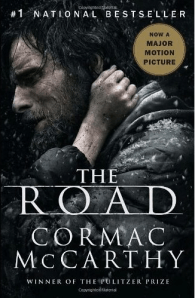
Book and Movie Review: The Road

The RoadTitle: The Road (movie)

Author: Cormac McCarthy

Genre: Literary Sci-Fi Horror

Read: Oct 29-30, 2010

Summary: Evocative.

_

At the suggestion of my friend Peter (in comments on my review of The Passage) I picked up The Road. I’d seen the movie a couple months ago. This novel is a relative oddity, being both literary and Sci-Fi post apocalyptic.

The prose: We have to speak first about the prose. At first, as with other McCarthy books, I found it jaring. He writes long sentences without much punctuation. He uses nouns and adjectives as verbs (like Shakespeare). For example, “The man glassed the horizon” (meaning he looked with binoculars) or “The white fog paled the trees.” These long sentences are interrupted with short burps in counterpoint. The dialog, what littler there is, has no quotations (remember he doesn’t like punctuation), and precious few tags. There’re no chapters, but scene breaks occur with startling rapidity. Many scenes are just description, slashes of images. McCarthy employs vocabulary the likes of “vermiculate,” (covered in worm like lines) or verbs like “hove” (past tense of heave). I found myself needing to use the kindle app’s built in dictionary feature. Still, after 15-20 pages I stopped noticing — well I didn’t stop entirely, but it grew comfortable. This very specific and personal voice is wonderfully evocative. Haunting, and spare, but with elegant and precise use of words and word parings does a good job of sketching the bleak setting. I’m not sure how the casual reader would react, but I certainly appreciate his skill with words. No awkward Stephenie Meyer style constructions here.

The book: Not a whole lot happens in the book. Basically “The man” and “the boy” wander through this post post apocalyptic landscape where nothing but an occasional hostile person moves. The world has burned and been all used up. There is no hope, absolutely none. Not a plant or animal lives. It’s just a matter of delaying the inevitable — perhaps avoiding being eaten by cannibals along the way. This bleakness is well conveyed. Still, I had issues with the overall setup. What the hell would kill EVERYTHING but humans? Every plant, bug, animal, but just leave the people? I don’t know, but we have the same biology as the other animals. I could see everything getting obliterated, or LOTS, but not every single thing but people. That being said, if that did happen, and you waited until really few were left, it might be this bleak. But I’d think that basic items like shoes would be easier to find. With 5 billion less people to wear them, they should be in decent supply. Overall I found it very evocative, and depressing, but there are only two characters, and the dialog felt staccato and stilted. Hard to follow, and not much reason to do so. I’m a plot and character reader first and formost, so I had mixed opinions. I enjoyed reading it, I liked the deft literary sketch work, and the book is the right length (short), but I can’t say that I absolutely loved it.

The movie: I did like the book better than the movie. I’m a Viggo fan (who couldn’t be after Lord of the Rings and Eastern Promises). The boy was very good too (he also stars in Let Me In, and does a great job there too). The film is surprisingly faithful. A few little adjusts, but the only big thing they changed was adding the flashbacks with the man’s wife. There’s one brief one in the book, but it’s more developed in the film. They didn’t need this. The film captures the bleak qualities, but without the energetic prose it’s just grim on grim. I found watching to be almost punishing. The unrelenting hopelessness, the fear of being eaten. It was much scarier than the book, but also harder to stomach. It’s certainly not a fun watch, although very well made.

Book and Movie Review: Twilight

TwilightTitle: Twilight

Author: Stephenie Meyer

Genre: YA Romantic Supernatural

Read: January 2008 and Oct 2010

Summary: Confused.

_

Since I’m such a vampire fan, having seen or read vast untold volumes of the stuff, I thought I should put my formal two-cents in on the strange source material that spawned the Twilight phenomenon.

First the book. I read it before the movie came out. There was a lot of buzz about it already, and I was excited about it. Generally, things that are really popular have a kernel of quality about them, and I love vampires and teen heroines. Buffy the Vampire Slayer is my favorite TV series of all time — I will blog about it one of these days. So I started reading Twilight in the Vegas airport while waiting for a flight. Despite the clunky prose (more on that later) I was actually pretty engaged in a low key way during the first half. Then Edward revealed to Bella that he was a vampire (not that I didn’t know) and the whole thing went to shit. I had to force myself through most of the rest, and the ending left me baffled. “Wait, where’d the fight go?  What about the climax?”

Back to the writing: It’s really clunky. I won’t go into too much detail, this other blogger did. But let me say Meyer is the anti Cormac McCarthy (I’m in the middle of The Road right now). He eschews punctuation, she loves it. Every long improper sentence is peppered with a random assortment of commas and em-dashes. She adores the em-dash, using it in approximately 50% of sentences, and usually not for its proper purpose of offsetting a parenthetical. Maybe she felt she had too many commas (she does), and needed to replace some of them with em-dashes for the hell of it. Oh, and she loves certain words or word combinations, like “cold fingers” and uses them several times a page in places. And she clearly choses random synonyms from the thesaurus without being aware of the connotations of said words. For example: “His expression shifted instantly to chagrin.” Can the word be used that way? I don’t think so. But none of this really matters when reading the book, you adjust and just role with it. I guess if you’re 14 and haven’t read a lot you don’t notice to begin with.

The plot and content: Given what actually happens in the first book, it’s pretty long: 118,000 words. Not much really does happen. We have a LOT of words devoted again and again to how pretty Edward is and how much Bella loves him. This isn’t really SHOWN too much, or justified, but she sure TELLS us about it a lot. But again, the first half was okay. However, once the reveal came in, it gets really silly. Basically they go play this ridiculous baseball game and the Black Eyed Peas (oops, I mean the evil vampires) walk onto the field, sniff Bella, and decide the most important thing in the world is to sink their fangs into her blood. There is no real attempt to sell anything in this plot, to provide any believable reasons, it just happens. You couldn’t possibly have more one dimensional villains — although they do compliment the one dimensional heros nicely. Then my all time biggest gripe, we close in on the unbelievable “final” confrontation of the book and Bella gets knocked unconscious (she is after all the narrator) and we miss the whole thing. It’s told to us by Edward after we know it came out okay so as to minimize tension. I had the feeling that the author didn’t know how to write an action scene, so she just chickened out.

The vampires: Oh my. It’s totally clear (particularly in later books) that Meyer doesn’t do research. This includes even watching a few vampire films or perhaps reading Dracula. Her undead aren’t really vampires, or even undead, except for being immortal and having a taste for blood, and “cold fingers.” They don’t seem dead, or particularly evil. They sparkle in the sun, they apparently have like, oh my God, no real weaknesses. And they’re all really pretty. We hear about that a lot. Let’s not forget their smorgasbord of cool psychic powers like seeing the future, and reading minds. These make hack plot construction really convenient. I actually started my novel a year before even hearing of Twilight, but reading it certainly motivated me to make sure my vampire heavy was a really bad-ass undead in a nasty evil way. He doesn’t sparkle in the sunlight but he will leave your entrails hanging from a tree to make a point — and he certainly wouldn’t ever concern himself to learn current High School vernacular.

Publishing mystery: Twilight had a very aberrant publishing history. As a first time novelist it was picked up by Jodi Reamer of Writers House really quickly. This is a very prestigious agency and that’s very rare. It was then sold quickly to a great publisher for a really huge advance. That Reamer showed interest in it is not what surprises me. There is a mysterious something about the first half of the book — it had potential. But what surprises me is that it was never edited — or if it was I’ve never heard of an editor that lax. The standard length for YA books is more like 50-70k, and there is a LOT of fluff in the book, not to mention the bad grammar and the flaccid ending that would be easy to fix. Having been through rounds and rounds of revision myself, the book was held to none of the standards my editors have exhibited. Of course it turned out to be a great decision for Jodi, but I still don’t understand why it was never edited.

The movie: Catherine Hardwicke directed the first movie. She actually did a really good job with the source material, and I think the movie is actually better than the book. Not exactly great, but better. The casting was excellent, particularly Kristen Stewart who does have a soft charisma, and she’s hot in a non obvious way. If you see her in some of her other films like Adventureland or Speak you realize that she’s actually a very fine young actress in certain roles. Twilight doesn’t provide a lot of room for subtle acting. I myself had casually known Hardwicke from when she did production design for Insomniac’s Disruptor in the mid 90’s (Insomniac was located next to my company Naughty Dog in those days). So I’d noticed when she started directing with Thirteen, which is a depressing but brilliant movie — particularly given what must have been a VERY low budget. Hardwicke brought the same kind of hand-held-documentary style to Twilight, and it worked well to offset the inherent cheese factor of the material. Not totally offset, but the result was somehow watchable. She did a nice job capturing Bella’s POV. This is tricky because in a novel, particularly a first person one like Twilight, so much of the book is dominated by the voice. With a combination of diary style voice over (more-or-less quoted from the book) and a peeping-over-the-shoulder viewpoint (as also used in Thirteen) Hardwicke pulls it off. For some reason, they ditched her with regard to directing the sequels, and the those devolve into further cheesiness. Of course so do the later novels. Can I just say Volturi?

Conclusion: I’m kinda baffled. Twilight isn’t particularly good, or well done, but it does have a certain appeal. However, the overall magnitude of success has left me totally confused. Harry Potter is ludicrously popular, but at its core rest three stunningly good initial books. The first book is really well written, the central premise is very novel and sold with incredible style. Even the ridiculously melodramatic Vampire Dairies is more fun than Twilight. I’m just left scratching my head and hoping the anti-vampire backlash isn’t too bad.

Book and Movie Review: Let Me In

Let Me InTitle: Let Me In / Let the Right One In

Author: John Ajvide Lindovist

Genre: Horror

Read: Mid Oct 2010

Summary: Liked it, but had issues with the second half.

_

This is the original novel (translated I believe from Swedish) that forms the basis of the recent movie Let Me In and last years Swedish film Let the Right One In. First I’m going to talk about the book, then I’ll also discuss both movies and a bit about the process of adaption.

The novel has a lot going for it. It’s a relatively new take on vampire feel — and I’ve certainly seen/read an exhaustive amount of vampire films/books. Lindovist loosely sticks to the basic lore tenants (some of which I regard as sacrosanct). No daylight sparkles, feeding on blood, requiring invitation, etc. But his vampire(s) live a more marginal less powerful existence than many. The emotional core of the story is about a human boy who is misunderstood and bullied in school, and how he is therefore ripe for the kind of symbiotic/parasitic relationship that the book’s central vampire needs to survive. This part I like, and the character of the boy is well done, as is the girl vampire and the relationship. For me it kind of depends on the pubescent pre-sexuality of the central couple. But there are some things the book does to work against itself.

It’s too long, and has an extensive subplot involving some neighbors in the apartment complex. I ended up skimming much of this and it hardly mattered. It should have been trimmed to the bone (which the movies did). In the later third the book also goes crazy with this hard to understand devolution of the vampire’s former thrall/Renfield type into some kind of weird brainless half-vampire. This also was cut from the movies for good reason. But most critically, in the later part of the book [ SPOILER ALERT ] the gender of the vampire is thrown into question back making her/him into a castrated boy, and tossing in a horrific undead on undead anal rape scene. I’m all for extreme, but this whole ending left me not only feeling grossed out, but requiring myself to kind of ignore it and try and pretend she was still  a girl to finish the book. I really didn’t see the point and this more than anything mared my overall opinion of the book. I try to like it despite the twist.

So this brings us to the film translations. The process of stripping down a longer work into the compact requirements of a feature film is interesting. You have to find the central story and rip everything else out. This is what the filmmakers did, and in my opinion, almost all for the better. By stripping down the subplots, removing the crazy monster, and most important the gender ambiguity (although there is a hint of it in the Swedish film, but not enough to bother) the story concentrates itself on the central relationship and becomes very effective. Both films are good. The Swedish one is a bit moodier and the vampire is a little more androgynous. In the American adaption, which at times feels like a shot by shot remake, the subplots have been stripped even further and the sexuality notched up just a hair (Chloe is very clearly feminine). The American version also adds a slight tragic-comic quality to the vampire’s old familiar which I liked. Both films are very good, and very similar (besides the language spoken). I really liked this combined take on the story. The only thing I would have borrowed more from the book was a sense of the strange pedophiliac relationship with the old familiar — which although horrible, jives well with the creepy mood of the work.