Some Ideas Never Die

I was back at my parents for the ThanksGavin and I noticed the magazine cover to the right sitting in their powder room. This ceramic dog head, it turns out, is an late 18th or early 19th century British object called a Stirrup Cup. These popular objects were used by aristocratic gentlemen and ladies for the purposes of libations (getting drunk) while hunting. They were ordinarily gifts the host offered during the fox-hunt, on the occasion of the final drink, usually containing port or sherry. Now this in itself is normal enough — considering the British — but for me as a History geek I was stuck by its resemblance to the object on the left.

This little fellow, which is known as a Rhyton, is Greek. Probably Apulian from the look of it, meaning made by Greek colonists in the boot-shaped part of Italy, somewhere roughly in the 4th or 5th century BC. 2200 years before.

So what? But I love this stuff. A Rhyton served the exact same function as the Stirrup Cup. You drank from it while hunting. In the case of the Greeks, undoubtedly wine. The lefthand example is typical Athenian-style glazed terracotta.

But the Greeks didn’t invent this form. It’s much older still, of Persian origin. Here are a trio of Persian horns from three different periods of Ancient Iranian history.

The lion in the upper left is Achaemenid, the Empire of Xerxes and Darius, featured as the villains in the movie 300 (boo hiss), and conquered finally by Alexander the Great. This specific vessel (or one like it) actually makes an appearance in my novel The Darkening Dream, as my 900 year-old vampire al-Nasir owns one. He’s partial to gold. And things owned by kings.

The stag is from Parthia, in North East Iran, and probably a bit later. You can see the more dramatically accentuated horn shape here.

This lovely little bovine is Sassanian, the later empire that existed in Persia during the late Roman period and prior to the Islamic conquest. This is the setting for Aladin by the way — more or less.

This form may be extremely ancient in central Asia, possibly going back for millennium and animal shaped drinking vessels have been found from as early as 5000 BC! Horns were probably in use as drinking vessels in the region since Neolithic times or earlier, and terracotta replicas could easily be 10,000 or 15,000 years old.

But how did it end up in Greece?

The Greco Persian War of course — again the subject of 300. Many of these were captured, and the Greeks took a liking to them. So they minted out all sorts of Hellenized versions, usually in terracotta, as this was the typical material for Grecian drinking vessels.

The resemblance is a bit more than coincidental. Athenian pottery in particular was immensely influential in the entire Hellenistic and then Roman world. These vessels remained in use, modeling all sorts of animal flavors from the 5th century BC until the late Roman period (and possible later), circa 3rd century AD.

By the late Roman period the influence of such things such things were undoubtedly well installed in the mindset of many people as part of hunting and feasting traditions. So therefore we find things like this.

These gold examples, in clear imitation of the Greek forms, were found in a hoard in Bulgaria. I’m too lazy to really research it, but I would suspect they are from the Bulgarian kingdoms of late antiquity. They could be earlier, possibly even Hellenistic.

So what happened to the Rhyton during the long dark period of Europe’s middle years. I tried to find out (casually, using only Google). Drinking horns themselves were in great use, particularly among Celtic and Germanic groups. Some retain animalistic features like.

This is not as obviously derived from the same prototype, but certainly could be. Undoubtedly the functional object, the hunting horn vessel never went away. But by the 18th century, particularly in Britain, the Stirrup Cup appears and with it full and intense revival of the ancient form. Is this due to continuos conservation of the form and idea through the entire Middle Ages? Probably not, but more likely reflects a deliberate harkening back to the classical era. All sorts of neoclassical trends were at work during the 18th century. Stylistically the three great trends of this era were: Neo-classicism, Rococo, and Chinoiserie.

This rabbit and fox are clearly the same idea. Like the Greeks before them, the British, with their own thriving new ceramics business, chose the medium of pottery.

Above is an early 19th century example in the Medeval Revival style that is clearly aping the older chicken legged drinking horn, if not the orginal prototype.

The British template made it across the shores to America in the above example, being particularly Southern. I’m sure these were quite popular with the Gone with the Wind set.

And finally, persists even today, in an over-commercialized red-neck variant.

Food as Art: Ortolan

Restaurant: Ortolan

Location: 8338 W. 3RD STREET, LOS ANGELES, CA 90048 (323) 653-3300

Date: Dec 11, 2010

Cuisine: Modern French


Ortolan, named after the finch the French like to eat, has been around for a few years. It’s always been a very sharp kitchen, but this was my best meal yet. This is the kind of cooking loosely called modern French. Inspired by the French gastronomical tradition, this is right there in the thick of mainstream “fancy food.” Despite the French part of the tradition, there is a light touch here that is very much California — and just plain good. It’s also worth noting that we came in at 6:15 and had a play to attend, and they powered through the prix fix in 70 minutes at our request!

The last bottle of this from my cellar. I might have to find more. Robert Parker gives this amazing Burgundy 95 points. “The exceptional, medium to dark ruby-colored 1999 Chambertin Clos de Beze has boisterous Asian spice and candied cherry aromas. Cookie dough, blackberry syrup, violets, candied cherries, and hints of licorice can be found in this muscular, opulent wine. Its liquid velvet-like personality screams of sur-maturite, yet it is fresh and delineated. It displays a prodigiously long, candied, supple finish. Projected maturity: 2004-2014.”

Tonight’s menu, with a few modifications for the none meat eaters at the table.

They have a Champagne bucket, which is always a sign of a good things to come.

I had noticed on previous visits that Chef Christophe Eme has a thing for test tubes. These Amuses came in two flavors, carrot and celery soups (warm). Yum, they were both great, I particularly liked the celery. I’ve said it before, but creme and veggie soups are usually good.

The several types of bread came with two types of butter, salted and unsalted, as well as this “eggplant caviar and pesto” dip.

Tomato Coulis with Heirloom Tomato and Yogurt Sorbet. I’m not a big tomato fan, but this was amazing. Not only did it look good, but the contents of the glass tasted like a good Gazpacho, albiet creamier with the yogurt and a bit sweeter.

The Halibut on the menu was substituted with this mushroom and quail soup. Again, cream seals the deal. The soup tasted like cream of mushroom (in a good way) and the poultry was succulent.

Cod with tomato, scallions.

Lobster Grape, Pumpkin Gnocchi and Pomegranate. That pasta is actually spaghetti wrapped around the lobster insides. That was pretty cool. The sweetness of the grapes went nicely. A few of the grapes seemed a little dried or something, but it was a great dish.

Short Ribs Polenta with Olives and Tomato Confit. Fatty meat and polenta are a tried and true combo, and this one worked perfectly.

Poached Salmon Peach, Fig, Fennel and Orange Sauce.

Wine number two. I have a lot of Beaucastel. For a reason. This one Parker gives a 96. “Beaucastel has been on a terrific qualitative roll over the last four vintages, and the 2001 Chateauneuf du Pape (which Francois Perrin feels is similar to the 1990, although I don’t see that as of yet) is a 15,000-case blend of 30% Grenache, 30% Mourvedre, 10% Syrah, 10% Counoise, and the balance split among the other permitted varietals of the appellation. This inky/ruby/purple-colored cuvee offers a classic Beaucastel bouquet of new saddle leather, cigar smoke, roasted herbs, black truffles, underbrush, and blackberry as well as cherry fruit. It is a superb, earthy expression of this Mourvedre-dominated cuvee. Full-bodied and powerful, it will undoubtedly close down over the next several years, not to re-emerge for 7-8 years. Anticipated maturity: 2008-2025.”

Apple Tart Ice Cream

Coconut Bar Chocolate 72%, Passion Fruit Emulsion and Coconut Sorbet. This was an amazing desert. I love passionfruit and I love coconut. The pineapple and chocolate didn’t hurt either.

As I mentioned at the beginning. This was an impressive meal (and we pounded through it in no time flat). I’ll be heading back.

Quick Eats: Taverna Tony

Restaurant: Taverna Tony

Location: 23410 Civic Center Way, Malibu, CA 90265, Tel: (310) 317-9667

Date: Dec 10, 2010

Cuisine: Greek


I have a weakness for Greek food. I spent big chunks of the summers of 1990 and 1991 in Greece, and a month in 2005. I know it isn’t always the fanciest (although in 2005 I had a brilliant modern Greek meal on the Island of Rhodos), but I love the flavor palette, particularly lamb and yoghurt. And Tzatziki, which I absolutely can’t get enough of. Here in LA our favorite Greek haunt is Taverna Tony. We haven’t exactly tried a zillion of them either, but Tony’s is fun.

The menu.

The serve one of the typical creamy greek spreads with their bread. This is one of the yogurt, garlic, eggplant, olive oil type ones. A guilty pleasure.

As big a wine snob as I am, I’m also a huge believer in drinking the local beverage. I actually like Greek wine. This one is a mainland wine made by monks, Tsantali Agioritikos. In my opinion the best Greek whites (I don’t really drink Greek reds) are from Santorini. If you want the really authentic flavor, go for Retsina — Tony has it — makes me remember my college summers in Greece, but not to everyone’s taste.

One thing about Tony’s, they have mega sized portions (to use the Greek). My wife always gets the “Vegetarian’s paradise” which is basically every dip and vegetarian appetizer known in Greece. It comes on two plates, the hot and cold. Don’t even think about trying to order an appetizer, or even a salad unless you have a lot of people. A partial list of what’s included is: Hummus, Tzatziki, Melitzanosalata, Tabouli, Spanakopita, Tiropita, Feta Cheese, Horta.

The hot plate of above. Spanakopita etc. You can see the ubiquitous rice and overcooked vegetables (I like them this way at Greek and Turkish places).


This is the “ROAST BABY LAMB KLEFTIKO, Baby Lamb, slow-roasted with Herbs, Garlic, Onions, Oregano – A House Specialty that melts in your mouth.” That pretty much says it all.

In case you couldn’t see the lamb itself well enough, here it is again!  Baah!

I always get a side of “TZATZIKI DIP  Fresh Yoghurt, Cucumber, Fresh Mint, Garlic.” Roast lamb is just not roast lamb unless slathered in Tzatziki.

It’s worth noting that the atmosphere is fun here, and they have very loud live Greek music. There seem to be an endless supply of families throwing some kind of big dinner’s with like 20-30 people at huge long tables laden with food — this also is very Greek. There might be better Greek food in town (if anyone knows please tell me), but I’m perfectly happy with my monthly dose of lamb, yogurt, and Greek wine.


You can see the band in the corner.


A giant table arrayed on the patio.

Food as Art: Chanukah in Style

Some old friends invited us over to their place for a Chanukah party. Now, as many of you may know, the traditional food for this occasion is potato latkes. These are basically shredded potato and onion deep fried. Like any fried thing, if fresh, they can be tasty.

Now bear in mind that I didn’t do any of the excellent cooking depicted below. The hostess of this party has always been an amazing cook, and this was a collaborative effort between many members of her family. I brought the wine.

Four different kinds of latkes were made (details below). This is the batter from the cheesy one. My one cooking contribution was to fold in the whipped egg whites. This is basically blintz filling.

Some frying. Latkes are usually pan fried.

The wine. Given that applesauce and the like are traditional latkes accompaniments, I brought a very fine sweet Riesling. Parker gave the 2008 a 95, but the 2009 hasn’t been reviewed yet by him. But I have some notes: “Sweet mineral and hay notes, with defined notes of fresh cut grass, honeysuckle, and lemon drop, are apparent in the intense perfume of the Wehlener Auslese. The bitter yet sweet flavors of citrus peel and white pepper enrapture the palate, while sweet lychee and melon notes become pronounced on the mid-palate, opening and expanding with the wine’s rich and nearly searing minerality. Yet this is a rich and creamy example of Auslese, its bold concentration and grip becoming more apparent on the back palate. Lingering cherry and apricot flavors are spent savorily on the minute long finish. This wine promises to take its place with the many of its ilk on the high-90s rating panel!”

Then one of my all time favorite wines, The M Chapoutier ‘Ermitage Le Pavillon. It always scores between 95-100. “Year in and year out, one of the three greatest Hermitages made is Chapoutier’s Le Pavillon. The 2001 Ermitage Le Pavillon exhibits a saturated ruby/purple color as well as a big, sweet nose of camphor, ink, creme de cassis, and hints of licorice as well as smoke. Although dense, rich, and full-bodied, the 2001 reveals more acidity in its delineated, nervous personality. Unquestionably great and intense, it will be less charming and precocious than its 2000 sibling. Anticipated maturity: 2010-2030. (I disagree, but Michel Chapoutier feels his finest three Le Pavillons to date have been 1991 followed by 1995 and 2000. I retain a preference for the glorious trilogy of 1989, 1990, and 1991.)”

Classic potato, but made totally from scratch.

On the left are the carrot latkes, and the right sweet potato. Personally, I thought both superior to the classic, but i’m not a huge potato fan. These were both awesome. Some of the sweet potato ones had nuts in them, which i liked.

The cheese latkes, made with the batter shown above. Raisons were mixed in. These were delectable, tasting like blintz filling, with a nice light fully ricotta flavor. Personally, I found them to be a bit reminiscent of a recipe from Apicius where the Romans mixed ricotta, herbs, lightly fried it, and drizzled it in honey.

Top shelf condiments. Two sorts of sour cream, two hand made apple sauces (from two apple types) and strawberry jam. Latkes go well with sweetness, cuts the fat.

A blend of various chilies, in case the above is just too sweet and mild.

This was an amazing salad. It had a bit of everything in it, and was delicious.

Two homemade deserts. The hostess makes the most incredible deserts. On the left is a praline cheesecake, and on the right is a bavarian cream tart.

All that needed an expresso.

Thanksgiving – Pork Insanity

On our third night of ThanksGavin craziness, after Wednesday, and the incomparable thursday, we move into our traditional Friday evening at my cousin Abbe’s. This year Abbe settled on roast pork sandwiches — a meal with deep South Philadelphia roots.

We begin with the pork roasts going into the over, basted in white wine. They came pre spiced from Fiorella’s on Christian Street in the Philly Italian market. They only do pork (specializing in sausage) and have been in biz since the 19th century.

Broccoli Rabe sauteed in garlic.

Roasted long-hots. Serious peppers.

Parker 93 points, “The 2008 Vico made from 100% Mencia with 30% whole clusters and aged for 9 months in seasoned French oak. Opaque purple-colored, it offers up a slightly reticent bouquet of damp earth, mineral, incense, black cherry, and black raspberry. Dense and loaded on the palate, the flavors are already complex and mouth-filling. Impeccably balanced and with a 45-second finish, it has the stuffing to blossom for another 2-3 years but can be approached now. It is a great value.”

A very nice super tuscan.

The 2001 Beaucastel, RP 96! “Beaucastel has been on a terrific qualitative roll over the last four vintages, and the 2001 Chateauneuf du Pape (which Francois Perrin feels is similar to the 1990, although I don’t see that as of yet) is a 15,000-case blend of 30% Grenache, 30% Mourvedre, 10% Syrah, 10% Counoise, and the balance split among the other permitted varietals of the appellation. This inky/ruby/purple-colored cuvee offers a classic Beaucastel bouquet of new saddle leather, cigar smoke, roasted herbs, black truffles, underbrush, and blackberry as well as cherry fruit. It is a superb, earthy expression of this Mourvedre-dominated cuvee. Full-bodied and powerful, it will undoubtedly close down over the next several years, not to re-emerge for 7-8 years. Anticipated maturity: 2008-2025.”

The Merlot was great too, tasting more like a Pomerol than a Cal Merlot.

Chef/Host Abbe chops grilled artichokes (from Claudio’s in the Philly Italian Market).

Our token white, “2009 Dönnhoff Niederhauser Hermannshöhle Riesling Spatlese Even the “off-vintages”, if there are any, for Donnhoff’s most renowned wines get high scores, and are of the finest quality and greatest longevity. Niederhauser Hermannshohle is one of two famous single vineyards which Dönnhoff farms, and the 2009 delivers a wallop, serving up a subtle olfactory treat of blood orange, pear, stone fruit, and talcum powder. In the mouth, incredible concentration comes to fore, as vivid flavors of orange pulp, blueberry, and wild cherry balance racy acidity, luscious mineral notes and a creamy, almost decadent, mouthfeel! A succulent, loaded offering that promises to delight for several years to come…that is, if you can possibly resist drinking it now!”

The heart stopping cheese selection. Camembert, Epposises, quince paste.

More options.

The bread.

And Thursday night’s Tapenade.

The wine keeps on rolling. A 2005 by Raul Perez, spectacular. And the Hall, “The dense purple-colored 2006 Cabernet Sauvignon Diamond Mountain reveals abundant aromas of cassis interwoven with hints of bay leaf, licorice, and underbrush. Moderately high tannins give pause, but the sweetness of the fruit as well as the level of glycerin and concentration bode well assuming the tannins fall away at a reasonable pace.”

Some folk don’t like the other white meat, so panko crusted pan fried flounder was on the menu for them.

The pork roasts emerge!

Cousin Matt invested in a meat slicer just for the occasion.

The pork was intended to be assembled into sandwiches. Here is salad, artichokes, and provolone fresh from Philly’s Italian market.

Chef Abbe presides over the fish, the broccoli rabe, the “juice” and rolls.

A fish sandwich.

My pork sandwich, with the spicy peppers, cheese, artichoke, broccoli rabe, etc. Pork is soaked in the juice (gravy) ala French dip style.

Mom levers her special “Apple Drapple” Cake out of the pan.

Lo and behold, a second pecan pie!

The Apple Drapple, dressed for my son’s second birthday.


ThanksGavin Calendar:

Wednesday night dinner

Thursday night Thanksgiving Feast

Friday night pork roast (this post)

Saturday Deli Brunch

Thanksgiving Proper

Thursday night has finally arrives and with it the serious consumption of traditional Thanksgiving fare. Last night we whet our whistles, CLICK TO SEE, and you’ve seen the echos of the past, but here is the real thing. Blow by blow.

When I arrived my father had already cracked this. The order was wrong but the wine was right. “A profound effort, the 2000 Figeac‘s opaque purple color is accompanied by a terrific bouquet of camphor, graphite, black currants, licorice, and smoked herbs. With well-balanced, powerful tannin, concentration, and pinpoint precision, finesse, and purity, this expressive effort will drink well between 2004-2018.”

A few appetizers. Bear in mind that EVERYTHING is made from scratch. Homemade guacamole (like mine, but not spicy — I make a special shotgun guac with Jalapenos, cyranos, and haberneros).Tapanade with olives, vegetables, garlic and olives. Olives, bread etc.

Flowers from Robertson’s, overpriced but lovely.

The room.

The next two wines. A 2002 Bonnes Mares (yum) and a nice CNDP. “Three separate tastings of this wine left me with the impression that there is a lot more to them than meets the palate. One of the finest estates of the appellation, Clos des Papes tends to produce wines that require 4-5 years of bottle age before they reveal themselves. That may be the case with the 1998, but I am still calling it relatively conservatively, especially when compared with other efforts. The color is very evolved, and not darkly saturated. The bouquet is top-notch, offering attractive cedar, dried herb, black cherry and raspberry scents that are intense yet delicate. Similar flavors emerge on the palate. Medium to full-bodied, with a restrained, elegant style, particularly for this vintage, Clos des Papes’ 1998 tastes as if it emerged from a different year because it was not exhibiting the power, unctuosity, and jamminess possessed by many 1998s. However, there is a lot to the wine, all of which may be revealed with further age.”

My father carries in one of the two turkeys. Multi hour BBQ.

Pounding through the wine. Parker gives this 92, one of my favorite Rhone wineries, “That may explain the open-knit, complex notes of tree bark, black cherries, licorice, seaweed, pepper, and floral notes in the 1998 Beaucastel. The wine is medium to full-bodied, has nice, sweet tannins, and is surprisingly open and approachable. This wine has reached the beginning of its plateau of maturity, where it should last for at least a decade or more. Atypically forward for a wine from Beaucastel, my recollection is that the actual percentage of Grenache, which never exceeds the Mourvedre in their final blend, was much higher in 1998 than in other years.”

The stuffing.

bread.

One of the two cranberry sauces. This is the “relish.”

Mom carves as well as cooks.

Turkey number two. You never know.

Sweet potato.

Brussel spouts, made fresh and not bitter in the least. My cousin-in-law made this one.

The gravy.

Roasted beets.

The turkey plate.

Corn soufflé. One of the few things not made by my mother and aunt.

Chugging through more wine. The 1994 Lagrande: “In comparison to the more open-knit, flattering style of the 1993, the 1994 is a backward, less precocious, more tannic wine that needs another 5-7 years of cellaring. It is a wine that recalls the style of the more tannic vintages of the sixties and seventies. The healthy dark ruby/purple color is followed by copious quantities of smoky, toasty, new oak. There is an impression of ripe fruit, but, for now, the wine’s personality remains dominated by excruciatingly strong tannin. Give this wine 5-6 years of cellaring, as patience is definitely a requirement for purchasing the 1994 Lagrange. It should last for 15-20 years.”

Also a Shiraz from my dad’s cellars. We had some cork issues but it came out okay.

Salad, because you need something to wash it down.

The second cranberry, the jelly (homemade of course).

The full spread.

And the official 2010 plate!

Mom presents the pecan pie.

Snickerdoodles made fresh by cousin Abbe, Grandmom D’s brownies and blondies made by cousin Matt.

The chocolatt cake and whipped cream.

The world’s best pecan pie!

This lovely PX returns from last night for yet another round. Motor oil soaked in sugar!

My dessert plate.

Full. Full. Full!

And last but not least: the Chefs!  My mother on the right, my aunt on the left.


ThanksGavin Calendar:

Wednesday night dinner

Thursday night Thanksgiving Feast

Friday night pork roast

Saturday Deli Brunch


Thanksgiving – The Prequel

Restaurant: Umbria

Location: 7131 Germantown Ave. Philadelphia. 215-242-6470

Date: Nov 24, 2010

Cuisine: Modern American


Our traditional family feast, which we could dub the Thanksgavin, begins with the Wednesday night forefeast (to borrow a term from the Greek orthodox). In 2010 it was at an American place in Germantown outside of Philadelphia, called Umbria. Curiously the name might lead one to believe it was an Italian restaurant, but no.  regardless, it was very good. There were 14 of us.

Yesterday I blogged a bit about our PAST THANKSGIVINGS, and tomorrow I will cover the main event itself.

We really don’t mess around with the wines at these dinners. For the white lovers we had a brand new “2009 J.J. Prum Riesling Wehlener Sonnenuhr SpatleseFrom the sultry bouquet which exudes saline minerality, bounded by a medley of baked pear, raspberry, and lime skins…to the sweet, succulent attack of white fig, lemon and lime skins, and orange cream…to the mid-palate laden with pepper and dark blueberry and candied Meyer lemon flavors…I think that you can get the picture. Namely, this rich, vibrant wine is one of the most complex I have had the pleasure of tasting in 2010! Lithe minerality is present on the back palate and rich lemon ice notes reverberate on the 75+…yes, more than 75 second…finish. Pure ecstasy in a bottle? Quite possibly so!”

Next up. Parker gives the Nuits-St.-Georges 93 points, “An assortment of candied cherries explode from the glass of the 2002 Nuits-St.-Georges Les Perrieres. This seductive wine’s character is drenched in black cherry syrup, rocks, and earth. Medium-bodied, it has outstanding depth, concentration, and a long, expressive finish that reveals copious quantities of ripe tannin. Anticipated maturity: 2008-2018.”

Then the 91 point “2004 Brunello di Montalcino is a fresh, vibrant offering bursting with dark cherries, violets, underbrush, minerals and sweet toasted oak on a medium-bodied frame. The wine reveals terrific balance in an energetic, focused style, with firm yet ripe tannins. The finish is long, clean and refreshing. This is a gorgeous effort from Loacker. Anticipated maturity: 2011-2019.”

And then the 94 point, “2005 Shardana is an awesome Carignano endowed with exuberant dark fruit, smoke, licorice, sage, rosemary and tar. This is a fairly big, masculine wine with great intensity, depth and roundness. It needs another year or two in bottle for the tannins to settle down. The Shardana is formidable, though, and a terrific choice for hearty cuisines. Anticipated maturity: 2011-2021.”

The menu tonight.

The room, or at least half of it.

Bread.

“Roasted butternut squash ravioli, sage hazelnut and wild mushrooms.” A fall take on an italian classic.

“Mixed green salad, asagio cheese, balsamic vinaigrette.”

“grilled fennel sausage, sweet and spicy fig sauce.” Wow! Wow! The sausage itself was amazing, and the sauce was basically what you would get at a thai or vietnamese place for fried spring rolls. Wow! The combo was amazing, with the sweet tangy goodness against the rich meaty sausage.

Escargot special.

Special “crab and wild mushroom soup.”

“Filet of salmon, cedar roasted, maple glaze.”

“lump crabmeat, fresh herbs, extra dry vermouth.” This emphasized the crab, without a lot of added fat or butter. It worked.

“Pork loin chop, apple bourbon grilling sauce.”

Grilled swordfish special.

Beef short rib special. The meat was seriously falling from the bone here, with a wonderful smoky flavor.

Hmmm.  Not sure. But it was a white meat or fish 🙂 This might have been the swordfish, and the above the chicken.  Hard to remember.

For the deserts, it was time to bring out the big guns — sweet wise — the motor oil vicous PX. Pure sugar in a bottle. Yum!

Carmel almond sundae. Wow!  This was amazing too.  The nuts toasted into a praline like whatever, and the homemade carmel with a bit of sea salt.

Pound cake with fruit.

Classic “creme carmel.” Good, and I love flan, but not as divine as the sundae.

ThanksGavin Calendar:

Wednesday night dinner

Thursday night Thanksgiving Feast

Friday night pork roast

Saturday Deli Brunch

Satyrs and Maenads, Oh My!

On Friday, Nov 19, 2010 we went to a special event at the Getty Villa.

The Making of a Satyr Play
Villa Education presents a workshop on Sophocles‘ play Trackers, the second most completely preserved script of a satyr play, featured in the exhibition. Michael Hackett, chair of the UCLA theater department, directs UCLA theater students and graduates in this presentation, accompanied by an introduction to satyr plays and a visit to the exhibition lead by curator Mary Louise Hart.

This was a very interesting event. Most of you probably don’t know that there was a third type of Greek Theatre besides comedy and tragedy: The Satyr play. At the theatre festival dedicated to Dionysus (as all theater inherently was — Dionysus being the god to which theater, masks, and acting was sacred) a day consisted of three tragedies and a satyr play all written by the same playwright/poet and performed by the same amateur troop. The satyr play is a kind of tragedy which is somewhat funny (but not a comedy), and which generally involves some mythological theme into which satyrs have been inserted. If you insert satyrs anywhere, things get inheriently funny.

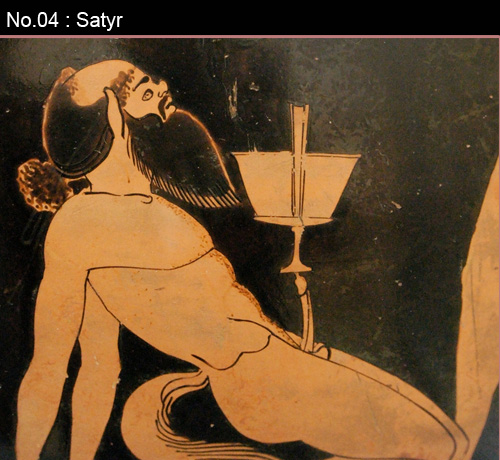
Case in point to the left here. Satyrs are the sacred disciples of Dionysus, and befitting the god of madness, intoxication, and altered states are hybridizations of male nature with beasts, specifically horses. Some might even argue that this is in fact the natural state of men, and doesn’t require a mythical race. In any case, satyrs inherit the tail, ears, and oversized member from their equine parent.

Back to satyr plays. We know little about them, as there are only 1.5 in existence. That’s right, dozens, possibly hundreds were written and performed, but beside a few scraps we only have the text of “Cyclops” by Euripides and half of  Sophocles’ “Trackers,” which was performed at this event. Ancient texts pretty much needed to be copied to survive, and well, monks weren’t that fond of satyrs.

The Trackers is the story of how Hermes steals Apollo’s sacred cows and builds the first Lyre, which eventually he trades to Apollo. So it could be thought of as the origin story of Apollo’s Lyre, which is one of the sun god’s primary attributes. Amusingly, and highly appropriate to satyrs, the tracking of the cattle involves detailed inspection of cow patties. Satyrs love a good shit joke, and this play has a veritable butt-load of them. The translation was brilliant, rendering them in meter and rhyme. It can’t be easy to translate poetic scatological humor from Greek to English.

Anyone who knows me well knows I’m an ancient history “amateur“, and how I’m particularly partial to death and resurrection gods like Dionysus and Osiris. So this was a brilliant and rare opportunity to see/hear some of this stuff in real life. They did some demonstrations of actor chorus interchange in Greek which I found fascinating. Then they paired this with reconstructed dance and limited music. You just don’t get to see/hear this very often. I know intellectually that Greek theatre was all written in meter, but it’s very different to hear it, even for someone who doesn’t (unfortunately) speak Greek. It gave me goosebumps. The UCLA students and professor who did the performance did an amazing job reconstructing the movements of the actors as well. Most of our visual information on Greek society comes from vase painting, and theatre (like drinking) is a favorite subject. To the right you can see an actor dressed as Hercules (left) and as Papa Silenus (right — father of the satyrs). Notice how the Silenus costume is basically a “furry body suit,” very cool. The actor holds the craggy old satyr faced mask up. As I learned yesterday, mask and “in character” are the same word in Greek. I love that, as I love masks and their Dionysian associations. My personal corporation is after all Mascherato, which is just Italian for masquerade. Back to the production. They did a really interesting job translating the postures and poses of satyrs and actors playing satyrs. You can see one of those in the upper right hand corner, recognizable by the fact that he is holding the head, actually a mask, of a satyr, and wearing special hairy “satyr pants.” These pants are the differentiating factor between real satyrs, like the one on the left “playing” with his wine vessel (real) and the upper right one (actor in satyr costume). It’s hard to explain in writing how they managed to copy the depicted mannerisms of satyrs, but they did.

The pairing of this often complicated motion, not so disimilar in some ways from modern dance, with the rhythm of the play’s dialog and the beat of the drum was very intriguing, and entertaining. One can totally see how these were exciting performances, and I think you could make a truly awesome modern ballet version of a satyr play. Perhaps with the satyrs and maenads preparing for the arrival of Dionysus. If I had a time machine I’d produce it, getting Stravinsky to write the music. Awesome! I guess you could do a production of The Rite of Spring with satyrs — as more or less was its intent — but I had in mind music that was somewhat more ancient in composition and instrumentation. The cult of Dionysus is not some happy go lucky party thing, but is essentially bound up with madness, chaos, and ecstatic murder. In other words, it’s pretty badass.


It’s worth mentioning our own little homage to the spirit of Dionysus, representing as it does an essential aspect of human nature. Our 2006 “Empires of the Ancient World Ball.” This was one of a series of black tie costume balls we hosted. This one included not only guests dressed as ancient characters and gods, but ancient music, theatre, and my personal favorite touch: A menu constructed entirely by recipes we selected from Apicius, the greatest of ancient chefs. The amazing Celestino Drago was kind enough to humor us by recreating these selections from an Italian version of the Latin cookbook. I should maybe blog separately about Apicius, but the flavor profiles of Roman cooking were in a lot of ways similar to watching this bit of ancient theatre: an exotic taste of the past. Both remind us that despite the passage of twenty five centuries, humans remain human, and interests, be they arts, food, politics, power, love, wealth or family, all remain at their core, the same.

Food as Art: Hatfield’s part 2

Restaurant: Hatfield’s [1, 2]

Location: 6703 Melrose Ave, Los angeles, Ca 90038. 323-935-2977.

Date: Nov 18, 2010

Cuisine: Modern American


I went back to Hatfield’s with friends to try it again. You can read about our PREVIOUS MEAL HERE.


They had the same Amuse, crab with quinoa and a light curry flavoring. It was okay, but certainly not mind blowing.

At one time I had two cases of the Gros Frere et Soeur 1998 Richebourg. This is my last bottle, and I’m sad to see it go. Not only were there only a couple hundred made, but it was last sighted on the internet for $1,332 a bottle. Oh well. Richebourg is one of my favorite wines, particularly when as balanced as this one. Some find it too subtle. Not I.


The Prix Fixe menu.


The regular menu.


The other half of the regular menu.


“Roasted baby beet and mizuna salad, french feta, falafel, balsamic vinaigrette.”


“Sweet corn soup, poached lobster, jicama, roasted hon shimeji mushrooms.”


I love these French style soups with the “pour in” around the stuff, I don’t know exactly why. I also love corn soups when done right.


“Warm creamy crab buckwheat crepe, pickled beets, marinated radish, fine herbs.” This was very yummy, particularly the guts of the crepe. Oddly, it was reminiscent of a high end version of that crab omelet thing they have a IHOP (haven’t been there in around 20 years — just so you know).

“Steamed skate wing salad, wild greens, fried maitakes, garnet yams, harissa.”

“Warm summer salad, corn agnolotti, cherry tomatoes, zucchini coulis, fava beans.”

“Charred octopus, caramelized fennel, saffron vanilla braised hearts of palm, red wine olive puree.” The fennel tasted like caramelized onions. Overall this was a very sweet (and tasty) dish with a variety of unusual textures.

“Slow cooked beef short rib, blue lake beans, braised radish, horseradish potato puree.”

“Sauteed Loup-de-mer, braised shelling beans, english pea puree, charred pea tendrils.” I always require my pea tendrils charred, otherwise The Day of the Triffids is a possibility.

“Brown butter-roasted cauliflower”, golden raisons, corn, etc.  — again (we had it on the previous vegetarian menu).

“Pan roasted duck breast, caramelized endive and cherry, pistachio pistou, celery root puree.” This was about as good as a duck breast dish gets (and I’ve tried plenty). The duck was medium rare, and perfectly tender.

The dessert options.

“Chocolate Carmel Semifreddo, salted peanut crunch, bitter chocolate sorbet.” Wow. This was a good dessert. Sort of like a chocolate caramel penut butter cup. There is a new trend to mix salt and caramel. Having always been a fan of the sweet/salty (I put syrup on my bacon), I’m loving it.

“Warm pear strudel, poached sour cherries, black walnut praline ice cream.” I only tasted the ice cream. It was pretty wonderful.

A repeat for the petit fours as well! At least the main menu changes up a lot. It takes a lot to create new dishes and it’s nice to see a place that is willing to experiment. Hatfield’s seems to me to spiritually pick up where Sona left off, with bright Franco-American market driven cuisine. I like it. Somehow it isn’t totally WOW, but it is very good. These are not easy dishes, and each was very good, nothing fell particularly flat. Our last meal at Sona before it closed, for example, felt limp. The chef’s here are as bold as a Ludo (SEE MY REVIEW HERE), but there is also a lower failure rate among dishes. I’d like sometime to try the chef’s “anything goes” menu and see what happens.

Food as Art: Hatfield’s part 1

Restaurant: Hatfield’s [1, 2]

Location: 6703 Melrose Ave, Los angeles, Ca 90038. 323-935-2977.

Date: Aug 27, 2010

Cuisine: Modern Cal French

Last night I ate at Hatfield’s, so as a sort of prequel I dredged up last summer’s meal here.  TO SEE MEAL 2 CLICK HERE.

Some of my foodie friends had recommended Hatfield’s.  It’s now the 4th place we have tried in this space:  Citrus, Alex, Mason G, and Hatfield’s. Most of the restaurants were quite good, but there just seem to be these spaces that have a curse about them. Hopefully this most recent entry sticks around, it’s very good. They also have a bunch of prix fix options, including vegetarian ones. I’m always a big fan of set dinners.

Crab, cilantro, and corn amuse.

Because it was just me drinking, I went with wine pairings on this particular evening. As one person it’s either getting very drunk in my attempt to finish off a single bottle all by myself (and hence avoid the wrath of Dionysus) or pick from the generally very small selection of half bottles most restaurants have. Wine pairs provides a nice third choice.

Tuna salad, with an aioli. This was really good.

A bright arugala, goat cheese, and wild strawberry salad.

The middle wine.

Fresh homemade pasta with heirloom tomatos and pesto/pistou.

Pork belly, with corn, a sweet potato puree. Rich on richer.

The meat wine. I’m not a huge Malbec fan, but this one was pleasant.

“Brown butter-roasted cauliflower”, golden raisons, corn, etc. Very nice.

A very rare lamb or beef with a mashers type puree underneath.

A kind of fruit tart.

“Sugar and spice beignets, venezulan chocolate fondue, preserved ginger milkshake shot.”

The Petit Fours, little cupcake/soufflé like things.

Very nice new entry in the “fine dining” category. Everything was very fresh, with bright innovative flavors.

TO SEE MY SECOND HATFIELD’S REVIEW, CLICK HERE.