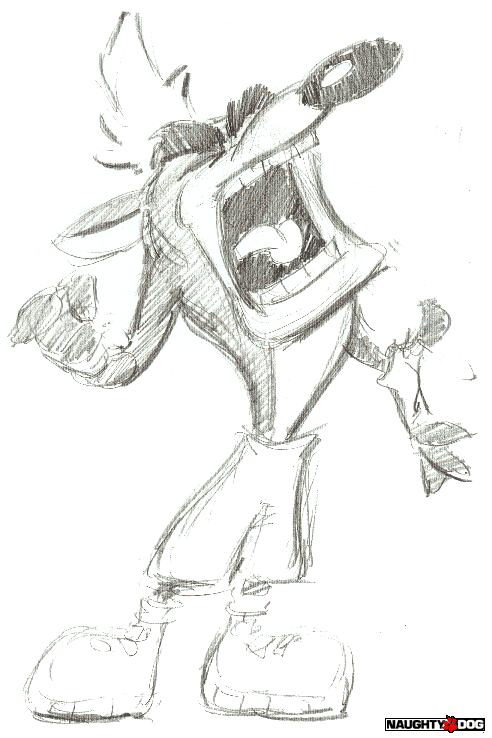
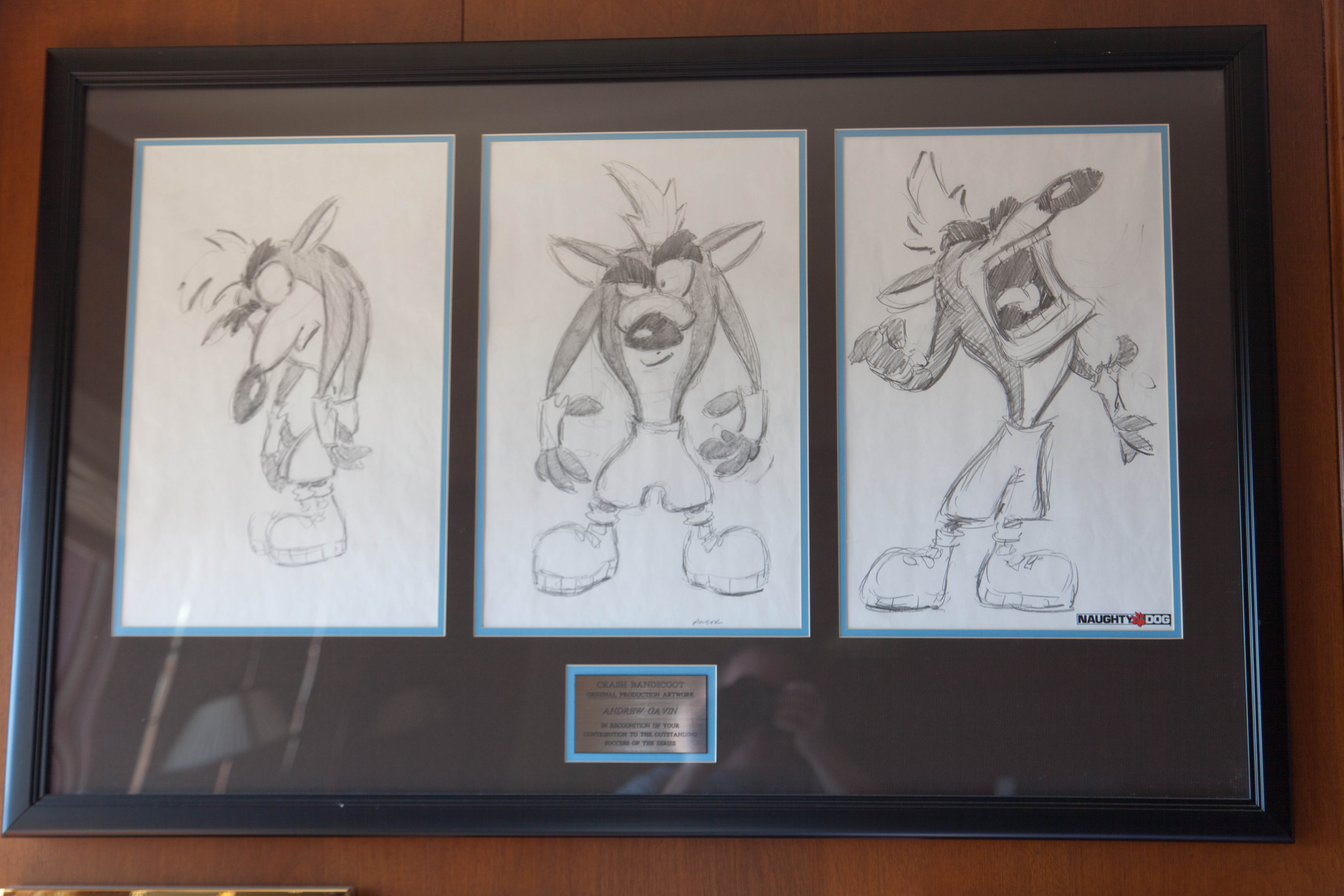
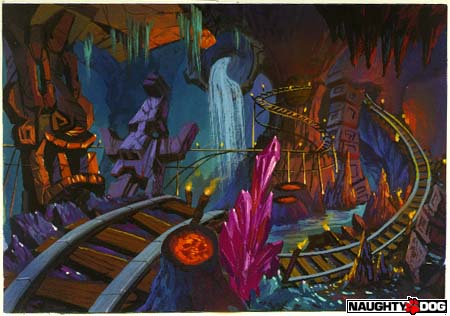
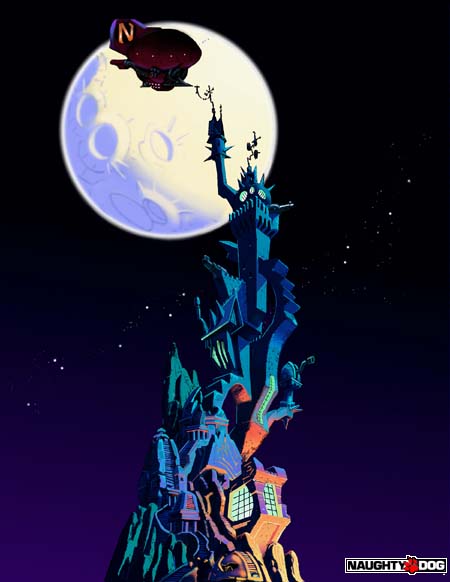
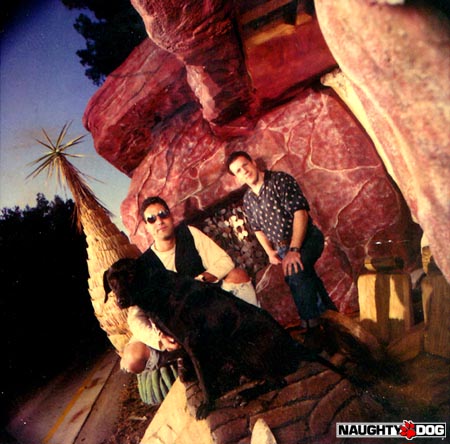
Crash Bandicoot – Teaching an Old Dog New Bits – part 1

This is loosely part of a now lengthy series of posts on the making of Crash Bandicoot. Click here for the PREVIOUS or for the FIRST POST .

Below is another journal article I wrote on making Crash in 1999. This was co-written with Naughty Dog uber-programmer Stephen White, who was my co-lead on Crash 2, Crash 3, Jak & Daxter, and Jak 2. It’s long, so I’m breaking it into three parts.


Teaching an Old Dog New Bits

How Console Developers are Able to Improve Performance When the Hardware Hasn’t Changed

by

Andrew S. Gavin

and

Stephen White

Copyright © 1994-99 Andrew Gavin, Stephen White, and Naughty Dog, Inc. All rights reserved.


Console vs. Computer

Personal computers and video game consoles have both made tremendous strides in graphics and audio performance; however, despite these similarities there is a tremendous benefit in understanding some important differences between these two platforms.

Evolution is a good thing, right?

The ability to evolve is the cornerstone behind the long-term success of the IBM PC.  Tremendous effort has been taken on the PC so that individual components of the hardware could be replaced as they become inefficient or obsolete, while still maintaining compatibility with existing software.  This modularity of the various PC components allows the user to custom build a PC to fit specific needs.  While this is a big advantage in general, this flexibility can be a tremendous disadvantage for developing video games.  It is the lack of evolution; the virtual immutability of the console hardware that is the greatest advantage to developing high quality, easy to use video game software.

You can choose any flavor, as long as it’s vanilla

The price of the PC’s evolutionary ability comes at the cost of dealing with incompatibility issues through customized drivers and standardization.  In the past, it was up to the video game developer to try to write custom code to support as many of the PC configurations as possible.  This was a time consuming and expensive process, and regardless of how thorough the developer tried to be, there were always some PC configurations that still had compatibility problems.  With the popularity of Microsoft’s window based operating systems, video game developers have been given the more palatable option of allowing other companies to develop the drivers and deal with the bulk of the incompatibility issues; however, this is hardly a panacea, since this necessitates a reliance on “unknown” and difficult to benchmark code, as well as API’s that are designed more for compatibility than optimal performance.  The inherit cost of compatibility is compromise.  The API code must compromise to support the largest amount of hardware configurations, and likewise, hardware manufacturers make compromises in their hardware design in order to adapt well to the current standards of the API.  Also, both the API and the hardware manufacturers have to compromise because of the physical limitations of the PC’s hardware itself, such as bus speed issues.

Who’s in charge here?

The operating system of a PC is quite large and complicated, and is designed to be a powerful and extensively featured multi-tasking environment.  In order to support a wide variety of software applications over a wide range of computer configurations, the operating system is designed as a series of layers that distance the software application from the hardware.  These layers of abstraction are useful for allowing a software application to function without concerning itself with the specifics of the hardware.  This is an exceptionally useful way of maintaining compatibility between hardware and software, but is unfortunately not very efficient with respect to performance.  The hardware of a computer is simply a set of interconnected electronic devices.  To theoretically maximize the performance of a computer’s hardware, the software application should write directly to the computer’s hardware, and should not share the resources of the hardware, including the CPU, with any other applications.  This would maximize the performance of a video game, but would be in direct conflict with the implementations of today’s modern PC operating systems.  Even if the operating system could be circumvented, it would then fall upon the video game to be able to support the enormous variety of hardware devices and possible configurations, and would therefore be impractical.

It looked much better on my friend’s PC

Another problem with having a large variety of hardware is that the video game developer cannot reliably predict a user’s personal set-up.  This lack of information means that a game can not be easily tailored to exploit the strengths and circumvent the weaknesses of a particular system.  For example, if all PC’s had hard-drives that were all equally very fast, then a game could be created that relied on having a fast hard-drive.  Similarly, if all PC’s had equally slow hard-drives, but had a lot of memory, then a game could compensate for the lack of hard-drive speed through various techniques, such as caching data in RAM or pre-loading data into RAM.  Likewise, if all PC’s had fast hard-drives, and not much memory, then the hard-drive could compensate for the lack of much memory by keeping most of the game on the hard-drive, and only spooling in data as needed.

Another good example is the difference between polygon rendering capabilities.  There is an enormous variation in both performance and effects between hardware assisted polygonal rendering, such that both the look of rendered polygons and the amount of polygons that can be rendered in a given amount of time can vary greatly between different machines.  The look of polygons could be made consistent by rendering the polygons purely through software, however, the rendering of polygons is very CPU intensive, so may be impractical since less polygons can be drawn, and the CPU has less bandwidth to perform other functions, such as game logic and collision detection.

Other bottlenecks include CD drives, CPU speeds, co-processors, memory access speeds, CPU caches, sound effect capabilities, music capabilities, game controllers, and modem speeds to name a few.

Although many PC video game programmers have made valiant attempts to make their games adapt at run-time to the computers that they are run on, it is difficult for a developer to offer much more than simple cosmetic enhancements, audio additions, or speed improvements.  Even if the developer had the game perform various benchmark tests before entering the actual game code, it would be very difficult, and not to mention limiting to the design of a game, for the developer to write code that could efficiently structurally adapt itself to the results of the benchmark.

Which button fires?

A subtle, yet important problem is the large variety of video game controllers that have to be supported by the PC.  Having a wide variety of game controllers to choose from may seem at first to be a positive feature since having more seems like it should be better than having less, yet this variety actually has several negative and pervasive repercussions on game design.  One problem is that the game designer can not be certain that the user will have a controller with more than a couple of buttons.  Keys on the keyboard can be used as additional “buttons”, but this can be impractical or awkward for the user, and also may require that the user configure which operations are mapped to the buttons and keys.  Another problem is that the placement of the buttons with respect to each other is not known, so the designer doesn’t know what button arrangement is going to give the user the best gameplay experience.  This problem can be somewhat circumvented by allowing the user to remap the actions of the buttons, but this isn’t a perfect solution since the user doesn’t start out with an inherent knowledge of the best way to configure the buttons, so may choose and remain using an awkward button configuration.  Also, similar to the button layout, the designer doesn’t know the shape of the controller, so can’t be certain what types of button or controller actions might be uncomfortable to the user.

An additional problem associated with game controllers on the PC is that most PC’s that are sold are not bundled with a game controller.  This lack of having a standard, bundled controller means that a video game on the PC should either be designed to be controlled exclusively by the keyboard, or at the very least should allow the user to optionally use a keyboard rather than a game controller.  Not allowing the use of the keyboard reduces the base of users that may be interested in buying your game, but allowing the game to be played fully using the keyboard will potentially limit the game’s controls, and therefore limit the game’s overall design.

Of course, even if every PC did come bundled with a standard game controller, there would still be users who would want to use their own non-standard game controllers.  The difference, however, is that the non-standard game controllers would either be specific types of controllers, such as a steering wheel controller, or would be variations of the standard game controller, and would therefore include all of the functionality of the original controller.  The decision to use the non-standard controller over the standard controller would be a conscious decision made by the user, rather than an arbitrary decision made because there is no standard.

Chasing a moving target

Another problem associated with the PC’s evolutionary ability is that it is difficult to predict the performance of the final target platform.  The development of video games has become an expensive and time consuming endeavor, with budgets in the millions, and multi year schedules that are often unpredictable.  The PC video game developer has to predict the performance of the target machine far in advance of the release of the game, which is difficult indeed considering the volatility of schedules, and the rapid advancements in technology.  Underestimating the target can cause the game to seem dated or under-powered, and overestimating the target could limit the installed base of potential consumers.  Both could be costly mistakes.

Extinction vs. evolution

While PC’s have become more powerful through continual evolution, video game consoles advance suddenly with the appearance of an entirely new console onto the market.  As new consoles flourish, older consoles eventually lose popularity and fade away.  The life cycle of a console has a clearly defined beginning:  the launch of the console into the market.  The predicted date of the launch is normally announced well in advance of the launch, and video game development is begun early enough before the launch so that at least a handful of video game titles will be available when the console reaches the market.  The end of a console’s life cycle is far less clearly defined, and is sometimes defined to be the time when the hardware developer of the console announces that there will no longer be any internal support for that console.  A more practical definition is that the end of a console’s life cycle is when the public quits buying much software for that console.  Of course, the hardware developer would want to extend the life cycle of a console for as long as possible, but stiff competition in the market has caused hardware developers to often follow up the launch of a console by immediately working on the design of the next console.

Each and every one is exactly the same

Unlike PC’s which can vary wildly from computer to computer, consoles of a particular model are designed to be exactly the same.  Okay, so not exactly the same, but close enough that different revisions between the hardware generally only vary in minor ways that are usually pretty minor from the perspective of the video game developer, and are normally transparent to the user.  Also, the console comes with at least one standard game controller, and has standardized peripheral connections.

The general premise is that game software can be written with an understanding that the base hardware will remain consistent throughout the life-span of the console; therefore, a game can be tailored to both exploit the strengths of the hardware, and to circumvent the weaknesses.

The consistency of the hardware components allows a console to have a very small, low level operating system, and the video game developer is often given the ability to either talk to the hardware components directly, or to an extremely low hardware abstraction layer.

The performance of the components of the hardware is virtually identical for all consoles of a given model, such that the game will look the same and play the same on any console.  This allows the video game developer to design, implement, and test a video game on a small number of consoles, and be assured that the game will play virtually the same for all consoles.

CLICK HERE FOR PART 2


Subscribe to the blog (on the right), or follow me at:

Andy:  or blog

Also, peek at my novel in progress: The Darkening Dream

or more posts on

GAMES or BOOKS/MOVIES/TV or WRITING or FOOD.

Crash Bandicoot – An Outsider’s Perspective (part 8)

This is part of a now lengthy series of posts on the making of Crash Bandicoot. Click here for the PREVIOUS or for the FIRST POST .

After Naughty Dog Jason and I joined forces with another game industry veteran, Jason Kay (collectively Jason R & K are known as “the Jasons”). He was at Activision at the time of the Crash launch and offers his outside perspective.

Although I would not meet Andy and Jason until after Crash 3 was released, the time around the launch of Crash Bandicoot was a fascinating time in the game business, and I believe that the launch of Crash, which was so far ahead of every other game of its generation in every aspect – technical achievement, production values, sound/music, design and balancing – caused everyone I knew in the business to rethink the games they were working on.

Warhawk: One of the best looking early PS1 games

It seems hard to imagine given the broad scope of games today — Console Games costing $50+ million, Social Games on Facebook with 100 Million monthly average users, gesture controlled games, $.99 games on iPhone – how troubled the industry was before the release of Crash, which heralded the rebirth of console games after a dormant period and ushered in the era of the mega-blockbuster game we know today. In the year that Crash Bandicoott released, only 74 Million games were sold across all platforms in the US – of which Crash accounted for nearly 5% of all games sold in the US. By 2010 – more than 200 Million games were sold, with the number one title, Call of Duty: Black Ops selling “only” 12 million copies in the US – about 6% of the total market. In some ways, adjusted for scale, Crash was as big then as Call of Duty is today.

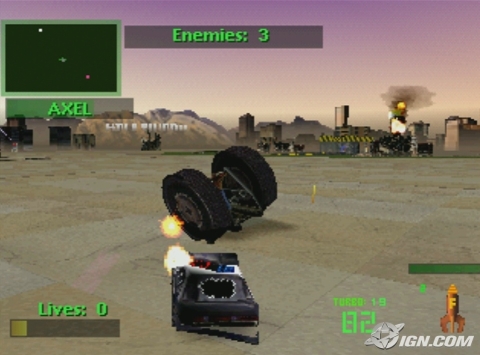
Twisted Metal - Another of the better early PS1 games

After the incredible success of Super Mario World and Sonic the Hedgehog, the game business was really in the doldrums and it had a been a boatload of fail for the so-called “rebirth of the console”. Sega had released a series of “not-quite-next-gen” peripherals for the incumbent Sega Genesis system (including the 32x and the truly awful Sega CD), and made vague promises about “forward compatibility” with their still-secret 32 bit 3D Saturn console. When the Saturn finally shipped, it was referred to by many people as “Two lies in One”, since it was neither compatible with any previous Sega hardware, and nor was it capable of doing much E3. Sega further compounded their previous two mistakes by giving the console exclusively to then-dominant retailer Toys “R” US, pissing of the rest of the retail community and pretty much assuring that console, and eventually Sega’s, demise in the hardware business.

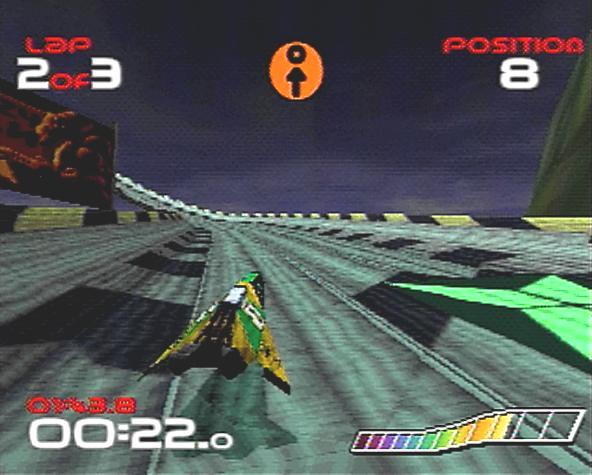
Wipeout - at the time it looked (and sounded) good

The PlayStation had shipped in Fall of 1995, but the initial onslaught of games all looked vaguely similar to Wipeout – since no one believed that it was possible to stream data directly from the PS1 CD-Drive, games were laboriously unpacking single levels into the PS1’s paltry 2 MB of ram (+ 1 meg vram and 0.5 meg sound ram), and then playing regular CD (“redbook”) audio back in a loop while the level played. So most games (including the games we had in development at Activision and were evaluating from third parties) all looked and played in a somewhat uninspiring fashion.

When Crash first released, I was a producer at then-upstart publisher Activision – now one of the incumbent powerhouses in the game business that everyone loves to hate – but at that time, Activision was a tiny company that had recently avoided imminent demise with the success of MechWarrior 2, which was enjoying some success as one of the first true-3D based simulations for the hardcore PC game market. To put in perspective how small Activision was at that time, full year revenues were $86.6 Million in 1996, versus over $4.45 Billion in 2010, a jump of nearly 50x.

MechWarrior 2: 31st Century Combat DOS Front Cover

Jeffrey Zwelling, a friend of a friend who had started in the game business around the same I did, worked at Crystal Dynamics as a producer on Gex. Jeffrey was the first person I knew to hear about Crash, and he tipped me off that something big was afoot right before E3 in 1996. Jeff was based in Silicon Valley, and a lot of the former Naughty Dogs (and also Mark Cerny) had formerly worked at Crystal, so his intel was excellent. He kept warning me ominously that “something big” was coming, and while he didn’t know exactly “what” it was, but it was being referred to by people who’d seen as a “Sonic Killer”, “Sony’s Mario”, and “the next mascot game”.

As soon as people got a glimpse of the game at E3 1996, the conspiracy mongering began and the volume on the Fear, Uncertainty and Doubt meter went to 11. In the pre-Internet absence of meaningful information stood a huge host of wild rumors and speculation. People “in the know” theorized that Naughty Dog had access to secret PlayStation specifications/registers/technical manuals that were only printed in Japanese and resided inside some sort of locked vault at Sony Computer Entertainment Japan. Numerous devs declared the Naughty Dog demo was “faked” in some way, running on a high-powered SGI Workstation hidden behind the curtain at Sony’s booth. That rumor seems in hindsight to have been a conflation of the fact that that the Nintendo 64 console, Code-Named “Project Reality” was in fact very similar to a Silicon Graphics Indigo Workstation and the Crash team was in fact writing and designing the game on Silicon Graphics workstations.

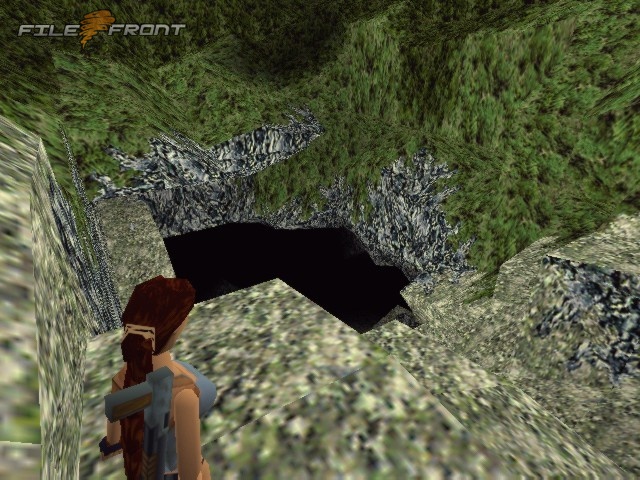
Tomb Raider - Crash contemporary, and great game. But the graphics...

Everyone in the business knew how “Sega had done what NintenDONT” and that they had trounced Nintendo with M-Rated games and better tiles in the 16 bit Era, and most of the bets were that Nintendo was going to come roaring back to the #1 spot with the N64. Fortunately for Nintendo, Sega’s hardware was underpowered and underwhelming and Nintendo’s N64 shipped a year later than the Playstation 1. With all the focus on many people’s attention on this looming battle, and the dismissive claims that what Naughty Dog was showing was “impossible”, most people underestimated both the PlayStation and Naughty Dog’s Crash Bandicoot.

Since no one that I knew had actually gotten a chance to play Crash at the show – the crowds were packed around the game – I fully expected that my unboxing of Crash 1 would be highly anti-climatic. I remember that Mitch Lasky (my then boss, later founder of Jamdat and now a partner at Benchmark) and I had made our regular lunch ritual of visiting Electronics Boutique [ ANDY NOTE: at Naughty Dog this was affectionately known as Electronic Buttock ] (now GameStop) at the Westside Pavilion and picked up a copy of the game. We took the game back to our PS1 in the 7th Floor Conference Room at Activision, pressed start, and the rest was history. As the camera focused on Crash’s shoes, panned up as he warped in, I literally just about sh*t a brick. Most of the programmers we had talked to who were pitching games to us claimed that it was “impossible” to get more than 300-600 polygons on screen and maintain even a decent framerate. Most of the games of that era, a la Quake, had used a highly compressed color palette (primarily brown/gray in the case of Quake) to keep the total texture memory low. It seemed like every game was going to have blocky, ugly characters and a lot of muted colors, and most of the games released on the PS1 would in fact meet those criteria.

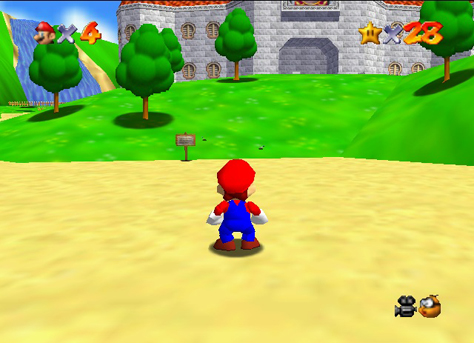
Mario 64 - Bright, pretty, 3D, not so detailed, but the only real contender -- but on a different machine

Yet in front of us, Andy and Jason and the rest of the Crash team showed us that when you eliminate the impossible, only the improbable remains. Right before my eyes was a beautiful, colorful world with what seemed like thousands of polys (Andy later told that Crash 1 did in fact have over 1800 polygons per frame, and Crash 2 cracked 3,100 polys per frame – a far cry from what we had been told was “a faked demo” by numerous other PS1 development teams). The music was playful, curious and fun. The sound effects were luscious and the overall game experience felt, for the first time ever, like being a character in a classic Warner Brothers cartoon. Although I didn’t understand how the Dynamic Difficulty Adjustment (discussed in part 6) actually worked, I was truly amazed that it was the first game everyone I knew who played games loved to play. There was none of the frustration of being stuck on one spot for days, no simply turning the game off never to play it again – everyone who played it seemed to play it from start to finish.

For us, it meant that we immediately raised our standards on things we were looking at. Games that had seemed really well done as prototypes a few weeks before now seemed ungainly, ugly, and crude. Crash made everyone in the game business “up their game.” And game players of the world were better off for it.


These posts continue with PART 9 HERE. You also never know when we might add more, so subscribe to the blog (on the right), or follow us at:

Andy:  or blog

Jason:  or blog

Also, if you liked this, vote it up at at Reddit or Hacker News, and peek at my novel in progress: The Darkening Dream

or more posts on

GAMES or BOOKS/MOVIES/TV or WRITING or FOOD.

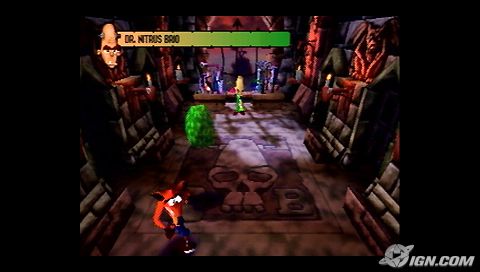
Detailed and Colorful - but most important fun

Certainly varied

Sorry for the lousy screen shots!

Crash Bandicoot as a Startup (part 7)

This is part of a now lengthy series of posts on the making of Crash Bandicoot. Click here for the PREVIOUS or for the FIRST POST .

Dave Baggett, Naughty Dog employee #1 (after Jason and I) throws his own thoughts on Crash Bandicoot into the ring:

This is a great telling of the Crash story, and brings back a lot of memories. Andy and Jason only touch on what is to me the most interesting aspect of this story, which was their own relationship. When I met them, they had been making games together — and selling them — literally since middle school. I remember meeting Andy for the first time in April 1992, at an MIT AI Lab orientation. He knew as much as I did about games and programming, was as passionate about it as I was, and was equally commercially-minded. I just assumed meeting someone like this was a consequence of the selectivity of MIT generally and the AI Lab in particular, which accepts about 25 students each year from a zillion applicants.

In the long run I found that assumption was wrong: Andy and Jason were ultimately unique in my experience. None of us on the Crash 1 team realized it, but as a team we were very much outliers. At 23, Andy and Jason had commercial, strategic-thinking, and negotiating skills that far exceeded those of most senior executives with decades of experience. These, combined with their own prodigious technical talents and skillful but at times happenstance hiring, produced a team that not only could compete with Miyamoto, but in some ways outdo him. (More on this in a moment.)

I still remember the moment I decided to bail on my Ph.D. and work for Andy and Jason as “employee #1”. I don’t think they saw themselves this way, but my archetype for them was John and Paul. (The Beatles, not the saints!) They were this crazy six-sigma-outlier yin/yang pair that had been grinding it out for literally years — even though they were still barely in their 20s. I knew these guys would change the world, and I wanted to be the George Harrison. One problem with this idea, however, was that they had been gigging together for so long that the idea of involving someone else in a really deep way — not just as an employee,but as a partner — was extremely challenging for them emotionally, and, I think, hard for them to conceptualize rationally from a business standpoint. This ultimately led to my leaving after Crash 2 — very sadly, but mostly for dispassionate “opportunity cost” reasons — though I continued to work with Josh Mancell on the music for Crash 3 and CrashTeam Racing, and remained close friends with all the ‘Dogs.

Andy and Jason had evolved a peculiar working relationship that the rest of the team found highly amusing. Jason would stomp around raging about this or that being terrible and Andy would play the role of Star Trek’s Scotty — everything was totally impossible and Jason couldn’t possibly appreciate the immense challenges imposed by what he was really asking for.  (As a programmer myself, I generally took Andy’s side in these debates, though I usually hid in my office when the yelling got above a certain decibel level.) Eventually when matters were settled Andy usually pounded out the result in a 1/10th of the advertised time (also like Scotty). The rest of us couldn’t help but laugh at these confrontations — at times, Andy and Jason behaved like an old married couple. The very long work hours — literally 100-hour weeks — and the stress level definitely amplified everyone’s emotions, especially theirs.

Andy and Japanese Crash in the NDI offices

On the subject of Mario 64, I agree more with Andy than with Jason, and think that Jason’s view highlights something very interesting and powerful about his personality. At the time I thought — and in retrospect, I still think — that Mario 64 was clumsy and ugly. It was the work of a great genius very much making a transition into a new medium — like a painter’s first work in clay. Going from 2D to 3D made all the technical challenges of games harder — for both conceptual and algorithmic reasons — and Miyamoto had just as hard a time as us adapting traditional gameplay to this new framework. The difference was that Miyamoto was an artist, and refused to compromise. He was willing and able to make a game that was less “fun” but more aggressively novel. As a result, he gave gamers their first taste of glorious 3D open vistas — and that was intoxicating. But the truth is that Mario 64 just wasn’t that fun; Miyamoto’s 2D efforts at the time — Donkey Kong Country and Yoshi’s Island — were far more fun (and, in fact, some of my personal favorite games of all time, though I never would have admitted that out loud at the time). As Andy said, the camera algorithms were awful; we had an incredibly hard time with camera control in our more constrained rails environment, and the problem wasn’t really technically solved for open environments like Mario 64’s until many years later. Mario 64’s collision detection algorithms were crap as well — collision detection suffers from a “curse of dimensionality” that makes it much harder in 3D than in 2D, as we also found. At Naughty Dog, we combined my ridiculously ambitious octree approach — essentially, dividing the entire world up into variable-sized cubes — with Mark’s godlike assembly coding to produce something *barely* fast enough to work — and it took 9 months. This was the one the one area on Crash when I thought we might actually just fail — and without Mark and I turning it into a back-and-forth coding throw-down, we probably would have. (As an aside, some coders have a savant-like ability to map algorithms onto the weird opportunities and constraints imposed by a CPU; only Greg Omi — who worked with us on Crash 2 — was in the same league as Mark when it came to this, of the hundreds of programmers I’ve worked with.)

But Jason was tormented by Mario 64, and by the towering figure of Miyamoto generally. Like Andy Grove, Jason was constantly paranoid and worked up about the competition. He consistently underrated his — and our — own efforts, and almost neurotically overrated those of his competitors. I saw this trait later in several other great business people I worked with, and it is one I’ve found that, while maddening, correlates with success.

Fifteen years later, I’m now on my third startup; ITA Software followed Naughty Dog, and now I’m doing a raw startup again. The Naughty Dog model set the mold for all my future thinking about startups, and so far each one has followed a similar pattern: you must have a very cohesive, hard-working, creative team early on. This team of 6-12 sets the pattern for the company’s entire future — whether it grows to 50, 500, or — I can only assume — 5000 employees. The Crash 1 team was one of those improbable assemblages of talent that can never quite be reproduced. And unlike our contemporaries, our team got lucky: as Andy said, we were able to “slot in” to a very low-probability opportunity. Yes, Andy and Jason, with Mark, had identified the slot, and that was prescient. But many things had to go our way for the slot to still be genuinely available. The Crash team was an improbably talented team that exploited an improbable opportunity. As a life-long entrepreneur, I’ve lived to participate in — and, now, try to create — teams like that. There’s nothing more gratifying in business.


Part 8 CONTINUES here with another guest post and subscribe to the blog (on the right), or follow us at:

Andy:  or blog

Jason:  or blog

Also, if you liked this, vote it up at at Reddit or Hacker News, and peek at my novel in progress: The Darkening Dream

or more posts on

GAMES or BOOKS/MOVIES/TV or WRITING or FOOD.
Making Crash Bandicoot – part 6

PREVIOUS installment, or the FIRST POST.

[ NOTE, Jason Rubin added his thoughts to all the parts now, so if you missed that, back up and read the second half of each. ]


Not only did we need to finish our E3 demo, but we needed a real name for the game — Willie the Wombat wasn’t going to cut it. Now, in the Naughty Dog office proper we knew he was a Bandicoot. In fact, we liked the idea of using an action name for him, like Crash, Dash, Smash, and Bash — fallout from the visceral reaction to smashing so many boxes.

Dr N. Cortex goes medieval on Universal Marketing

But the Universal Marking department (of one) thought differently. They had hired one of those useless old-school toy marketing people, a frumpy fortyish woman about as divorced from our target audience – and the playing of video games – as possible. This seems to be a frequent problem with bigger companies, the mistaken idea that you can market an entertainment product if you aren’t also an enthusiastic customer of said product. On the other hand, everyone making the game played constantly. We had regular Bomberman tournaments, we could all debate the merits of control in Sonic vs Mario, and Dave was even a former Q*Bert world champion.

In any case, this obstacle (the marketing woman) wanted to call the game “Wuzzle the Wombat,” or “Ozzie the Otzel.” Fortunately, after much yelling we prevailed and Crash Bandicoot became… Crash Bandicoot.

Crash's hot girlfriend, Tawna

It’s also worth mentioning that she objected to Crash’s rather busty girlfriend (or Bandicoot-friend) on basic sexist principles. Now, Tawna wasn’t the most inspired of our character designs, more or less being Jessica Rabbit as a Bandicoot, and without the cool personality. But remember who generally played games like Crash. The same kind of guys we had been 5-10 years earlier.

The music also had to be cobbled together before E3 – and in classic video game development fashion had been left to the last minute. This task had been assigned to our nominal producer at Universal, a gentleman who mostly sat in his office and played Sexy Parodius. While of dubious benefit to the project, at least he loved video games. However, he proposed that instead of conventional music we create something called “the urban chaotic symphony” in which the programmer (me) would cause random sound effects such as bird chirps, car honks, grunts, and farting noises (actually listed and underlined), to be randomly selected and combined. When we rejected this innovative proposal, we were introduced to Mark Mothersbaugh of Devo and more recently Mutato Muzika. He and (mostly) Josh Mancell composed all the music for the games, produced by music aficionado and Naughty Dog programmer Dave Baggett.  Besides, Dave actually knew the game inside and out.

Finally we arrive at E3, and the debut of the N64 and Mario 64. Gulp.

Jason (right) and I (left) at E3 1996

Mario was a bit of a two edged sword for us. First of all, the attention it garnered helped force us into the limelight. Sega was engaged in the slow process of killing themselves with bad decisions and bad products, and so Sony and Nintendo found themselves head to head. This literally put Crash and Mario into the ring together. In fact, this was depicted on the cover of at least one game magazine (along with Sonic who declined to enter the ring).

In any case, since Crash released about a month after Mario the press often assumed that we had copied various elements, which always bugged us to no end, as both games were developed with no real knowledge of each other. Crash was nearly beta by the time we saw Mario at E3, and gold mastered by the time the N64 shipped and we could play it. Both games took very different approaches to the then unproven 3D CAG genre.

With Crash we decided to emphasize detailed cartoon visuals and classic Donkey Kong Style gameplay. So we used a camera on rails (albeit branching rails).

With the N64’s VERY limited texture system and poly count, but with its smoothing and z-buffer, Mario chose to go with a very loosely defined polygonal free roaming world and a much more playground style of gameplay.

Mark & I watch Miyamoto play Crash

Personally when I first got my hands on Mario I was like WTF? How is anyone going to know what to do here? And although there was a pretty real sense of marvel in this funny new world, I never found it very fun. The early camera AI was brutally frustrating. And the Mario voiceover. I still cringe, “It’sa me, Mario!” Still the game was brilliantly innovative, although I remain convinced that if anyone but Miyamoto had made the game it would have flopped.

Really, the future lay in the hybrid of the two.

Critics loved Mario. Perhaps because many of them were Nintendo fan boys, perhaps because it was more innovative (and it was). But the players loved both, because they sure bought a LOT of Crash Bandicoots too, approximately 35-40 million of our four PS1 games.

In a lot of ways Crash was the last of the great video game mascot characters, despite the fact that Sony never really wanted a mascot. We set out to fill this void, and made a game to do it, but we never really expected – only hoped – that it would happen. By the era of PS2 and X-box, the youthful generation of video game players had grown up, and the platforms began to appeal to a much wider age range. With this, and increased graphics horsepower that made possible more realistic games, came a shift to more mature subjects. The era of GTA, of Modern Warfare and Halo. Sophisticated and dark games mirroring R-rated action movies.

A part of me misses the simple, but highly crafted comic fun Crash represented.


Jason says:

There were so many great stories from Crash Development.  I’m sad that this is the last of 6 blog posts.  There is so much that has been missed.

One of my favorite memories relates to the collision detection.  Crash had more detailed environments than most games had attempted at that point, and there was no known solution for such complex collision detection in games.  Even after Crash came out, most developers just let their characters wade through most objects, and stuck to simple flat surfaces, but we wanted the character and the world to interact in a much more detailed fashion.

Andy and Dave called one of their friends at the Media Lab at MIT.  Basically, the Media lab worked on state of the art visual and computing problems.  They were, and still are, some of the most advanced in the world.  They asked their friend what high detail collision detection solutions were kicking around at that time.

The next day the friend called back and said he had the perfect solution.  Unfortunately, it demanded a Cray Supercomputer and hundreds (thousands?) of PlayStations worth of memory to work in real-time.

Andy and Dave hung up and started to come up with something on their own.

Naming Crash was one of the hardest things I have ever had to take part in.  It became so confused, so frustrating, so combative, and so tiring that I remember starting to think that Willie Wombat sounded good!

Credit goes to Taylor and Dave for combining Crash and Bandicoot for the first time.

If Andy and I deserve credit for anything name related, it is for viciously defending our character from the ravages of the Universal Marketing Death Squad.  I remember the name mooted by Universal to be Wez or Wezzy Wombat, but as I said things were very confused, and frankly it doesn’t matter what the alternate name was.

When Universal stated that as producer and they were going to pick the name, Andy and I walked the entire team (all 7 of us!) into the head of Universal Interactive’s office and said, “either we go with ‘Crash Bandicoot’, or you can name the game whatever you want and finish the development yourself.”

I think the result is obvious.

This was not the only time this tactic had to be used with Universal.  With all the “everyone grab your stuff and head to the office at the other end of the hall” moments, I don’t know how we even finished the game.

But we didn’t win every battle.  Crash’s girlfriend Tawna ended up on the chopping block after Crash 1.  We tried to choose our battles wisely.  Unlike the name “Crash Bandicoot”, Tawna wasn’t worth fighting for.

There was so much negativity and dispute with Universal Interactive that it is a miracle it didn’t scupper the game.

For example, Naughty Dog was told that it wasn’t “allowed” to go to the first E3.  This was part of a continuing attempt by Universal Interactive to take credit for the product.  It might have worked if Universal were parents and Naughty Dog was their six year old child, but we were an independent company working under contract.  Nobody was going to tell us what we could or couldn’t do.

There were also some leaked copies of the temporary box cover and press materials for E3, upon which Naughty Dog’s logo had “mysteriously,” and in direct conflict with the letter and spirit of our contract, been forgotten.

My response to both was to draft and print 1000 copies of a glitzy document entitled “Naughty Dog, creator and developer of Crash Bandicoot” ostensibly to hand out in front of the Crash display at E3.  As a “courtesy” I to passed these flyers out “for review” to Universal Interactive beforehand.

The head of Universal Interactive came as close to literally flipping his lid as a person can come.  He stormed into Andy’s office, made some extremely threatening comments, and then promptly went off to a shooting range in order to produce a bullet-riddled target to hang on his office door.

Things did get heated from time to time.

And just for the record, kudos to Mark for surviving all the hassle.  He was an employee of Universal Interactive yet completely uninvolved in any chicanery.  And as I’ve said before, he was always the Nth Dog, so times like these were harder on him than anyone else.

But all this is keeping us from discussing E3!

Ah the big show…

Sony booted one of its own internal products to give Crash the prime spot on the floor.  Walking in and seeing dozens of monitors playing the game was a moment I will never forget.

But I don’t think Andy and I had spent more than a moment looking at our triumph before we went off to fight the hoards at the Mario 64 consoles over at Nintendo’s booth for a chance on the controller.  As amazing as it was seeing our wall of monitors, seeing the lines for Mario made my heart drop.  Could it be that good?

Unlike Andy, I actually think Mario 64 WAS that good.

Mario 64 was a better game than the first Crash Bandicoot.

Miyamoto-san was at the top of his game and we were just getting started.  Crash was our first platformer, remember, and thus it lacked many of the gameplay nuances that Mario had.

Mario 64’s controls and balance were just better.

And then there was our annoying way of making players earn continues.  This was a major mistake.  It makes players that need lives fail while boring players that don’t.  It is the opposite of good game balance.

We were already learning.  We had realized that if a novice player died a lot of times, we could give them an Aku Aku at the start of a round and they had a better chance to progress.  And we figured out that if you died a lot when running from the boulder, we could just slow the boulder down a little each time.  If you died too much a fruit crate would suddenly become a continue point.  Eventually everyone succeeded at Crash.

Our mantra became help weaker players without changing the game for the better players.

We called all this DDA, Dynamic Difficulty Adjustment, and at the time the extent to which we did it was pretty novel.  It would lead later Crash games to be the inclusive, perfectly balanced games they became.   Good player, bad player, everyone loved Crash games.  They never realized it is because they were all playing a slightly different game, balanced for their specific needs.

But for all of our triumphant balancing attempts, we still made many mistakes in the first title.

Miyamoto-san didn’t make these mistakes.  3D Gameplay choice and art aside, Mario 64 was a better game.

And that isn’t to say that we didn’t have some serious advantages of our own.

For example, Crash looked better.  I am sure there will be disagreement with this statement.  But when 100 people were lined up and asked which looked more “next generation” (a term like ‘tomorrow’ that is always just over the horizon), most people pointed to Crash.

If I had to guess what Miyamoto-san was thinking when he was playing Crash in the photo above it was probably “damn this game looks good.”

Of course he had consciously made the decision to forgo the complex worlds Crash contained.  The N64 had prettier polygons, but less of them to offer.  Crash Bandicoot could not be made on the N64.  Of course Mario 64 couldn’t be done on the PlayStation either.  The PlayStation sucked at big polygons, specifically scissoring them without warping textures.  Mario 64 relied on big polygons.

But more fundamentally, the open world he chose would tax ANY system out at that time.   Mario 64 couldn’t be open and any more detailed than it was.  Miyamoto-san had chosen open and that meant simple.

Spyro later split the difference with walled open worlds, but at E3 1996 there was only the choice between the complex visuals of Crash, or the crayon simple expansive simplicity of Mario 64.

Yes, Crash was a throwback to old games and on “rails”.  But Mario 64 just didn’t look (as much) like a Pixar movie.  That created space for an argument, and thus one of the great wars between games, and by proxy consoles, could be fought.

I believe, right or wrong, that Crash won that comparison when it got to the shelves.

And this was just the beginning.

Unlike Miyamoto-san, Naughty Dog was willing to forgo the light of day to bring out a sequel to Crash Bandicoot one year later in September 1997.  By comparison, there wouldn’t be another Mario platformer until “Mario Sunshine” in 2002.

We took what we had learned from Crash 1, and from Mario 64 for that matter, and went back to the drawing board.   Crash 2 was re-built from the ground up.  Everything was improved.  But most importantly we focused on the gameplay.

Crash Bandicoot had taxed us to our limits.  Much of that time had been spent figuring out what the game would be, and then getting it working.

The second game could be built on the platform and successes of the first, but also from its mistakes.  The same would eventually true of Jak and Daxter, and, though I had no hand it the games, is probably true of Uncharted.  While Andy and I led Naughty Dog it had, and seems from outside to still have, a relentless pursuit of improvement.  That has meant historically that the second game in a series tends to be a better game.

Crash 2 would be a MUCH better game than Crash 1.  I would even argue that Crash 2 would end up being as good, if not better, than Mario 64.

But that is as story for another day.


This (sort of) continues with a virtual part 7 by Dave Baggett with his thoughts on Crash.

Also, subscribe to the blog (on the right), or follow us at:

Andy: or blog

Jason: or blog

Also, if you liked this, vote it up at at Reddit or Hacker News, and peek at my novel in progress: The Darkening Dream

or more posts on

GAMES or BOOKS/MOVIES/TV or WRITING or FOOD.
The Limited Edition Launch Poster

Making Crash Bandicoot – part 5

PREVIOUS installment, or the FIRST POST.

[ NOTE, Jason Rubin added his thoughts to all the parts now, so if you missed that, back up and read the second half of each. ]


A Bandicoot, his beach, and his crates

But even once the core gameplay worked, these cool levels were missing something. We’d spent so many polygons on our detailed backgrounds and “realistic” cartoon characters that the enemies weren’t that dense, so everything felt a bit empty.

We’d created the wumpa fruit pickup (carefully rendered in 3D into a series of textures — burning a big chunk of our vram — but allowing us to have lots of them on screen), and they were okay, but not super exciting.

Enter the crates. One Saturday, January 1996, while Jason and I were driving to work (we worked 7 days a week, from approximately 10am to 4am – no one said video game making was easy). We knew we needed something else, and we knew it had to be low polygon, and ideally, multiple types of them could be combined to interesting effect. We’d been thinking about the objects in various puzzle games.

So crates. How much lower poly could you get? Crates could hold stuff. They could explode, they could bounce or drop, they could stack, they could be used as switches to trigger other things. Perfect.

So that Saturday we scrapped whatever else we had planned to do and I coded the crates while Jason modeled a few, an explosion, and drew some quick textures.

About six hours later we had the basic palate of Crash 1 crates going. Normal, life crate, random crate, continue crate, bouncy crate, TNT crate, invisible crate, switch crate. The stacking logic that let them fall down on each other, or even bounce on each other. They were awesome. And smashing them was so much fun.

Over the next few days we threw crates into the levels with abandon, and formally dull spots with nothing to do became great fun. Plus, in typical game fashion tempting crates could be combined with in game menaces for added gameplay advantage. We even used them as the basis for our bonus levels (HERE in video). We also kept working on the feel and effects of crate smashing and pickup collection. I coded them again and again, going for a pinball machine like ringing up of the score. One of the best things about the crates is that you could smash a bunch, slurp up the contents, and 5-10 seconds later the wumpa and one-ups would still be ringing out.

This was all sold by the sound effects, executed by Mike Gollom for Crash 1-3. He managed to dig up the zaniest and best sounds. The wumpa slurp and the cha-ching of the one up are priceless. As one of our Crash 2 programmers used to say, “the sounds make the game look better.”

For some reason, years later, when we got around to Jak & Daxter we dropped the crate concept as “childish,” while our friends and amiable competitors at Insomniac Games borrowed them over into Ratchet & Clank. They remained a great source of cheap fun, and I scratch my head at the decision to move on.

Now, winter 95-96 the game was looking very cool, albeit very much a work-in-progress. The combination of our pre-calculation, high resolution, high poly-count, and 30 fps animation gave it a completely unique look on the machine. So much so that many viewers thought it a trick. But we had kept the whole project pretty under wraps. One of the dirty secrets of the Sony “developer contract” was that unlike its more common “publisher” cousin, it didn’t require presentation to Sony during development, as they assumed we’d eventually have to get a publisher. Around Thanksgiving 1995, I and one of our artists, Taylor Kurosaki, who had a TV editing background, took footage from the game and spent two days editing it into a 2 minute “preview tape.” We deliberately leaked this to a friend at Sony so that the brass would see it.

They liked what they saw.

Management shakeups at Sony slowed the process, but by March of 1996 Sony and Universal had struck a deal for Sony to do the publishing. While Sony never officially declared us their mascot, in all practical senses we became one. Heading into the 1996 E3 (May/June) we at Naughty Dog were working ourselves into oblivion to get the whole game presentable. Rumors going into E3 spoke of Nintendo’s new machine, the misleadingly named N64 (it’s really 32 bit) and Miyamoto’s terrifying competitive shadow, Mario 64.

Crash and his girl make a getaway

For two years we had been carefully studying every 3D character game. Hell, we’d been pouring over even the slightest rumor – hotly debated at the 3am deli takeout diners. Fortunately for us, they’d all sucked. Really sucked. Does anyone remember Floating Runner? But Mario, that wasn’t going to suck. However, before E3 1996 all we saw were a couple of screen shots – and that only a few weeks before. Crash was pretty much done. Well, at least we thought so.

Now, we had seen some juicy magazine articles on Tomb Raider, but we really didn’t worry much about that because it was such a different kind of game: a Raiders of the Lost Ark type adventure game starring a chick with guns. Cool, but different. We’d made a cartoon action CAG aimed at the huge “everybody including kids” market.

Mario  was our competition.


Jason says:

The empty space had plagued us for a long time.  We couldn’t have too many enemies on screen at the same time.  Even though the skunks or turtles were only 50-100 polygons each, we could show two or three at most.  The rest was spent on Crash and the Background.  Two or three skunks was fine for a challenge, but it meant the next challenge either had to be part of the background, like a pit, or far away.  If two skunk challenges came back to back there was a huge amount of boring ground to cover between them.

Enter the crates.   The Crates weren’t put in to Crash until just before Alpha, or the first “fully playable” version of the game.

Andy must have programmed the “Dynamite Crate/Crate/Dynamite Crate” puzzle 1000 times to get it right.  It is just hard enough to spin the middle crate out without blowing up the other two, but not hard enough not to make it worth trying for a few wumpa fruit.  Getting someone to risk a Life for 1/20th of a Life is a fine balancing act!

Eventually the Crates led to Crash’s name.  In less than a month after we put them in everyone realized that they were the heart of the game.  Crash’s crash through them not only filled up the empty spots, the challenges ended up filling time between Crate challenges!

This isn’t the place for an in depth retelling of the intrigue behind the Sony/Crash relationship, but two stories must be told.

The first is Sony’s first viewing of Crash in person.  Kelly Flock was the first Sony employee to see Crash live [ Andy NOTE: running, not on videotape ].  He was sent, I think, to see if our videotape was faked!

Kelly is a smart guy, and a good game critic, but he had a lot more to worry about than just gameplay.  For example, whether Crash was physically good for the hardware!

Andy had given Kelly a rough idea of how we were getting so much detail through the system: spooling.  Kelly asked Andy if he understood correctly that any move forward or backward in a level entailed loading in new data, a CD “hit.”  Andy proudly stated that indeed it did.  Kelly asked how many of these CD hits Andy thought a gamer that finished Crash would have.  Andy did some thinking and off the top of his head said “Roughly 120,000.”  Kelly became very silent for a moment and then quietly mumbled “the PlayStation CD drive is ‘rated’ for 70,000.”

Kelly thought some more and said “let’s not mention that to anyone” and went back to get Sony on board with Crash.

The second story that can’t be glossed over was our first meeting with the Sony executives from Japan.  Up until this point, we had only dealt with Sony America, who got Crash’s “vibe”.  But the Japanese were not so sure.

We had been handed a document that compared Crash with Mario and Nights, or at least what was known of the games at the time.  Though Crash was rated favorably in “graphics” and some other categories, two things stood out as weaknesses.  The first was that Sony Japan didn’t like the character much, and the second was a column titled “heritage” that listed Mario and Sonic as “Japanese” and Crash as “other.”  The two negatives were related.

Let us remember that in 1995 there was Japan, and then there was the rest of the world in video games.  Japan dominated the development of the best games and all the hardware.  It is fair to say that absent any other information, the Japanese game WAS probably the better one.

Mark presided over the meeting with the executives.  He not only spoke Japanese, but also was very well respected for his work on Sonic 2 and for his years at Sega in Japan.  I could see from the look in Mark’s eyes that our renderings of Crash, made specifically for the meeting, did not impress them.

We took a break, during which it was clear that Sony was interested in Crash for the US alone, hardly a “mascot” crowning.  I stared at the images we had done.  Primitive by today’s standards, but back then they were reasonably sexy renderings that had been hand retouched by Charlotte for most of the previous 48 hours.  She was fried.

I walked over to her.  I think she could barely hold her eyes open.  I had spent the previous month spending all of my free time (4am-10am) studying Anime and Manga.  I read all the books available at that time in English on the subject.  All three!  I also watched dozens of movies.  I looked at competitive characters in the video game space.  I obsessed, but I obsessed from America.  I had never been to Japan.

I asked Charlotte if she could close Crash’s huge smiling mouth making him seem less aggressive.   I asked her to change Crash’s eyes from green to two small black “pac-man” shapes.  And I asked her to make Crash’s spike smaller.  And I told her she had less than 15 minutes.  With what must have been her last energy she banged it out.

I held up the resulting printout 15 minutes later.

Sony Japan bought off on Crash for the international market.

I don’t want to make the decision on their part seem arbitrary.  Naughty Dog would do a huge amount of work after this on the game for Japan, and even then we would always release a Japanese specific build.  Whether it was giving Aku Aku pop up text instructions, or replace a Crash smashing “death” that reminded them of the severed head and shoes left by a serial killer that was loose in Japan during Crash 2’s release, we focused on Japan and fought hard for acceptance and success.

We relied on our Japanese producers, including Shuhei Yoshida, who was assigned shortly after this meeting, to help us overcome our understandable ignorance of what would work in Japan.  And Sony Japan’s marketing department basically built their own Crash from the ground up for the marketing push.

Maybe Charlotte’s changes showed Sony that there was a glimmer of hope for Crash in Japan.  Maybe they just saw how desperate we were to please and couldn’t say no.  Maybe Universal put something in the coffee they had during the break.

Who knows, but Crash was now a big part of the international PlayStation push.  So there were more important things for us to worry about then Sony and the deal:

The fear of Miyamoto was thick at Naughty Dog during the entire Crash development period.  We knew eventually he would come out with another Mario, but we were hoping, praying even, that it would be a year after we launched.

Unfortunately that was not to be.  We started seeing leaks of video of the game.

It was immediately obvious that it was a different type of game: truly open.  That scared us.  But when we saw the graphics we couldn’t believe it.  I know there will be some that take this as heresy, but when we saw the blocky, simple, open world we breathed a sign of relief.  I think I called it I Robot Mario, evoking the first 3D game.

Of course we hadn’t played it, so we knew we couldn’t pass judgment until we did.  That would happen at E3.


CONTINUED in PART 6 or

more on GAMES or BOOKS/MOVIES/TV or WRITING or FOOD.

The Big Fight!

Making Crash Bandicoot – part 4

PREVIOUS installment, or the FIRST POST.

[ NOTE, Jason Rubin added his thoughts to all the parts now, so if you missed that, back up and read the second half of each. ]


But this brings us to the gameplay. We were forging new ground here, causing a lot of growing pains. I started fairly programming the control of the main character early. This is the single most important thing in a CAG, and while intellectually I knew this from Way of the Warrior, it was really Mark who drove the message home. I did all the programming, but Mark helped a lot with the complaining. For example, “he doesn’t stop fast enough,” or “he needs to be able to jump for a frame or two AFTER he’s run off a cliff or it will be frustrating.” Jason’s also really good flaw detection. Which is a good thing. Internal criticism is essential, and as a programmer who wrote dozens of world class control schemes in the years between 1994 and 2004, I rewrote every one at least five or six times. Iteration is king.

Even after the control was decent, we still had no idea how to build good 3D gameplay with it. Our first two test levels “the jungle, level1” and “lava cave, level2” were abysmal, and neither shipped in the final game. First of all, they were too open with way too many polygons. Level1 had over 10 million, whereas a shipping level tended to have around a million (a lot back then). Level2 was better, but not much.

So during the summer of 1995 we retrenched and tried to figure out how to make a level that was actually fun. The F word is the most important concept in making games. Too many forget this.

But Mark – who served the practical function of producer – never let us.

By this time most of the art design for the game was complete, including the vast layout of possible looks and levels, but we skipped to about 2/3 through and used Cortex’s factory levels to really focus on fun. Our first successful level was essentially 2D (“Heavy Machinery”). It was all rendered in 3D, but the camera watched from the side like a traditional platformer. Here we combined some classic devices like steam vents, drop platforms, bouncy pads, hot pipes, and monsters that tracked back and forth in simple patterns. This was in essence a retreat to success, as it employed the basic kind of techniques that Donkey Kong Country had used so successfully. This palate of objects would be arranged in increasingly more difficult combination.

It worked. Thank God.

Simultaneously, we were working on a more ambitious level where the camera sat above and “Willie” walked both into/out and side to side (“Generator Room”). This factory level included drop platforms, moving platforms, dangerous pipes, and various robots. By using a more mechanical setting, and briefly forgoing the complex organic forest designs we were able to distill this two axis gameplay and make it fun. In both areas we had to refine “Willie’s” jumping, spinning, and bonking mechanics.

We then got our third type of level working (“Cortex Power”). This involved having the camera behind the character, over his shoulder, in the original “Sonic’s ass” POV that had faired miserably with level1 and level2. By taking some of the new creatures and mechanics, and combining them with hot pipes and slime pits we were able to make it work in this more factory-like setting.

Having learned these lessons, we turned back to the jungle design with a new jungle level, known as “levelc” (“Jungle Rollers”). This used some of the pieces from the failed level1, but arranged as a corridor between the trees, much like the over-the-shoulder factory level. Here we utilized pits, skunks on paths, stationary plants, and rollers to create the palate of obstacles. With this level the into-the-screen gameplay really came into its own, and it remains one of my favorite levels. Each element served its purpose.

Rollers (big stone wheels that could crush the player, and rolled from side to side) provided timing gates. They could be doubled or tripled up for more challenge.

Skunks traveled down the path tracking back and forth toward the player, requiring him to attack them or jump over them.

Fallen logs, tikis, and pits needed to be jumped over.

Stationary plants could strike at the player, requiring one to tease them into a strike, then jump on their heads.

Once we had these three level types going things really begun to get on a roll. For each level art design, like jungle, we would typically do 2-3 levels, the first with the introductory set of challenges, and then the later ones adding in a few new twists combined at much harder difficulty. For example in the sequel to the jungle level we added drop platforms and moving platforms. The elements combined with the characters mechanics to form the fun.

It’s also worth noting that we stumbled onto a few of our weirder (and most popular) level designs as variants of the over-the-shoulder. First “Boulders,” aping that moment from Raiders of the Lost Ark when the giant stone ball starts rolling toward Indy. For this we reversed the action and had the character run into the screen. This proved so successful that we riffed on it again in Crash 2 and 3. Same with “Hog Wild,” in which the character jumps on the bag of a wild “hog ride” and is dragged at high speed through a frenetic series of obstacles.

Jason says:

Making games is no game.  So many aspiring designers think that all you do is come up with a great idea and the sit around and play.  That may be true if you are aping something that exists, like making just another first person shooter (this time in ancient Sumeria and with Demon Aliens!), or making something small and easy to iterate, but it is certainly NOT true when you are trying something new in the AAA space.

And to make matters worse, the LAST person who can attest to a good game design is the game designer.  Not only do they know what to do when they test it, but they are also predisposed to like it.

Oh no, the proper test is to hand it to a complete noob, in Crash’s case the ever rotating list of secretaries and clerical staff that worked at Universal.   For many of them it was their first time touching a controller, and they succeeded immediately in failing, miserably, to get a single challenge passed.  As they smiled and tried to be positive they were saying “this sucks” with their hands.  Thus a good designer has to both dread and seeks out other people’s advice, especially those most likely to hate the work he has done.  And the designer has to accept the third party opinion over theirs.  Every time.  Only when the noobs start completing challenges and smile WHILE PLAYING do you know you are getting somewhere.

I don’t know why, but I have always had an innate ability to see the flaws in my own projects, even after they are “final” in everyone else’s eyes.   Naughty Dog graphic engine coder Greg Omi, who joined for Crash 2, once said I could spot a single pixel flicker on his monitor at 30 yards while holding a conversation with someone else and facing the opposite direction.  Whatever it is, I get a weird frustrated sweat when I see something wrong.  Mark Cerny has the same “talent.”

The two of us were always unhappy with the gameplay.  I don’t mean just the early gameplay, I mean always unhappy with the gameplay, period.  I know in retrospect that I was to hard on the team quite often because of this, and that perhaps more often than not I was too poignant when voicing my frustration (letting myself of easy here!), but I think a certain amount of frustration and pain is inherent in making gameplay success.

Stripping the game down to familiar 2D, and then building from there to levels that contained only platforms floating in space was the crutch we used to get to the jungle levels that made Crash such a success.  In the end, these levels aren’t that different in gameplay design.  But starting with the Jungle was too big a leap.  We needed simple.  Upon simple we built complex.

Andy has done a good job of compressing a year of design hell into a blog-sized chunk.  With all our technical and art successes, the game could not have succeeded without good gameplay.  This was by far the hardest part of making Crash Bandicoot.

Dave and Andy’s code, Justin’s IT and coloring, Charlotte Francis’s textures, And Bob, Taylor and my backgrounds and characters would have been worth nothing if Crash hadn’t played well.

Jason, Andy, Dave, Bob, Taylor, Justin, Charlotte

CONTINUED in PART 5 or

more on GAMES or BOOKS/MOVIES/TV or WRITING or FOOD

Making Crash Bandicoot – part 3

PREVIOUS installment, or the FIRST POST.

Crash in the Jungle

While all this art design was going on, I, and then in January 1995, Dave, struggled to build an engine and tool pipeline that would make it possible to render these grandiose cartoon worlds we had envisioned on paper. Since during fall of 1994 Jason was also the only artist, he frantically generated all the source material and banged on my head to make sure it would look incredible.

Our motto was “bite off more than we could chew, then figure out some crazy complicated way to make it work.”

The Playstation had this oddball 512×240 video mode that everyone else ignored, it wasn’t standard (320×240) and ate up video memory others wanted for textures. But it looked SHARP and we found the machine was really good at rendering shaded, but un-textured, triangles. In fact, just as fast in the 512 mode as 320. Jason pointed out — he’s always been the master of seeing the intersection between art and tech — that since polygons on 3D characters our size were just a few pixels, shaded characters actually looked better than textured ones. So we went with more polys on the characters, less texture. This was a highly usual approach, but had lots of advantages. The characters popped, like cartoons are supposed to, we had lots more polygons to work with, and it worked around the Playstation’s lack of texture correction or polygon clipping.

Since the soul of good Animation, is…. drum roll please… animation! We were obsessed with making ours look like that really good Disney or Looney Tunes stuff. In those days, most people used a simple skeleton system with “1 joint” weighting, and very few bones. This gives a very stiff look, so we went instead with vertex animation. This allowed us to use the more sophisticated 3-4 joint weighting available in PowerAnimator, which the Playstation had no hope of matching at runtime (until the PS2), instead we stored the location of every vertex, every frame at 30 frames a second. No one else had the guts, as while this was easy to render, it required inventing some totally hardcore assembly language vertex compressors. First me (three times), then Dave (twice), then finally Mark took a crack at it. Mark’s was the best — being the best assembly programmer of us three — but also the most complicated.

Complexity became the name of the game at Naughty Dog.

We also wanted vast and detailed worlds. Dave, Jason, and I had done a bunch of research “post Doom” on visibility calculation. And Dave and I were convinced that extensive pre-calculation of visibility could allow the renderer to handle A LOT more polygons. So we did experiments in free roaming camera control and settled on branching rail camera + pre-calculation = gorgeous visuals.

The Evolve-o-Ray

The idea was that the camera would follow along next to, behind, or in front of the character, generally looking at him, moving on a “track” through the world. Dave and I experimented with pre-calculating the visibility and sort (the Playstation had no z-buffer, and hence no easy way to sort polygons) ahead of time on the SGI workstations the artists used. Although painful and expensive, this worked really well. As long as you could never SEE more than a set number of polygons (800 for Crash 1, 1300 for Crash 2 or 3) from any given position we could have perfect occlusion and sort, with no runtime cost. We conceived of using trees, cliffs, walls, and twists and turns in the environment to hide a lot of the landscape from view – but it would be there, just around the corner.

So we decided to use an entirely SGI and IRIX based tool pipeline. In fact the game itself even ran on the SGI (with terrible keyboard control). This meant buying programmers $100,000 SGIs instead of $3,000 PCs. Gulp again. No one else did this. No one. And at the time, when a 50mhz Pentium with 8-32 megs of RAM was typical, our 250mhz 64 bit SGIs with 256 or 512 megs of RAM opened up totally different computational possibilities. By 1997 I had 4 gigs of ram in my machine! Of course some of those computational possibilities were so brutal that I had to code tools to distribute the calculations out to the video hardware, and chop it up onto all the office machines, where processing could be done in parallel 24 hours a day. Levels often took several hours to process on our 5-8 machine farm!

This was not easy in 1995!

I also concocted a crazy algorithmic texture packer that would deal with the fact that our gorgeous 512×240 mode left us with too little texture memory. And the even crazier – way crazier – virtual memory system required to shoehorn the 8-16 meg levels the artists created into the Playstation’s little 2megs of RAM. Dave meanwhile had to invent insane bidirectional 10x compressors to help get the 128meg levels down into 12, and figure out some tool for managing the construction of our gigantic 3D worlds.

Our levels were so big, that our first test level, which never shipped and was creatively named “level1” or “the jungle,” couldn’t be loaded into Alias PowerAnimator even on a machine with 256megs. In fact, it had to be cut up into 16 chunks, and even then each chunk took 10 minutes to load!

So Dave created a level design tool where component parts were entered into a text file, and then a series of 10-15 Photoshop layers indicated how the parts were combined. The tool, known as the DLE, would build each chunk of the level and save it out. Artists tweaked their photoshop and text files, ran the tool, then loaded up chunks to look for errors. Or they might let the errors pass through the 8 hour level processing tool, there to possibly pick up or interact with new (or old) programmer bugs. If one was lucky, the result wouldn’t crash the Playstation.

But the craziest thing I did was create a new programming language – with Lisp syntax – for coding all of the gameplay. It had all sorts of built in state machine support (very useful with game objects), powerful macros, dynamic loading etc. It was also highly irregular and idiosyncratic, and in true Naughty Dog fashion “powerful but complicated.”


Jason says:

The secret to Crash’s success was its Art.  And the secret to its Art was its Programming. [ Andy NOTE: well, and the F-word ]

Andy and Dave broke a lot of rules.  First and foremost, they didn’t follow PlayStation’s library restrictions.  Other developers often complained that Crash was using some sort of secret Sony library.  That is the exact opposite of the truth.  The truth is that Crash used as little as it could of Sony’s library and the programmers basically hacked everything right to the hardware.

Years later Sony tried to create a game called Harry Jalapeño to compete with Crash.  No, I am not making that up.  Besides the name fail, the internal team in San Francisco also utterly failed to create the complex worlds and characters that we created in Crash.  Let me repeat – an internal Sony team couldn’t create Crash.  Let the rumors of “insider information” forever rest.

Hitting the hardware directly was against the rules.  But by the time Sony saw the results they needed a Mario killer.  It was too late for them to complain.

It is easy to underestimate the value of the pre-occlusion and vertex animation hacks.  But let me tell you, this was everything.

The occlusion meant more polygons in the background, and more polygons meant we could do the levels.  Without it we NEVER could have made the world look as good as it did.

Our occlusion worked on a texture level.  That is, if we had a giant polygon with a fern texture on it (think many leaves but lots of empty space) the occlusion could actually get rid of polygons behind the leaf part of the texture but leave the polygons seen through the alpha channel holes.  No other game had that kind of detail in occlusion, and it paid off immensely. Given how small ground polygons could be in the distance, a little fern action went a long way.

We were up against the polygon draw limit at every twist and turn in the game.  We wanted to have as much distance and detail visible as possible, but the minute we went over that limit the game started getting “hitchy.”  We’d build a level over night (really 4am-11am, the only times the office was ever empty) and come in to see the results.  Wherever we had too many polygons we’d add some leaves or whatever to occlude some distance.  Wherever there were more polygons available to draw we’d pull leaves out.

And remember, more foreground (boxes, enemies, platforms) meant we had to have less background.  So just when you had a level perfectly balanced, someone (usually me or Mark) would determine that the level was too hard or easy and we’d have to add a platform or enemy and the level builder (usually Bob Rafei or Taylor Kurosaki) would have to start balancing the background poly count over again.  It was so cruel.

We couldn’t see the result of any change for at least 12 hours, so if we made a mistake we’d make a tweak and then we’d have to repeat the process.   No level was “done” till the game shipped.

Crash was 512 polygons in the first game, with textures only for his spots and his shoelaces, and his model didn’t change much through the 3 platform titles.  It took me a month to settle on the perfect 512.   As Andy said, we went with non-textured polygons instead of textured ones on most of the characters.  Instead of texture, we used corner colors to create the textures that seemed to be there.

There were many advantages to this strategy.  The simplest was that we got more polygons.  But we also solved a texture stretching and warping issue inherent in the PlayStation’s renderer that tended to make textures look terrible.  Since you spent most of your time looking at the character, and he could get quite close to the camera, avoiding texture mess meant a lot for visual quality.

And there was another important issue solved by using polygons instead of textures.  The PlayStation tended to render every polygon as a pixel, no matter how small it got.  Had Crash’s pupils been texture, they might have disappeared when the got smaller than a pixel.  But by making the pupil 2 polygons (a quad), they almost always showed up as long as the total eye, including whites, was more than a few pixels tall.  Subtle, but trust me, it made the game so much more clean looking.  It’s the small things that matter.

The most important advantage of our character system was vertex animation.  I cannot imagine the torture that other game developers went through trying to bend the low polygon arms and legs of their characters using nothing but bone weighting!  When the bones failed for us, and they often did in a character with <1000 polygons, we just grabbed vertices and yanked them around until things were fixed.  This is why Crash doesn’t bend and fall apart when animating.  It meant more mobility and stretchability.

In some of the most stretched or bent poses, we just pulled vertices by hand and forgot the bones altogether, which brought us two additional abilities that nobody else had. [ Andy NOTE: this allowed the same animation techniques then at use at Pixar into our little effort ]

The first is that the characters in Crash had different facial expressions on every single frame.  Forget bones.  I just pulled the vertices until I had what I wanted.  It doesn’t sound like a big distinction, but I could go from a huge smile full of teeth to a whistle mouth that was toothless or no mouth at all just by collapsing vertices on top of each other to make zero volume polygons.   Thus Crash had a more expressive face than any other character had ever had before, and this created emotion that gamers hadn’t felt before.

It was that opening sequence, when Crash pulls his flat face out of the sand, shakes it off, looks confused, leaps up, looks at the camera and does his great big goofy smile that SOLD Crash as a character.  No 2d game could afford the art, and no other 3d game had the facial animation that our vertex system brought.  And thus the main character transformed from emotionless “vehicles” to an emotive friend.

Before Crash characters had no emotion (Pacman, and even Mario), or one dimensional emotions (Sonic was “fast”).  Crash had facial emotions that let him speak to you and gave him personal range.  Crash wasn’t any one emotion.  Crash was Crash.  For example, you could see Crash acting like a mime.  Sonic and Mario weren’t capable expressing even a mimes range of emotion until after Crash came out.  “Itsa me, Mario” just doesn’t cut it, especially when Mario’s face didn’t even animate as he said it!!

Of course it wouldn’t be until much later that the game industry got fully 3 dimensional characters, like Daxter, who had full personalities, and could go beyond mime and do, for example, a scene from Shakespeare, but in their very own way.  But that’s a story for another time. [ Andy NOTE: and when we got there we had to build a special “face engine” and “eye engine” to do it ]

The second thing that vertex animation allowed is total warping of the character beyond bones.  If I wanted Crash to become a balloon, I just animated a keyframe of him wrapped around a sphere (shoes and face usually un-stretched!) and the game tweened to it.  If I wanted to smash him flat into his shoes I just folded his legs and body up into his face and cleaned up the resulting frames as it went.   The animators were free to do anything, and we did.   Again, helped endear Crash as a character.

That made Crash’s characters feel more like the Loony Toons than the stiff 3d bone creatures of the day.  I still have a signed copy of Disney’s “The Illusion of Life,” by Frank Thomas and Ollie Johnson, two of the greatest animators of all time.  It’s dog-eared and beat up.  Bob, Taylor and I read it, absorbed it, and tried to live it.

Again, all this was only possible thanks to some incredibly crafty programming from Andy, Dave, and Mark.

CONTINUED HERE WITH PART 4 or

more on GAMES or BOOKS/MOVIES/TV or WRITING or FOOD

Crash was never suave

Making Crash Bandicoot – part 2

CONTINUED FROM PART 1 ABOVE.

So what was it that Sega and Nintendo had in 1994, but Sony didn’t?

An existing competing mascot character. Sega had Sonic and Nintendo had Mario (even if the N64 was just a rumor at that point). But Sony product slate was blank.

So we set about creating a mascot on the theory that maybe, just maybe, we might be able to slide into that opening. I’m still surprised it worked.

The first real Crash

Next we had to find a creature to hang our hopes on. We wanted to do what Sega had done with the hedgehog and Warner Bros had done with the Tasmanian Devil and find some kind of animal that was cute, real, and no one really knew about. We bought a copy of “Tasmanian Mammals – a field guide” and flipped through. The Wombat, Potoroo, and Bandicoot fit the bill. For the meantime we went with Willie the Wombat, as both Jason and I like alliteration. We never considered it a real name as it was too dorky. And just a month or so later someone told us about some other non-game property with the same name, so it remained a working title. By October 1994 the character was a Bandicoot as far as we were concerned.  We loved the word, but we kept calling him Willie, and the game Willie the Wombat until spring of 1996. It wasn’t really worth it to sort out a final name – some marketing department would probably change it anyway.

In September and October of 1994 we were busy trying to figure out who this Willie guy was. We felt he should be goofy and fun loving, and never talk — on the theory that voices for video game characters were always lame, negative, and distracted from identification with them.

But the villain gelled faster than the hero.

Dr. Neo Cortex -- pissed

I remember it clearly. The four of us were eating at this mediocre Italian near Universal and I had this idea of an evil genius villain with a big head. Obviously brainy cartoon villains have big heads. He was all about his attitude and his minions. Video games need lots of minions. Jason had become very fond of Pinky and the Brain and we imagined a more malevolent Brain with minions like the weasels in Who Framed Roger Rabbit. A villain, all full of himself, unable to conceive of ever doing anything the simple way, but constantly (in his eyes) betrayed by the incompetence of his henchmen.

I put on my silly villain voice and intoned, “If you had three neurons between you, you couldn’t make a triangle!” With this attitude, his name, Doctor Neo Cortex, popped instantly into our heads.

For “Willie” was to be – in our minds – a game that tried to combine the game play of Mario or Donkey Kong Country with the animation and cartoon sensibility of a Looney Tunes or Tex Avery cartoon.

To that effect, we took the very unusual step of hiring real “Hollywood” cartoon designers to help with the visual part of the production. This was Mark’s idea at first, although Jason and I saw the brilliance of it immediately. In those days we were enamored with the idea blending the best of Hollywood into game making – creative synergy if you will. In the long run, we would be disabused of much of the synergy notion. However, production design, sound design, voice acting, and later motion capture, were to be the areas in which Hollywood resources proved valuable to video game teams.

A Crash that wasn't

The guys we brought on were Charles Zembillas and Joe Pearson. Charles was principally character, and Joe background. These two were instrumental in developing the look of Crash Bandicoot, particularly prior to us hiring Bob Rafei in January 1995. Bob was an extremely talented young artist who would eventually come to head the art design at Naughty Dog. But in 1994, what Charles and Joe did was provide the fleshing out, or visualization, of ideas pitched mostly by Jason, myself, or Mark. In essence, they translated into cartoon sensibility.

Charles in particular was a very fast sketch artist, with a real knack for capturing cartoon emotion. So we would just say things like, “Cortex has a huge head but a tiny body, he’s a mad scientist, and he dresses a bit like a Nazi from the Jetsons” and in 2 minutes he’d have a gray and blue pencil sketch. We might then say, “less hair, goofier, crazier” and he’d do another sketch. Repeat.

The jungle, concept

Joe did the same for the backgrounds, but as landscapes have more lines, on a slightly longer time scale. Given that “Willie” was Tasmanian we set him on a mysterious island where every possible kind of environment lurked. Evil geniuses like Dr. Cortex require island strongholds. So we had lots of environments to design. Jungles, power stations, creepy castles, evil natives, sunset temples, spooky caves, etc. At some point early on we hit on the “tiki” idea and thus: goofy Easter Island tikis everywhere.


Jason’s comments:

When we started designing Crash, or Willie as he was first known internally, we decided that there need be no connection between the real animal and the final design — hey, all mammals, uh marsupials.  A Wombat looks nothing like Crash.  He is closer to a Bandicoot, maybe, but that was pure luck.  Instead the design of the character was determined 51% by technical and visual necessity and 49% by inspiration.

A (very) partial list of the Necessities:

Why is Crash Orange?  Not because we liked it, but because it made the most sense.  First I created a list of popular characters and their colors.  Next I made a list of earthly background possibilities (forest, desert, beach, etc.) and then we strictly outlawed colors that didn’t look good on the screen.  Red, for example, tends to bleed horribly on old televisions.  At the time, everyone had old televisions, even if they were new!  Crash was orange because that was available.  There are no lava levels, a staple in character action games, because Crash is orange.  We made one in Demo, and that ended the lava debate.  It was not terribly dissimilar to trying to watch a black dog run in the yard on a moonless night.

Why is Crash’s face so large?  Because the resolution of the screen was so low.  Some people think we were inspired by the Tasmanian devilPerhaps, but it was the necessity of having features large enough to be discernable that caused us to push for the neckless look.  The move made it a little harder to turn his head, and created a very unique way of moving, but it let you see Crash’s facial expressions.  And that was to be very important.

Why does Crash have gloves, spots on his back, and a light colored chest?  Resolution, bad lighting models, and low polygon counts.  Those small additions let you quickly determine what part and rotation of Crash you were looking at based on color.  If you saw spots, it was his back.  Yellowish orange was the front.  As the hands and arms crossed the body during a run the orange tended to blend into muck.  But your eyes tracked the black gloves as they crossed Crash’s body and your mind filled in the rest.

We were wrestling with these design constraints the entire process.  Joe and Charles, with all their talent, were free to do anything that they could imagine on paper.  But Bob and I were the artists that eventually had to ground that back in the reality of calculator strapped to a TV that was the PlayStation 1.

Charles would hand us a sketch and we would start the math:  240 pixel high screen, character 1/6 to 1/4 of the screen height, character 40 to 60 pixels high, proposed hat 1/8 of height of Character, hat 5 to 6 pixels high, hat has stripes.  Striped hat won’t work because the stripes will be less than 1 pixel high.

Take the image Andy posted titled “A Crash that Wasn’t.”  I can tell you immediately that the tail and any kind of flappy strap was immediately shot down because it would have flickered on and off as the PlayStation failed to have pixels to show it.  And that little bit of ankle showing beneath the long pants would have been an annoying orange flicker every few frames around the bottom of his pants and shoes.  Shorter pants would have to prevail.  Crash did end up with a belly button, but it would be about 2x as big.

The first sketches of Crash as we know him

Charles would look at us like we were speaking SwahiliBut then he’d go off and draw something totally cool and all would be well.

Cortex had few of these issues.  We could make him totally improbable, un-animatable, and just keep him bigger on the screen.   He didn’t show up too often anyway.  He could never really walk with those short legs.  He had to do a weird thrusting tra-la-la dance.  But he looked cool so we just kept him stationary most of the time.

Cortex was my favorite.  I think Andy preferred Crash.  They fit our differing personalities!  Andy has the original ink Crash sketches and I have the original Cortexes.  Both are a true testament to Charles Zembillas’ skill as a character designer. [ NOTE from Andy: I love both, but I too have a secret fondness for my brainchild — he’s just funnier, and he takes himself way too seriously to ever dress in drag. ]


CONTINUED HERE WITH PART 3 HERE or

if you liked this, vote it up at Reddit or  HERE at Hacker News, and peek at my novel in progress: The Darkening Dream

or more on GAMESBOOKS/MOVIES/TVWRITING or FOOD

Caves, concept

Castle Cortex

Making Crash Bandicoot – part 1

Crash Bandicoot cover

In the summer of 1994 Naughty Dog, Inc. was still a two-man company, myself and my longtime partner Jason Rubin. Over the preceding eight years, we had published six games as a lean and mean duo, but the time had come to expand.

In 1993 and 1994 we invested our own money to develop the 3D0 fighting game, Way of the Warrior. In the summer of 1994 we finished it and sold the rights to Universal Studios. At the same time we agreed to a “housekeeping” deal with Universal, which meant moving to LA, and for me bailing out on my M.I.T. PhD halfway. It certainly didn’t turn out to be a bad decision.

Jason and I had been debating our next game for months, but the three-day drive from Boston to LA provided ample opportunity. Having studied arcade games intensely (yeah, in 1994 they were still relevant) we couldn’t help but notice that 2 or 3 of the leading genres had really begun making the transition into full 3D rendering.

Racing had, with Ridge Racer and Virtua Racing. Fighting, with Virtua Fighter. And gun games, with Virtua Cop. Racing was clearly 100% the better in 3D, and while Virtua Fighter wasn’t as playable as Street Fighter, the writing was on the wall.

Sensing opportunity, we turned to our own favorite genre, the character platform action game (CAG for short). In the 80s and early 90s the best sellers on home systems were dominated by CAGs and their cousins (like “walk to the right and punch” or “walk to the right and shoot”). Top examples were Mario, Sonic, and our personal recent favorite, Donkey Kong Country.

So on the second day of the drive, passing Chicago and traveling through America’s long flat heartland, fed on McDonalds, and accompanied by a gassy Labrador/Ridgeback mix (also fed on McDonalds), the idea came to us.

We called it the “Sonic’s Ass” game. And it was born from the question: what would a 3D CAG be like? Well, we thought, you’d spend a lot of time looking at “Sonic’s Ass.” Aside from the difficulties of identifying with a character only viewed in posterior, it seemed cool. But we worried about the camera, dizziness, and the player’s ability to judge depth – more on that later.

Jason, Andy & Morgan on arriving at Universal

Before leaving Boston we’d hired our first employee (who didn’t start full time until January 1995), a brilliant programmer and M.I.T. buddy of mine named Dave Baggett. We were also excited to work closely with Universal VP Mark Cerny, who had made the original Marble Madness and Sonic 2. In California, in 1994, this foursome of me, Jason, Dave, and Mark were the main creative contributors to the game that would become Crash Bandicoot.

We all agreed that the “Sonic’s Ass,” game was an awesome idea. As far as we knew, no one had even begun work on bringing the best-selling-but-notoriously-difficult CAG to 3D. Shigeru Miyamoto, the creator of Mario, was said to be working on Yoshi’s Island, his massive ode to 2D action.
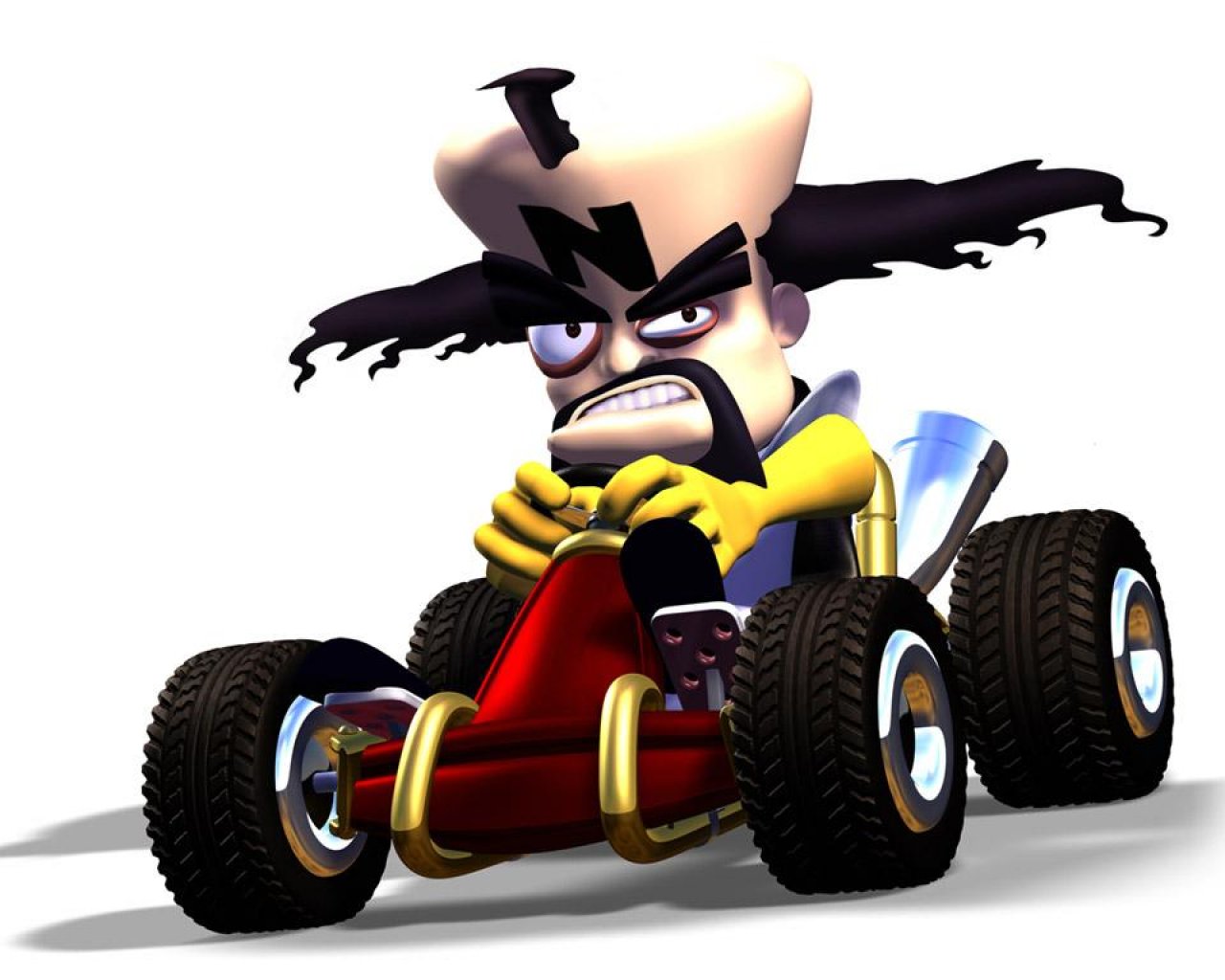
But an important initial question was “which system?”

The 3D0 was DOA, but we also got our hands on specs for the upcoming Sega Saturn, the Sega 32X, and the mysterious Sony Playstation. The decision really didn’t take very long.  3D0, poor 3D power, and no sales. 32X, unholy Frankenstein’s monster – and no sales. Saturn, also a crazy hybrid design, and really clunky dev units. Then there was the Sony. Their track record in video games was null, but it was a sexy company and a sexy machine – by far the best of the lot. I won’t even bring up the Jaguar.

So we signed the mega-harsh Sony “developer agreement” (pretty much the only non-publisher to ever do so) and forked out like $35,000 for a dev unit.  Gulp.  But the real thing that cinched the deal in Sony’s favor though wasn’t the machine, but…

Before we continue to part 2 below, my parter and friend Jason Rubin offers the following thoughts on this section:

Andy and I always liked trying to find opportunities that others had missed.  Fill holes in a sense.  We had done Way of the Warrior in large part because the most popular games of the time were fighting games and the new 3DO system didn’t have a fighting game on it.  Our decision to do a character action game on the PlayStation was not only based on bringing the most popular genre on consoles into the 3D, but also because Sega already had Sonic and Nintendo already had Mario.  Instead of running headlong into either of these creative geniuses backyard, we decided to take our ball to a field with no competition.

Filling a hole had worked to an extent with Way of the Warrior.  The press immediately used Way as a yardstick to make a comparison point against other systems and their fighting games.  This gave it a presence that the game itself might never have had.  And as a result, ardent fans of the system would leap to defend the title even when perfectly fair points were made against it.  The diagonal moves were hard to pull off because the joypad on the 3DO sucked?  No problem, said the fans, Way of the Warrior plays fantastically if you just loosen the screws on the back of the joypad.

Why couldn’t the same effect work with a character action game on PlayStation?

And remember, at the time these games were the top of the pile.  It is hard to look at the video game shelves today and think that only 15 years ago childish characters dominated it.  There were first person shooters on the PC, of course, but sales of even the biggest of them couldn’t compare to Mario and Sonic.  Even second tier character games often outsold big “adult” games.

It’s also easy to forget how many possible alternatives there were along the way.  Most of Nebraska was filled with talk of a game called “Alosaurus and Dinestein” which was to be back to the future like plot with dinosaurs in a 2d side scrolling character action game.  I still like the name.

The “Sonic’s ass” nomenclature was more than a casual reference to the blue mascot turned 90 degrees into the screen.  It defined the key problem in moving a 2d game into the third dimension:  You would always be looking at the characters ass.  This might play well (it had never been tried) but it certainly would not be the best way to present a character.

Our solution, which evolved over the next 2 years, was multi-fold.  First, the character would start the game facing the screen (more on this later).  Second there would be 2d levels that guaranteed quality of gameplay and a chance to see the character in a familiar pose allowing comparison against old 2d games.  And third, we would attempt the reverse of a Sonic ass level – the run INTO the screen – which became the legendary boulder levels. [ NOTE from Andy, more on that in part 4 ]

It may have been this very Sonic’s ass problem that caused Naka-san to “cop out” of making a true 3D game called Nights for Saturn.  I also believe, but have no proof, that he felt so unsure of the move to 3D that Sega didn’t want to risk Sonic on that first experimental title.  Instead they created a new character.  This lost Sega the goodwill that Sonic would have brought to the three way game comparison that eventually ensued.  That ended up working to our favor.

Of course Miyamoto-san did not have this problem.  He created a truly new type of character action game with Mario 64.  The controls and open world allowed you to see the character from all sides.  Eventually this proved to be the future of 3d Character games.  But at the time it had disadvantages.  More on that later.

The concept of making a mascot game for the PlayStation was easy.  The odds of succeeding were next to nil.  Remember, we were two 24 year olds whose biggest title to date had not reached 100,000 units sold!  But if there was something we never lacked it was confidence.

NEXT PART [1, 2, 3, 4, 5, 6, 7, 8, 9, 10, 11] PART 11 is brand new 08/13/11.

The index of all Crash posts is here.

And peek at my novel in progress: The Darkening Dream

or more on GAMESBOOKS/MOVIES/TVWRITING or FOOD

The Crash Bandicoot in-game model. His only texture was the spots on his back, but every vertex was lovingly placed by Jason

How do I get a job designing video games?

If I had a penny for every time I’ve been asked this question…

Game developers have only a few broad types of employees. Excluding administrative ones like office management, HR, and IT, broadly the team has Programmers, Artists, Sound Engineers, Game Designers, and Testers (some also have Producers, but at Naughty Dog we didn’t believe in them, so we distributed their work among the team leads). Of these jobs, only “Game Designer” is “purely creative” per se. Truth is, on a good team all game jobs are creative, but designers are alone in that they don’t have a craftsmany trade.

Except they do, because game design requires a lot of craftsmanship. The trick is, it’s not something you can have learned anywhere else but by making games.

Programers can write some other kind of application and demonstrate their coding skills. Artists can show off awesome models, animation, textures, lighting, sketches etc. Externally, at home or school, an artist can learn to use art tools to build good looking art. It can be seen. He can say, “I modeled all of that in 2 weeks, although my friend did the textures.”

Game designers have to learn on the job. While all good game designers LOVE video games, not all lovers of video games make good game designers. There are different sub-types of designer, and all of them require many specific skills and personality traits. Creativity, organization, obscene work effort, organization, creativity, organization, organization, cleverness, willingness to take a beating, willingness to stand up for and demand what you believe is good, grace to admit when you idea sucked ass.

So how do you learn this stuff? How do you demonstrate it to a prospective employer. Tough.

Some you learn by playing insane amounts of games. Better yet, you make games. But… unlike a programmer or artist, it’s kinda hard for a designer alone to make anything. So you need to hook up with a great artist friend and a great programmer friend and make something cool. There are school programs now for this too, but the projects don’t have the sustained scope, scale, brutality, hideous cruelty, pain, and near death quality that real game development has. No. Not even close, not even a tinsy bit.

An old method was to become a game tester, and hope that the brass would notice your organizational skills, creativity, etc and promote you to a junior designer position. Probably this will sometimes still work. It requires a lot of stamina and a high tolerance for day-old hot wings, dirty bare boy-feet, and stale crispy cremes. But then again, if you can’t stomach that stuff you don’t belong in games.

You could also try and grab some kind of coveted internship and try to prove yourself. Also requires extremely high self motivation. Then again, if you don’t have that than forget trying to be a game designer anyway.

Maybe the bigger companies take junior designers with no experience. At Naughty Dog we never did.

But it’s still possible with an artist friend and a programmer friend to make a cool iPhone / Flash / etc. game. Do it. Do it again. Do it again. Do it again. Do it again. When a couple of them are good, you’ll find a job.

NOTE: I originally posted this on Quora, and if you want to see the whole thread CLICK HERE.

Also, if you want to read more of my posts on Writing/Creating, CLICK HERE.